
Uraeus – Sacred Emblem That Symbolized Sovereignty, Royalty, Deity And Divine Authority In The Land Of Pharaohs
A. Sutherland - AncientPages.com - The king wore the Uraeus on a wreath or on his crown during the Middle Kingdom. It symbolized legitimacy to the ruler and was represented by a rearing cobra with an inflated hood.
It is also of great importance to certain symbols how they are placed. Therefore, the vertical positioning and higher elevation of the emblem – in this case, that of Uraeus, means - spiritual superiority.
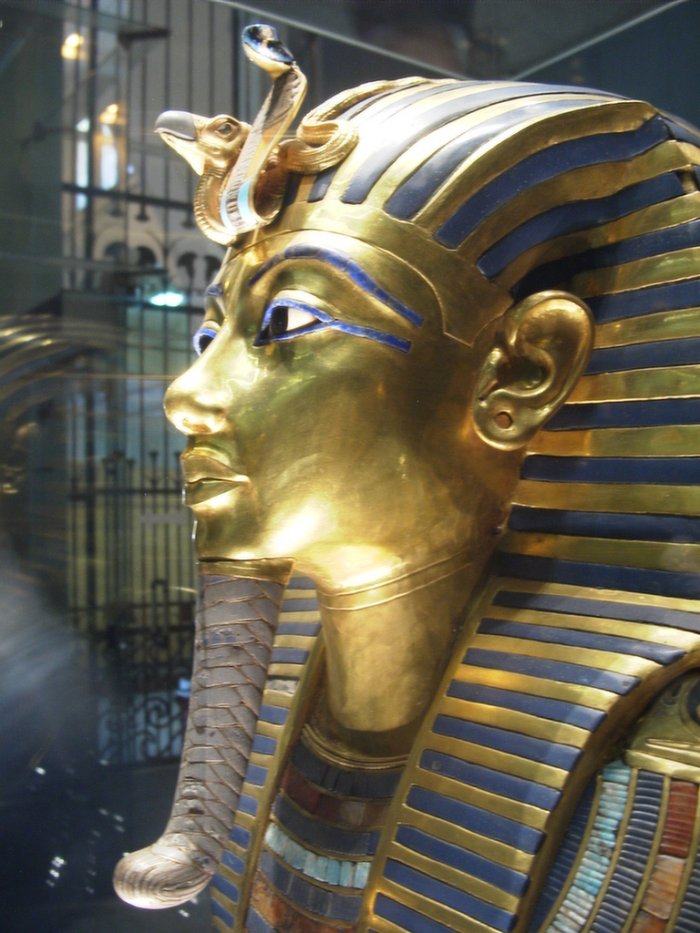
Uraeus on the forehead of Tutankhamun's mask. (Yippie~commonswiki - Photo: Erik Hooymans - CC BY-SA 2.5
Generally, the emblem of Uraeus (from the Greek: 'Ouraios - at its end"), is a stylized, simple form of the Egyptian cobra, symbolizing sovereignty, royalty, deity, and divine authority in Ancient Egypt.
The Pharaohs wore it as a head ornament: either with the body of the goddess Wadjet on top of the head or as a crown encircling the head. It indicated the protection of Wadjet and strengthened the pharaoh's claim to the country. While placed on the Pharaoh's head, the Uraeus was part of the ruler's crown.
The Uraeus of Egyptian rulers, positioned on the forehead, expressed the spiritualization of the inner force, the importance of which is significant in Tantrist Yoga.
As worn on the head, this powerful object dates back to the tradition of the tribes in ancient Libya. Still, in ancient Egypt, the Uraeus's power focused on the Pharao, giving him protection.
In myths, the snake had many associations with great mythological symbols like the Eye of Ra, the Eye of Horus, and the crown of Lower Egypt. Its importance is associated with the Sun God, Ra, and its omnipotence. The emblem was Ra's guardian, always ready to spit poison at his enemies.
Uraeus And Close Associations With Goddesses
The Uraeus was also associated with Hathor, Bastet, Sakhmet, Tefnut, and sometimes Nekhbet of Upper Egypt, which we know as the vulture goddess usually depicted as a cobra.
The Uraeus was a hieroglyphic sign for "Goddess," derived from the Serpent Mother, one of Egypt's oldest deities, known as Uatchet, Uachit, or Ua Zit. The Greeks recognized her as Buto ('the Green One') due to her connection to the sacred city Per Uto. Uto was the patron goddess of Lower Egypt and the counterpart of the Upper-Egyptian goddess Nekhbet.
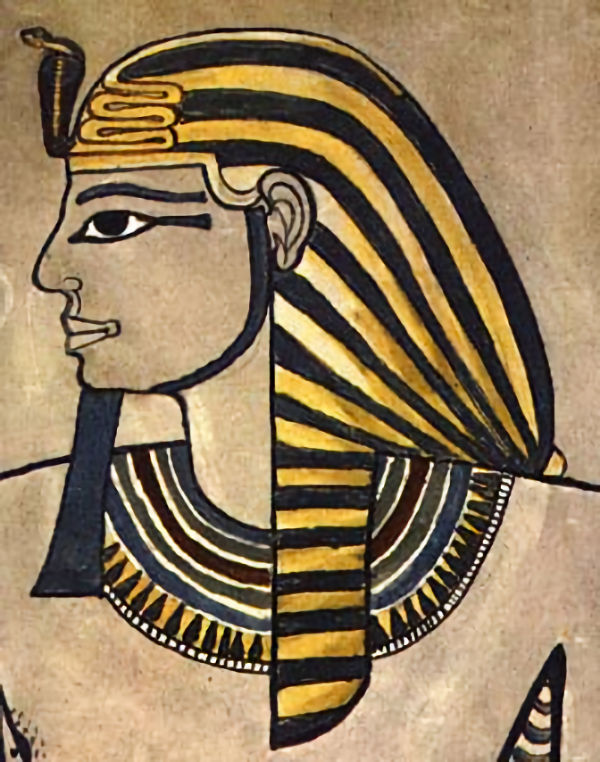
Amenhotep II Uraeus from KV35, East Valley of the Kings, Luxor, Egypt. Credit: Public Domain
And again, Uto and the vulture Goddess Nekhbet represented cycles of birth and death and beginning and ending.
The goddess Wadjet, one of the earliest Egyptian deities who protected Lower Egypt was depicted as a 'Cobra-Uraeus,' and also, Isis gained the throne of Egypt for her husband, Osiris with this sacred emblem.
Without any doubt, the Uraeus symbolizes the raised serpent. It's worth noting that the Kundalini is often depicted as a serpent that is the universal symbol of strength transformed into spirit or an aspect of power.
Juan Eduardo Cirlot Laporta, Spanish poet, art critic, and mythologist, wrote that Carl Gustav Jung (1875 – 1961) suggested that the Egyptian Uraeus is the visible expression of the Kundalini on a higher plane.
The Uraeus is the most precious ornament of the royal headdress, and its use as a royal symbol dates back to the most ancient representations of the ruler in ancient Egypt. Although it is not displayed on every image of a pharaoh, especially in Egypt's early dynasties, it remains omnipresent until Roman times.
The Uraeus's appearance changed with time. Its markings and design varied considerably during the three thousand years of use in the Land of the Pharaohs.
However, the emblem's primary form of an erect cobra with an extended hood never changed or was modified.
It was often worn on the foreheads of deities and rulers in the position of the "third eye" of insight, and thus, it stood for royal spirit, healing, and wisdom.
Written by – A. Sutherland - AncientPages.com Senior Staff Writer
Copyright © AncientPages.com All rights reserved. This material may not be published, broadcast, rewritten or redistributed in whole or part without the express written permission of AncientPages.com
Expand for referencesReferences:
Cirlot, J. E.. A Dictionary of Symbols
Walker, Barbara G. The Woman's Dictionary of Symbols and Sacred Objects
Nozedar, Adele. The Element Encyclopedia of Secret Signs and Symbols
More From Ancient Pages
-
 Fortress Wall Of Ancient Roman City Of Sexaginta Prista Discovered
-
 Mysterious Ancient Circular Structure Discovered In Turkey – Has Zippalanda, The Lost City Of The Hittites Been Found?
-
 Evidence Humans Have Been Using Bear Skins For At Least 300,000 Years Discovered
-
 More Greek Gods’ Heads And A Life-Sized Statue Of A Man Unearthed In The Ancient City Of Aizanoi
-
 30,000-Year-Old Hidden Writing Found At Sacsayhuamán Temple Could Re-Write History
-
 Idiots Were Not Allowed To Vote In Ancient Athens
-
 Brutus Of Troy: First King Of Britain Or Just A Myth?
-
 Sophisticated Masonry In Anasazi Dwelling Ruins At Mesa Verde National Park, Colorado, USA
-
 On This Day In History: Julius Caesar Dedicated Temple To Venus Genetrix – On Sep 26, 46 BC
-
 Ukraine – A Place Where People From Different Cultures Intersected Until About 500 Years Ago
-
 New Light On Prehistoric Chalk Plaques From Stonehenge Using Innovative Technology
-
 Antonine Wall: Impressive Roman Frontier Built By Empire’s Three Legions In Scotland
-
 Discovery Of Camouflaged Ancient Stone Chest In Egyptian Temple May Reveal Hidden Royal Tomb – Who Is Buried Near Hatshepsut’s Temple?
-
 Four Canopic Jars Dated To The 26th Dynasty Unearthed At South Asasif Necropolis, Luxor
-
 Has The Tomb Of The Real Santa Claus Been Found In Turkey?
-
 Monte d’Accoddi – Mesopotamian Ziggurat In Europe Built By King Of Uruk?
-
 40 Elite Graves Of Men, Women And Children Unearthed On Danish Island Of Bornholm
-
 Ancient DNA Reveals That Female Lineages Dominated Neolithic City Of Çatalhöyük, Turkey
-
 On This Day In History: Admiral Richard E. Byrd Made His First Flight Over The South Pole – On Nov 29, 1929
-
 Rhodogune Of Parthia Refused To Bath And Comb Her Hair Until She Subdued The Rebels

