
Tahpanhes – Biblical City Where Prophet Jeremiah And King Zedekiah’s Daughters Hid From The Babylonians
Ellen Lloyd - AncientPages.com - Tahpanhes was once an important city to the people of the Kingdom of Judah and ancient Egyptians.
From the thirty-ninth chapter of Jeremiah and Josephus we learn that after Nebuchadnezzar II, the greatest ruler of ancient Babylonia and conqueror of Judah had seized Jerusalem and captured the Judean King Zedekiah. Then, Nebuchadnezzar II burned the city of Jerusalem and took most of its inhabitants to Babylon.
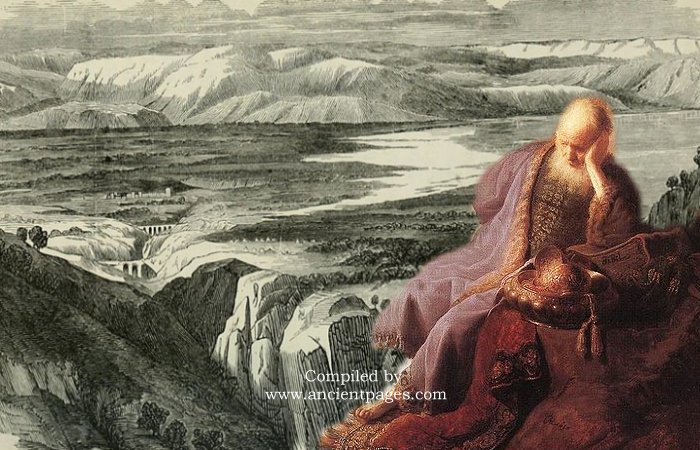
Prophet Jeremiah And King Zedekiah's Daughters Fled To Tahpanhes
Pharaoh Apries, who had the misfortune of becoming King shortly after the Babylonian Exile, attempted to help the kingdom of Judah, and in 588 B.C. Apries, referred to as Hophra in Jeremiah 44:30, "dispatched a military unit to Jerusalem to protect it from Babylonian forces sent by Nebuchadnezzar II. However, the Egyptian army soon realized they were no match for the Babylonians, and they had to withdraw to avoid a deadly confrontation." 1
Among those who managed to flee Jerusalem were King Zedekiah's daughters, Prophet Jeremiah, and Baruch, his amanuensis. They sought refuge in Tahpanhes, located about twelve miles west from the modern El Kantara, on the Suez Canal. The ancient Greeks called this Biblical city Daphne. This Hebrew party reached Tahpanes during the reign of Pharaoh Apries, who had a palace at Tahpanhes, even though the capital of the XXVIth Egyptian dynasty was at Sais.
Knowing his Egyptian army had been defeated, Pharaoh Hophra "was able to give the Hebrews no further assistance save the refuge which the palace at Tahpanes afforded the remnant who escaped from Jerusalem.
Prophet Jeremiah's Vision Of Tahpanhes
After the flight to Egypt the divine command came to the prophet Jeremiah saying:
Take great stones in thy hand, lay them in mortar in the brick work which is at the entry of Pharaoh's house at Tahpanes, in the sight of the men of Judah; and say unto them, Thus saith the Lord of Hosts, the God of Israel: Behold, I will send and take Nebuchadnezzar, the King of Babylon, my servant, and will set his throne upon these stones that I have hid, and he shall spread his royal (glittering) pavilion over them (Jer. 48: 8-1o).
That this prediction became history, and that the Babylonian King did twice invade Egypt and conquered it, is no longer doubted." 2
We owe much of our knowledge about the ancient history of Tahpanes to Egyptologists Sir William Matthew Flinders Petrie (1853 – 1942) who discovered the site in 1886. At the time of Flinders' first contact with this historical place, the city was called known by natives as Qasr Bint al-Yahudi, the "Castle of the Jew's Daughter.
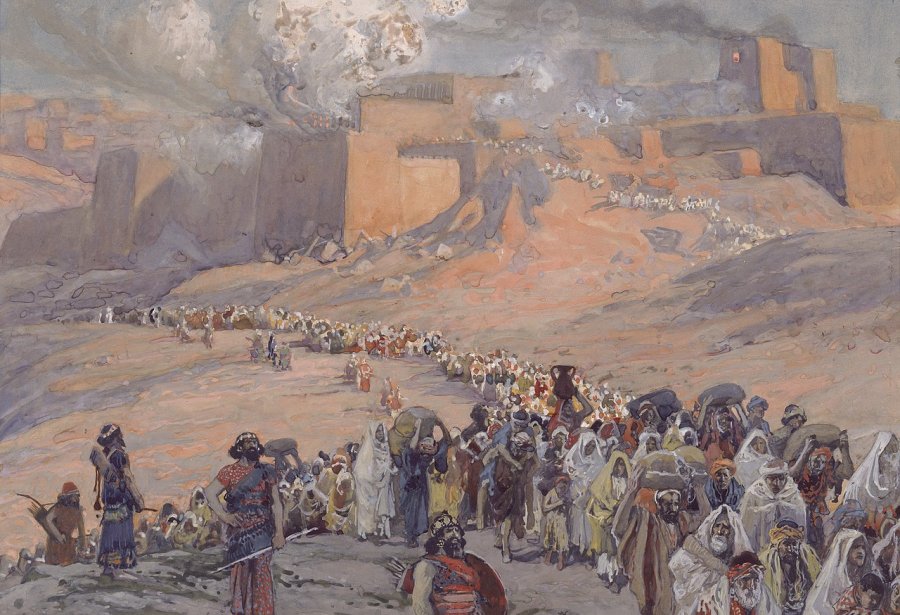
An artist's depiction of the deportation and exile of the Jews of the ancient Kingdom of Judah to Babylon and the destruction of Jerusalem and Solomon's temple. Jewish Museum, New York, NY. Public Domain
The meaning of the name Tahpanes is still unknown, but scholars suggest it may be of Egyptian origin. When Petrie excavated at the site, he unearthed the house of Pharaoh Apries. Petrie recalled it laid bare an "area of continuous brick work, resting on sand, about a hundred by sixty feet, facing the eastern entrance to what seem royal buildings."
"It is curious how exactly this answers to the Biblical description of the entry of Pharaoh's house in Tahpanes," Petrie said when examining the ancient ruins.
The late archaeologist "dug into this square platform and found there some rough,"unhewn stones," but without inscriptions. He was surprised, on inquiry, to learn that the mound from which these stones are exhumed is called by the Arabs to this day Kasr el khint el Yahudi, " The Castle of the Jew's Daughters." Thus the Biblical story of the royal princesses still clings to the ruins as a historical echo from the remote past." 2
Petrie also discovered a mound tower. The structure "was about a hundred and fifty feet high. It was square and contained many stories. The basement had certainly been used for a kitchen. In one room were stones for grinding corn, dishes, jars, and iron rods-the spits used for roasting meat." 2
Pharaoh Apries was known under a variety of names. He is called Uahabra, with the throne name Ra- haa-ab in the Egyptian inscriptions, Vaphres by Manetho and Ouaphre in the Septuagint." 2
Petrie unearthed several ancient artifacts that contained the name of Uahabra, and thus there is no doubt this was the city where Pharaoh Apries let build a palace.

Was Pharaoh Apries murdered by his own people? Read more
The ancient city of Tahpanhes is important to historians because it provides information about significant historical events. To Biblical scholars and Christians, Tahpanhes is equally of great importance as it offers evidence many stories in the Holy Book were based on actual events.
Prophet Jeremiah's life is still a mystery. We do know his prophetic ministry took place between 626 and 586 B.C., but there is no information about his death. However, "archaeology has illuminated much of the Old Testament. Archaeologists have spent their lives looking for physical evidence to support and prove the biblical record. These discoveries have gone a long way in showing that Jeremiah actually existed." 3
Ancient ruins of cities such as Tahpanhes can eventually provide us clues to some of the greatest Biblical mysteries.
Written By Ellen Lloyd - AncientPages.com
Copyright © AncientPages.com All rights reserved. This material may not be published, broadcast, rewritten or redistributed in whole or part without the express written permission of AncientPages.com
Expand for references- Ellen Lloyd - Pharaoh Apries – Was The Betrayed Egyptian King Murdered By His Own People? AncientPages.com
- Lysander Dickerman, D.C. - Mr. Petrie's Discoveries At The Biblical Tahpanes, The Journal of Religion, Volume 10, Number 5, May, 1890
- David Tee - Biblical Prophet Jeremiah Whose Prophecies Disappointed People, AncientPages.com
- Naville, Edouard. "The Geography of the Exodus." The Journal of Egyptian Archaeology10, no. 1 (1924): 18-39.
More From Ancient Pages
-
 Rare Discovery Of Ancient Artifact Depicting Norse God Loki In Denmark Remains A Mystery
-
 Phurba Dagger: Magical Weapon That Restrains Evil And Harmful Occult Forces
-
 Mysterious Sumerian Star Tablet And Strange Divine Omens – Communication With The Gods – Part 2
-
 Ancient Tomb With A Massive False Door Belonging To Prince Waser-If-Re Unearthed In Saqqara, Egypt
-
 What Happened To The Ancient Tribe That Entered A Secret Underground World And Never Came Back?
-
 Unsolved Mystery Of The Aleppo Codex And Its Missing Pages: One Of The World’s Most Precious Ancient Books
-
 Enigmatic Newport Tower – Built By The Vikings, Knights Templar, Freemasons Or Someone Else?
-
 Beautiful Legend Of Maneki-neko – The Japanese Good Luck Charm Cat Raising A Paw
-
 On This Day In History: Howard Carter Discovered King Tut’s Tomb In The Valley Of The Kings – On Nov 4, 1922
-
 Rare Rock Panel Sheds New Light On Ancient Egyptian History
-
 Ullr – Famous Norse Archer – God Of Asgard And Fastest Skier Ever Known Who Taught People The Art
-
 Ptolemaic Granite Sarcophagus Found In Alexandria, Egypt
-
 Looking Into The Secrets Of Parthenon’s Illumination That Enhanced The Sense of Awe And Religious Experience
-
 Ancient Secrets Of The Damascus Steel – Legendary Metal Used By Crusaders And Other Warriors
-
 Great Sakya Library Is Home To 84,000 Scrolls Left Untouched For Hundreds Of Years
-
 Oldest English Book On Cheese Reveals Some Surprising Secrets
-
 Rediscovery Of Lost Tombs And Quarries On A British Military Base In Cyprus
-
 Bulgaria’s Aquae Calidae Spa Complex: More 40 Coins Dated To 4th Century CE – Found
-
 The Wild Hunt And The Danger Of Seeing The Phantom Army Of Odin
-
 Early Māori Settlement On The Subantarctic Islands -Uncovering Some Of The Unknown

