
Is The Tomb Of Genghis Khan Hidden And Protected In The Khentii Mountains Because Some Fear It’s Cursed?
Ellen Lloyd - AncientPages.com - What ancient secrets are hidden in the Khentii Mountains? Is the tomb of the great warrior Genghis Khan hidden deep inside the mountains? Is this the reason why this region is a protected zone that we are not allowed to enter?

Credit: Adobe Stock - Andrey Burmakin
The location of the tomb of Genghis Khan remains an unsolved ancient mystery. Finding the burial place of the 13th-century warrior, conqueror, and imperial ruler would be one of the greatest archaeological discoveries of all time. Still, all attempts to locate the ancient tomb have failed so far. Is it because the tomb of Genghis Khan is deliberately hidden and protected from the outside world because some fear it’s cursed?
Ancient Secrets Of Sacred Burkhan Khaldun Mountain – Protected And Forbidden Zone
Many experts believe Genghis Khan was buried somewhere in a valley near the sacred Mongolian mountain of Burkhan Khaldun, near his birthplace in Khentii Aimag, northeastern Mongolia.
Great Burkhan Khaldun Mountain and its surrounding landscape lie in the central part of the Khentii Mountains chain that forms the watershed between the Arctic and Pacific Oceans.

Burkhan Khaldun Mountain - Image credit: Wikipedia
It is believed that Genghis Khan built a beautiful place in the Khentii Mountains, called the Great Taboo or Ikh Khorig, by the Mongols. According to an ancient legend Genghis Khan stated that this was the place where he wanted to be buried.
Many historians suspect Genghis Khan’s tomb was a vast necropolis deep inside the mountains. After the construction was completed, all tomb builders were executed to conceal the secret. Even the soldiers who killed the builders of the tomb were executed. One historical source holds that 10,000 horsemen “trampled the ground so as to make it even.” Another source states a forest was planted over the site to hide the leader in his final resting place.
Today, it’s challenging to judge how much of this is true, but there are reasons to suspect the tomb of Genghis Khan, the Great Khan and founder of the Mongol Empire is really buried somewhere in the Khentii Mountains.
Investigating the region and looking for Khan’s tomb is easier said than done because the Mongolian government forbids access to the site.
For 800 years, Mongolia's sacred mountain, Burkhan Khaldun, associated with Genghis Khan's origin, has been part of the Khan Khentii Strictly Protected Area. Tourists and travelers are forbidden to enter this remote area.

Genghis Khan as portrayed in a 14th-century Yuan era album; the original version was black and white. The original size is 47 cm wide and 59.4 cm high. Paint and ink on silk. Now located in the National Palace Museum, Taipei, Taiwan. Credit: Public Domain
Some years ago, an expedition supported by the University of California, San Diego, and the National Geographic Society was granted permission to explore the mountain range. National Geographic’s Valley of the Khans Project and archaeologist Fredrik Hiebert used satellite imagery to identify potential locations for the burial site of Genghis Khan and then “ground-truthed” the areas with GPR to determine their viability.
The tomb of Genghis Khan was not found. Are we looking in the wrong place, or is it simply very well hidden?
Fear The Tomb Of Genghis Khan Is Cursed
Many traditional Mongolians are afraid Khan's tomb is cursed. Some fear finding Genghis Khan's tomb will bring about the end of the world.
People connect the search for Khan's tomb with the discovery of the resting place of Timur, a 14th Century Turko-Mongol military leader who conquered most of the Muslim world, central Asia, and parts of India.
When Timur died in 1405, his tomb was inscribed with one of the most convincing curses in history, reading: "When I rise from the dead, the world shall tremble."
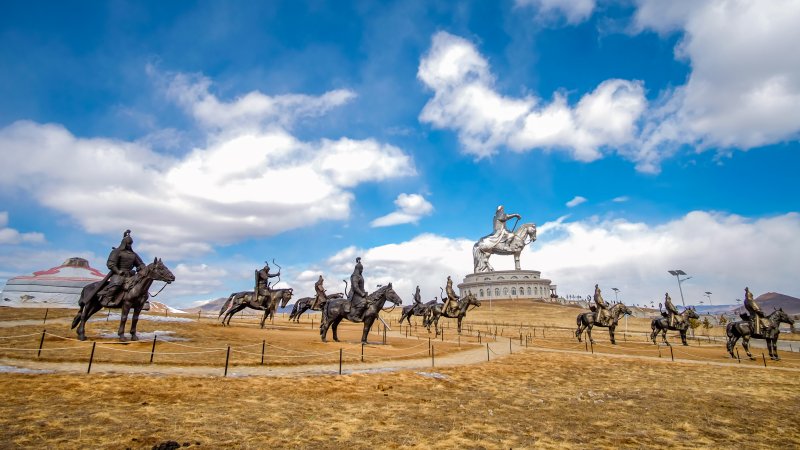
The quest for Khans' tomb will continue. The Genghis Khan statue complex Ulaanbaatar, Mongolia. Credit: Adobe Stock - Nuttee
Another inscription on his casket read: "Whomsoever opens my tomb shall unleash an invader more terrible than I." Russian archaeologists ignored the warning and opened the tomb. Three days later, Adolf Hitler launched Operation Barbarossa, the largest-ever military invasion of the Soviet Union.
Many think that opening the cursed tomb of Timur tomb triggered some of the biggest struggles of World War 2, and they worry something similar might happen if Genghis Khan's tomb is located and opened.
According to historian John Man finding the tomb in Mongolia would have 'geopolitical repercussions'
In his book Genghis Khan: Life, Death, and Resurrection, he wrote: “Many people in China believe Mongolia, like Tibet, should be part of China, as it was under Kublai Khan.
"If China succeeds in establishing mining rights in Mongolia and a dominance over that industry, then Genghis’s tomb might become a focal point for political ambitions, the like of which we have never seen.”
Interestingly, not one single artifact has been found that belonged to the leader who killed more than 40 million people.
Perhaps some things are not meant to be found...
Updated on November 27, 2023
Written By Ellen Lloyd - AncientPages.com
Copyright © AncientPages.com All rights reserved. This material may not be published, broadcast, rewritten or redistributed in whole or part without the express written permission of AncientPages.com
Expand for referencesMore From Ancient Pages
-
 Eating And Social Habits Of People In The Balearic Islands 3,000 Years Ago – Reconstructed
-
 On This Day In History: Independence Of Greece Is Recognized By The Treaty Of London – On May 7, 1832
-
 Why Did Vikings Burn And Bury Their Longhouses?
-
 Knights Templar – Among The Most Wealthy And Powerful Of The Western Christian Military Orders
-
 Fossilized Remains Of A Gigantic Jurassic Pterosaur Unearthed In Oxfordshire, UK
-
 Oklahoma’s Ancient Mosaic Floor With Mysterious ‘Post Holes’ Could Re-Write History Of North America
-
 12,000 Years Ago Siberian People Possessed Technique To Soften Ivory And Create Toys Or Art Items
-
 Strange And Unexplained Events In Transylvania – One Of The Most Mysterious Places In Europe
-
 Amazing Discovery: Great Pyramid Of Giza And Its Chambers Concentrate Electromagnetic Energy
-
 15 Prehistoric Rock Paintings Discovered Near Ancient Armenian City Of Ani
-
 How King Arthur Became One Of The Most Pervasive Legends Of All Time
-
 Mystery Greek tomb was dedicated to companion of Alexander – experts say
-
 Iktomi – Native American Spider-Trickster Spirit Whose Stories Teach Moral Values
-
 Intriguing El Tajin – Pre-Hispanic Ceremonial Site Dedicated To Totonac Rain God
-
 Nabataean Culture Lived On Long After Their Kingdom Disappeared – New Evidence
-
 Underwater Excavations: Greek And Danish Archaeologists Research Ancient Harbor Town Lechaion
-
 Ancient Hindu High-Tech That Contributed To Modern Science
-
 Unique 8,400-Year-Old Burial Of A Dog Different From Modern Dogs Discovered In Sweden
-
 Ninkasi – Sumerian Goddess Of Beer And Alcohol – The Hymn To Ninkasi Is An Ancient Recipe For Brewing Beer
-
 Rainbow Was A Powerful Symbol In People’s Ancient Beliefs

