
Archaic Marble Lions On The Sacred Island Of Delos
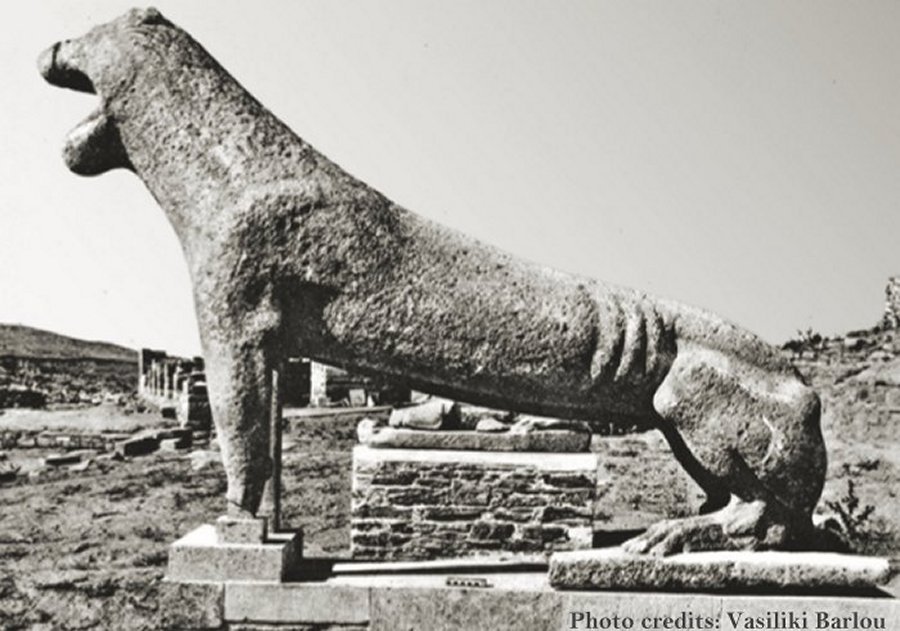
A. Sutherland - AncientPages.com - Shortly before 600 BC, the Naxos people dedicated the "Terrace of the Lions" to Apollo. Originally, marble guardian lions were erected north of the sanctuary of Apollo overlooking the Sacred Lake.
They still represent one of the most eye-catching landmarks of the island of Delos.
The island is one of approximately 220 (some say 300) islands called the Cyclades (meaning the "round grouped ones"), located south-east of the mainland of Greece. At least for a thousand years before the time of Jesus Christ, Delos was visited by the ancient pilgrims because it was the birthplace of Apollo, God of the sun, and Artemis (Diana, for the Latins), goddess of the moon. Delos was one of the most sacred sites in the ancient world and still is the sacred place today.
Unfortunately now, Delos is an island full of ruins, a UNESCO world heritage archaeological site protected and managed by the Greek government. Among the most famous are Santorini (Thira), Tinos, Paros, Milos, Mykonos, Ios, Andros, and Naxos, where artists used the Naxian marble to create the lions, which are considered as one of the earliest examples of beautiful monumental Naxian sculpture.
According to Strabo (ca. 64 BC -ca. AD 23), a Greek geographer and historian, the Cyclades formed a circle around Delos's sacred island. The Cyclades' mysterious society appeared many centuries before the arising of the famous Minoan Civilization.
Originally nine or even as many as 16 lions lined an avenue in the sanctuary complex dedicated to Apollo.
The lions - a symbol of power and royalty - were once a famous gift to that island of Delos from Naxos. At that time, the Naxians dominated commerce in the Cyclades during the 8th and 7th centuries BC. They created a monumental avenue comparable to Egyptian avenues of sphinxes. (There is a Greek sphinx in the Delos Museum.) Today, only seven (or five) of the original lions remain.
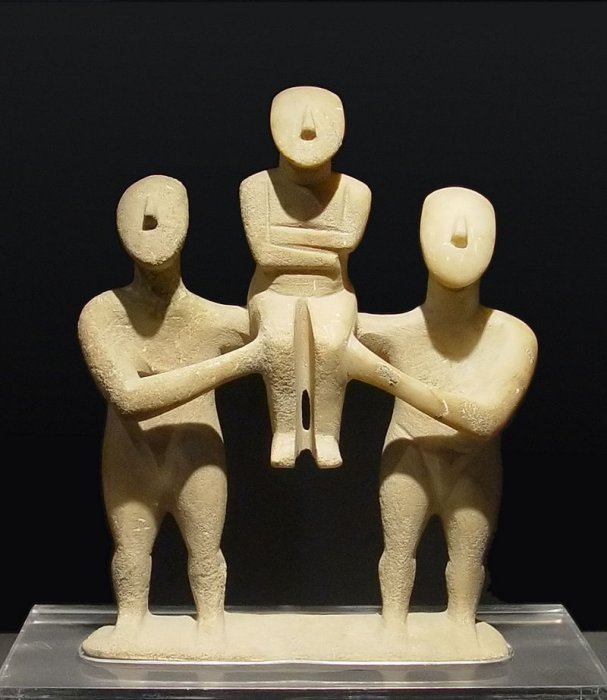
Cycladic figurines. Credit: Smial - CC BY-SA 2.5
Originally the sculptures must have stood on the terrace directly on the ground, as no sign of separate bases was discovered during the excavations.
The marble lions have been transferred to the museum, a row of exact copies replacing them on the modern rectangular pedestals set up on the terrace during the 20th century. Several of the lions unearthed during the major excavations of 1904-1906 were deemed to be left in the original place.
The lions once formed a unique and imposing ensemble that has no exact parallels in Greece or elsewhere. Therefore, according to researchers, it isn't easy to interpret the whole arrangement. It has been suggested that the avenue with Delos lions imitated Egyptian sphinx or lion promenades, such as those in Thebes (Karnak and Luxor). In these examples, however, the sculptures form two rows left and right, and the promenade can be approximately 2-3 km long.
The sculptures – standing parallel to each other – were separated by approximately 3.20-3.50 m.
According to a Greek myth, the statues faced east towards the Sacred Lake, where Apollo's sacred swans and geese were kept.
An oracle was of great significance for the ancient Athenians, who, commanded by the oracle's power, purified Delos's island, which is recognized as the birthplace of the god Apollo and his sister Artemis.
The dead bodies, which had been buried there, were taken up and removed from all places within view of the temple.
The bodies were transported to the neighboring island of Rhenaea and interred there.
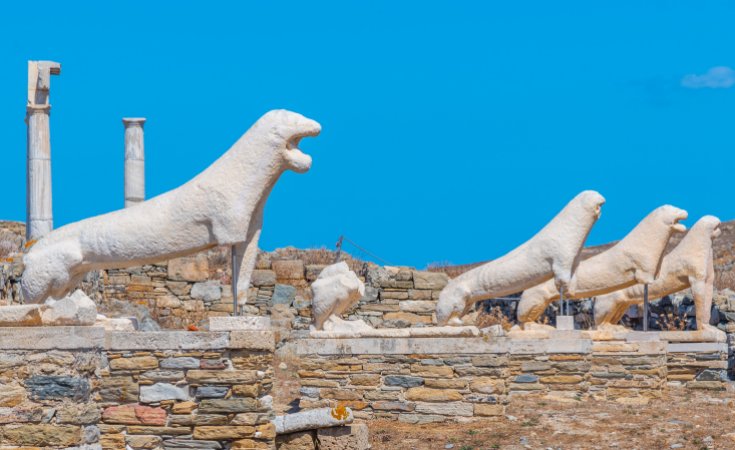
The terrace of the lions at Delos island in Greece. Credit: dudlajzov - Adobe Stock
After having done this, to prevent Delos from pollution "in the time to come, they published an edict that for the future, no person should be suffering to die, nor any woman to be brought to bed, in the island, but that, when death or parturition approached, they should be carried over into Rhenaea."
In other words, no inhabitant was allowed to be born or to die on this sacred island. Unlike other Greek islands, Delos did not have an indigenous, self-supporting community of its own. As a result, in later times, it became uninhabited.
Today, Delos is one of the most important archaeological sites in Greece. The French archaeologists have excavated Delos for more than 100 years. Delos is still uninhabited except for the French archaeologists and site guardians.
Written by – A. Sutherland - AncientPages.com Senior Staff Writer
Copyright © AncientPages.com All rights reserved. This material may not be published, broadcast, rewritten or redistributed in whole or part without the express written permission of AncientPages.com
Expand for referencesMore From Ancient Pages
-
 Ancient Cult Of Human Skulls And Communication With The Other World
-
 Earliest Fascinating Concepts Of Artificial Intelligence And Robots In Ancient Myths – Examined
-
 Ancient Mexican City Endured For Centuries Without Extremes In Wealth And Power
-
 Nephthys – Egyptian Funerary Goddess Who Also Protected The Pharaohs While They Were Alive
-
 Strange Ancient Artifacts And Foreigners Who Were Not Meant To Be In North America
-
 Lares: Roman Household Gods That Protected Home And Family
-
 Incredible Treasure Of Extremely Rare Greek Coins And Aqueduct Found In Ancient Tenea, Greece
-
 Prehistoric Spread Of Millet From East Asia To Central Europe – New Study
-
 Mysterious Visitors From Other Realms And Enigma Of Atmospheric Phenomena
-
 Unique Discovery – 2,000-Year-Old Roman Coins Found On Gotska Sandön In Sweden
-
 Oldest Footprints In Europe Belonged To A Mysterious 950,000-Year-Old Ancestor
-
 Pharaoh Ahmose I Expelled The Hyksos Invaders And Changed History Of Ancient Egypt
-
 New Entrances To Ancient Underground City In Kayseri, Turkey – Found Accidentally
-
 Rare And Well-Preserved Inka Tunic Discovered In Chile
-
 Ancient DNA Shows Neanderthals Used Plant-Based Medicine To Treat Pain And Illness
-
 Intriguing Ptolemaic And Roman Treasures Unearthed In Al Bahnasa, Egypt
-
 Oldest Known Projectile Points In The Americas Discovered In Idaho
-
 Smuggled Ancient Egyptian Artefacts Finally Arrive Home From Italy
-
 Human Footprints Of People Who Used Caves Of Ojo Guareña, Burgos 4600 Years Ago
-
 Tool Patterns Reveal What Caused The Neanderthals’ Extinction In The Iberian Peninsula

