
Lares: Roman Household Gods That Protected Home And Family
A. Sutherland - AncientPages.com - Many ancient cultures worldwide believed in someone protecting the home and looking after the entire household and the family members.
In some ancient cultures, the people had a domestic or hearth goddess. Brownies were household spirits from Scottish folklore and ancient Egypt. Taweret was considered a guardian of the house and a guardian of sleep, and the goddess amulets protected against evil charms.
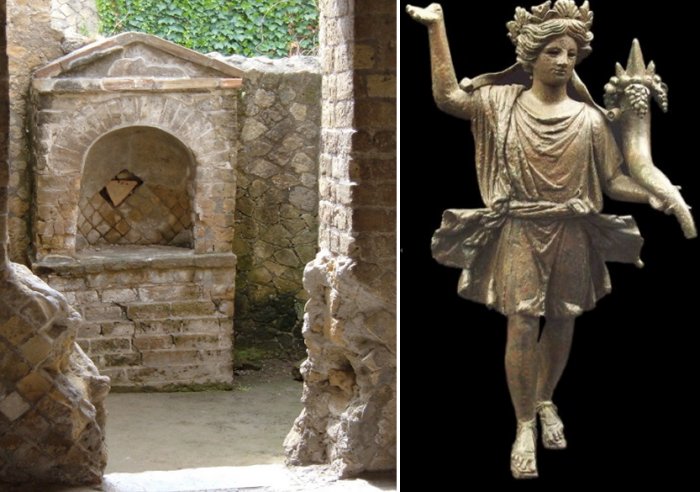 Left: Household altar in Herculaneum (Italy). source; Right: Bronze Lar Familiaris from the 1st century CE (M.A.N., Madrid). source
In old Slavic beliefs, Domovik was a household spirit that guarded the sanctity of the home.
In earlier times, Roman houses were tiny; yet, there was a place for a hearth, the primary source of light and heat for everyone, and next to it, the family members gathered every day to eat, rest and talk.
The cult of Lares was widespread in the Roman Empire, and symbolically, a Lar (Familiaris) or (lares, if more of them), a highly respected household god, was present at the center of family life.
Lares were guardians of the hearth and the family meals, fields, fertility, and households at the crossroads, and as such, they were known as Lares compitales (Latin: 'compita' roadsides). They supported the home, family, and community as a whole. They were asked for help with childbirth, initiation rites, marriage, and death.
The head of the family was the high priest of the Lar cult. The trees and groves were dedicated to the Lares, and unique offerings were regularly made to the household spirit at family festivals. The Lares' holiday was the so-called 'compitalia,' taking place on the second of May, to which public games were added sometime during the republican period.
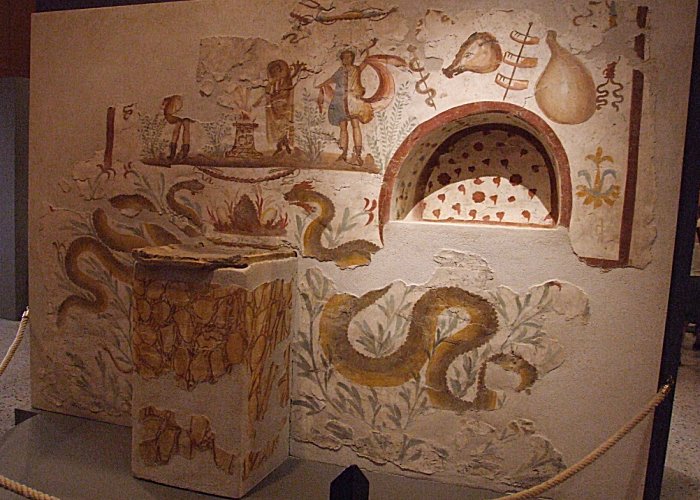 Household lararium in Pompeii. source
From the Etruscans, the cult of Lares was taken over by the Romans, who trusted them, worshiped, and perhaps even sometimes feared them. However, the true origin of these household gods remains unknown.
Lararia In Pompeian Homes
In many Pompeian houses, archaeologists discovered large and small shrines ('lararia') dedicated to the gods of the household.
Two dancing Lares hold raised drinking horns and are accompanied by the Genius (the personal protective spirit), who is dressed in a toga ( the garment of high-ranking Roman magistrates) and making a sacrifice. Beneath them is a serpent, often depicted in the lararium of the Romans.
Originally each household had only one Lar, usually a tiny bronze figurine depicting a youthful figure in dancing postures. Its dress was a short tunic or short robe, holding a drinking horn in one hand and a cup or cornucopia, a symbol of abundance and nourishment.
 Lararium from the House of the Vetti. source
The family's worship of the Lares was associated with the Penates, the gods of the warehouse. They protected the household and his immediate family and, therefore, the family's prosperity. The Lares Familiaris, on the other hand, protected all household members and enslaved people and were always linked to one particular place. When the family moved to another location, this spirit did not follow.
Slaves Used To Seek Protection Of Lares
The ancient Romans believed that they supervised the traditional norms in the relationship of family members and punished violators, especially masters who were too cruel to slaves. Therefore, enslaved people used to seek protection from their master's wrath at the hearth (or altar) of the Lar and actively participated in their cult.
Small statues of the Lares and Penates are usually found, one on each side of the central figure of Vesta, the goddess of the fire, home, and family, or the protective spirit Genius related to each man.
The Roman City Was Well Protected By Lares
The public Lares, which belonged to the state religion, had guardianship over city districts, roads, villages, crossroads, and military expeditions. A legend has it that the Lares and Penates were once the household gods of Aeneas, a Trojan hero and the mythical ancestor of the Roman people. The hero carried them out of Troy with his aged father, Anchises, and sailed to Italy.

Genius, the personal protective spirit accompanied by two lares. Source
The state had its own Lares (praestites), protecting the city's patrons. They had a temple and altar and were represented as men wearing military cloaks, carrying lances, and seated with a dog (the emblem of watchfulness) at their feet.
What kind of deities were these lares? As we know, the Romans had many public gods and goddesses. However, aside from them, the spirits worshipped privately at home played an important role.
A town's shops, factories, houses, and street corners highly respected the spirits' presence. Whether private or civic, the Lares figurines (usually in pairs) were always freshly painted, repainted, and treated with respect.
Written by – A. Sutherland - AncientPages.com Senior Staff Writer
Updated on May 21, 2024
Copyright © AncientPages.com All rights reserved. This material may not be published, broadcast, rewritten or redistributed in whole or part without the express written permission of AncientPages.com
Expand for referencesMore From Ancient Pages
-
 The Lost Prophecy Reveals Chilling Future Events – The Last Words To Mankind?
-
 Royal Inscription Of Naram-Sîn Of Akkad: The First Ancient King To Use Blocks For Printing Bricks
-
 Peace Of Callias – A Treaty That Ended The Greco-Persian Wars
-
 Hindu Monkey God Hanuman May Have Been Homo Erectus – Scientist Says
-
 Ants May Hold the Clues Why The Human Brain Decreased In Size 3,000 Years Ago – Scientists Say
-
 Anglo-Saxon Warlord’s Grave: Archaeologists And Metal-Detectorists Work Together
-
 Virtual Nubia: Sudan’s Medieval Monasteries Digitally Reconstructed By Polish Archaeologists
-
 Skeleton Of Last Trojan Discovered – Ancient City Of Troy May Have Been A Religious Sanctuary – Archaeologists Say
-
 Struggle To Get Mail On Time Has Lasted More Than 5,000 Years – Part 3
-
 Comet Explosion 13,000 Years Ago Wiped Out Megafauna And The Clovis Culture In North America
-
 Viking Ship Found With Unexpected Goods For Unclear Purpose Puzzles Scientists
-
 Ancient Petroglyphs Of Cholpon-Ata And Mysterious Balbals Figures That Guard Grave Sites, Kyrgyzstan
-
 Ancient Cave Church Complex In Basarabi, Romania
-
 Rock-Cut Tomb Of Pennut, Viceroy Of Nubia Under Reign Of Ramses VI
-
 Has A New Study Of 5,000-Year-Old DNA Solved The Mystery Of The Tarim Basin Mummies?
-
 Armenia: Old Land Where Myths, Legends And Long History Meet
-
 King Tut’s Face Reconstructed By Bioarchaeologist
-
 Why Is A Snake Symbol Of Medicine And Pharmacies?
-
 Rare Ancient Roman Sun Hat On Display For The First Time Ever At Bolton Museum
-
 ‘Cradle Of The Scythians’ Studied By Russian-Polish Archaeologists

