
Giant Solar Mirrors And Sophisticated Lenses – Advanced Ancient Technology Used By Our Ancestors
Ellen Lloyd - AncientPages.com - Proof of advanced ancient technology can be found in many places. We come across artifacts that re-write history and offer evidence our ancestors were more advanced than we previously thought.
Not all ancient objects can be found, but there are several descriptions of remarkable high-tech devices in myths legends and sacred texts.
Scientific benefits of lenses were known to our ancestors already thousands of years ago. Although the telescope was officially invented in the 16th century, it is possible that ancient Assyrian astronomers used the so-called Nimrud lens that allowed them to watch the skies nearly 3,000 years earlier.

The Nimrud lens is 3.000-year-old-
The Minoans were the Bronze Age civilization of Crete that thrived from about 3000 BC to about 1100 BC. These people created tiny, wonderful seals, which were skillfully carved out of soft stones, ivory, or bone. Undoubtedly their creation required extraordinary skills of craftsmen and special tools.
Researchers have long wondered over technologies used by the ancient people. How did the Minoans make tiny, microscopic engravings? To produce such images, they must have used at least one tool to magnify the surface. Did the Minoans learn how to use lenses from the Babylonians perhaps?
Crystal Lenses Used In Ancient Egyptian And Babylonian Temples
The use of crystal lenses was common in ancient Egypt. In our article Mystery Of Ancient Ever-Burning Lamps, we discussed the possibility that our ancestors discovered the secret of eternal light.
Flavia Anderson discussed the subject of advanced light sources in her book “The Ancient Secret: Fire from the Sun”. She suggests that many Grail legends are based on the existence of ancient crystal lenses.
These crystals lenses were precious objects used by priests in ancient Egyptian and Babylonian temples, especially during religious ceremonies.

Anderson also thinks that the legend of the Phoenix Bird, rising from the ashes of the fire that consumes it, maybe based on certain rituals that used a magnifying crystal. The legend of the Phoenix Bird was known to a number of ancient civilizations. Roman, Greek or Egyptian mythologies speak about an amazing mythical firebird, Phoenix, a symbol of Sun, immortality, rebirth, resurrection, and eternal life.
This mythical creature has also its counterpart in China, Japan, and India, and in each of these cultures, many appearances of Phoenix have been created but all of them have similar significance. They are all alike.
Anderson thinks that a special lens was used to focus the sun on some dry straw or other tinder and a trained bird then played in the fire. She demonstrates in her book that a trained bird, a rook, in this case, can play with fire in this manner and not be burnt or harmed in any way.
Perhaps ancient crystal lenses do explain the legend of the Phoenix Bird.
Knowledge of crystal lenses spread from Egypt and near East to South America. “The Spaniards recorded on their arrival in Peru that the heathen priests were accustomed to light their sacred fires from the sun’s rays by means of a concave cup set in a metal bracelet,” Childress writes in his book Technology of the Gods.
Ancient Secrets Of Magical Mirrors
In Ancient China and Japan, people were familiar with so-called magical mirrors. The exact origins of ancient Chinese “magical” mirrors are unknown. About 1,200 years ago, a book entitled 'Record of Ancient Mirrors' still existed and contained the secrets of these enigmatic objects and their constructions. Unfortunately, the book has been lost for over a thousand years.
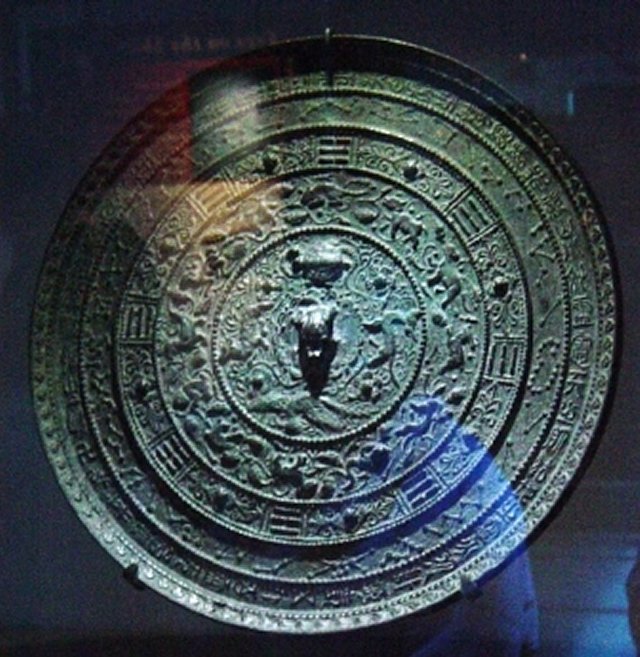
Magical mirrors were common in ancient China and Japan.
Today, we wonder what secrets lie behind the thousand-years-old “magical” mirrors that have the creepy ability to project patterns from the back when light is shining on the front?
See also:
Sophisticated Lenses Of Minoans Discovered In The Sacred Idaion Cave
Advanced Ancient Technology – Talos A Greek Robot Created By The God Of The Forge
Mysterious Jade Cong – Perplexing Ancient Chinese Artifact
In ancient China, there is one type of rare mirror called 't’ou kuand ching', which means literally “light-transmitting mirror”. When a strong light strikes the undecorated polished front surface and is reflected onto a wall or screen, the patterns decorating the back of the mirror mysteriously appear in the reflection.
Giant Solar Mirrors Used As Ancient High-Tech Weapons
Ancient Chinese legends describe a Ying-Yang mirror that was carried by warriors to burn the enemy.
Of all giant solar mirrors, the most famous invention was created by the Greek mathematician and scientist Archimedes, born in 287 B.C. Some alternative history researchers call it an “ancient death ray”.
The fearsome solar mirror was used in the Battle of Syracuse in 212-215 BC, to set fire on the invading Roman fleet.

Archimedes giant solar mirror.
The evidence and knowledge of Archimedes’ work on machines of war comes to us from later historians such as Polybius, Livy, and Plutarch. It means it’s difficult to determine with certainty what really happened. However, from the writing of Zonares and Tzetzes, we learn that a large mirror was used during the Battle of Syracuse.
“When Marcellus [The Roman General] had placed the ships a bow shot off, the old man [Archimedes] constructed a sort of hexagonal mirror. He placed at proper distances from the mirror other smaller mirrors of the same kind, which were moved by means of their hinges and certain plates of metal.
He placed it amid the rays of the sun at noon, both in summer and winter. The rays being reflected by this, a frightful fiery kindling was excited on the ships, and it reduced them to ashes, from the distance of a bow shot. Thus, the old man baffled Marcellus, by means of his inventions.”
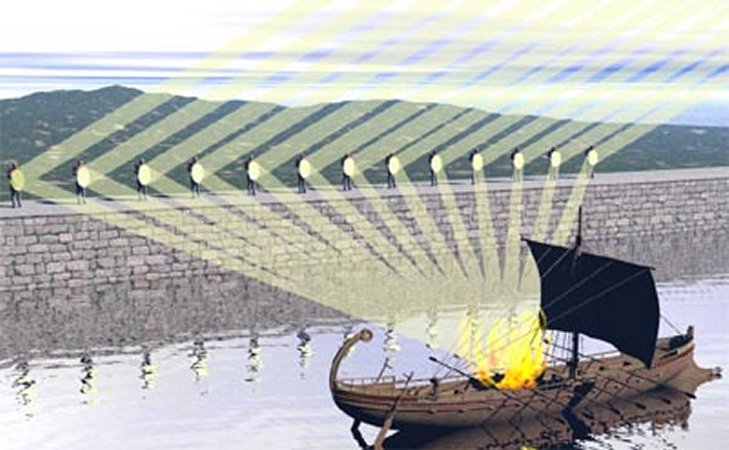
Soldiers using multiple flat mirrors could concentrate light on a ship. Image credit & copyright: Lee Krystek, 2011)
Archimedes was able to create this giant mirror and parabolic disc and focus the Sun’s rays on a fleet and set the ships on fire.
Using a magnifying glass to concentrate the sun's rays onto a small piece of wood, setting it on fire can be done easily. However, those who questioned the Archimedes’ method wondered if he could have built a mechanism with the tools he had available at the time to concentrate enough sunlight to set the deck of a wooden ship on fire.
Some years ago, the Mythbusters television crew attempted to reconstruct the ancient battle, using 500 flat mirrors controlled by 500 volunteers. They tried for one hour to focus the Sun on a sail (which should have had an ignition point of only about 500 degrees Fahrenheit) they could only get the temperature up to about 230 degrees.
The television crew concluded that it was theoretically possible to set a ship on fire with mirrors, but it was unlikely Archimedes used this method in battle.
Those who disagree with this conclusion suggest that mirrors could have been used on the crew and not the ship. A light beam focused on you could raise your skin temperature to over 200 degrees and it would be extremely unpleasant. It would also force the crew of the attacked ship to jump into the water.
We may never know how Archimedes’ giant solar mirror was used in battle, but we do know that our ancestors possessed advanced knowledge that covered lenses, different forms of light sources, and weapons we today are not yet fully familiar with. Though we cannot answer all questions, awareness of the past gives us the resources necessary to make comparisons between our contemporary world and past times. This knowledge shapes our future.
Written by Ellen Lloyd – AncientPages.com
Copyright © AncientPages.com & Ellen Lloyd All rights reserved. This material may not be published, broadcast, rewritten or redistributed in whole or part without the express written permission of AncientPages.com and Ellen Lloyd
Expand for referencesMore From Ancient Pages
-
 Prophetic Dream Revealed Priceless Ancient Treasure That Was Later Stolen Or Destroyed – Was The Discovery Too Dangerous?
-
 Lady Justice (Justitia): Legal And Philosophical Concept Produced In Remote Antiquity
-
 Gryla: Cannibalistic, Evil Troll And Her Sons ‘Yule Lads’ – In Icelandic Folklore
-
 Discovery At Fujiwarakyu Palace Complex Offers Better Glimpse Of 7th-Century Japan
-
 Maori God Pourangahua And His Flying Bird Traversing The Ancient Skies
-
 1,400-Year-Old Christian Chalice With Etched Symbols Found In Rubble At Vindolanda Fort, Britain
-
 On This Day In History: Canute Lavard Was Murdered By His Cousin, Magnus I Of Sweden – On Jan 7, 1131
-
 Mystery Of Viking Ruler Rollo Continues – Surprising Discovery In Ancient Grave
-
 On This Day In History: Napoleon Bonaparte Dies In Exile – On May 5, 1821
-
 Rasputin – Controversial Mystic With Healing Powers – An Evil Or Misunderstood Man?
-
 Ancient Seal Offers First Biblical Evidence Of The Prophet Isaiah?
-
 Cambridge Supports Nigeria’s Claim For Return Of Benin Artefacts From University Collections
-
 Cuneiform Tablet Unearthed In Hittite City Samuha Refers To Love And War Goddess Sausga
-
 Lofn ‘Matchmaker’ – Norse Goddess Of Forbidden Marriages Of People Who Wish To Be Loved And Search For Partners
-
 Treasures Of Polish Archaeological Dig In Czermno Medieval Fortified Settlement – Revealed
-
 On This Day In History: Knights Templar Arrested In The Kingdom Of France – Oct 13, 1307
-
 First Discovery Of 60,000-Year-Old Quina Technology In East Asia Challenges Understanding Of Ancient Human Evolution
-
 Constantine The Great – Did First Roman Christian Emperor Use Faith For His Own Agenda?
-
 Codex Gigas – The Devil’s Bible – Ancient Secrets Of The World’s Largest Book
-
 Underwater Archaeologists Retrieve Over 100 Magnificent Glass Objects at Chengene Skele Bay, Bulgaria

