
Nidhogg – Dreadful Winged Corpse-Eating Dragon Who Is Enemy Of Asgard And Yggdrasil Tree
A. Sutherland - AncientPages.com - In Norse mythology, Nidhogg (also (Nithog, Nidhögg) is the corpse-eating dragon that lives entwined around Yggdrasil’s foot. Nidhogg is stalking in the roots of Yggdrasil.
In the Völuspá, a very powerful female shaman and seer, Völva, reveals that Nidhogg ("the Dread Biter") gnaws the roots of Yggdrasil; his evil deed symbolizes the destructive elements in the universe and this malevolent dragon is, in fact, the greatest threat to the tree of life.
Accompanied by his serpent sons (Goinn, Moinn, Grabakr, Grafvolludr, Ofnir, and Svafnir), Nidhogg gnaws the root of the sacred ash tree, threatening to destroy it.
It is Nidhogg’s plan to kill the tree because he knows that its death would be to signal the downfall of the gods.
Dwelling Place And Duties of Nidhogg
Nidhogg dwells in the spring Hvergelmir (‘Roaring Kettle’ or Roaring Cauldron), located in the center of Niflheim. From Hvergelmir flowed the eleven poisonous rivers that, with time, collapsed into the chasm, froze, and filled it with poisonous ice.
In “Gylfaginning”, Snorri Sturluson says that the place has a mythic past:
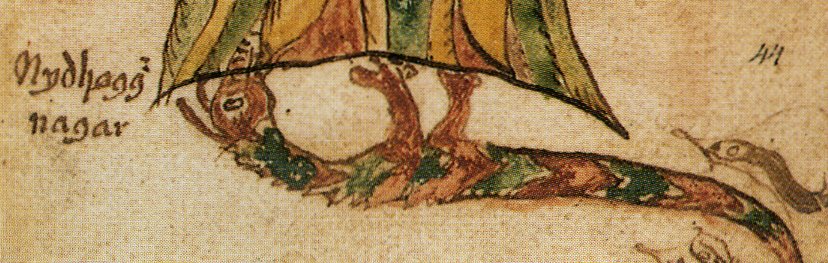
Nidhogg gnaws the roots of Yggdrasill in this illustration from a 17th-century Icelandic manuscript. Credit: Public Domain
“It was many ages before the earth was created, that Niflheim was made, and in the middle of it is the spring Hvergelmir, and from it flow those rivers that are so named: Svöl (Cool), Gunnthrá (Battle-pain), Fjörm (Rushing), Fimbulthul (Mighty-wind or Mighty-speaker), Slíd (Dangerous) and Hríd (Storm), Sylg (Slurp) and Ylg (She-wolf), Víd (Wide), Leipt (Flash)…”
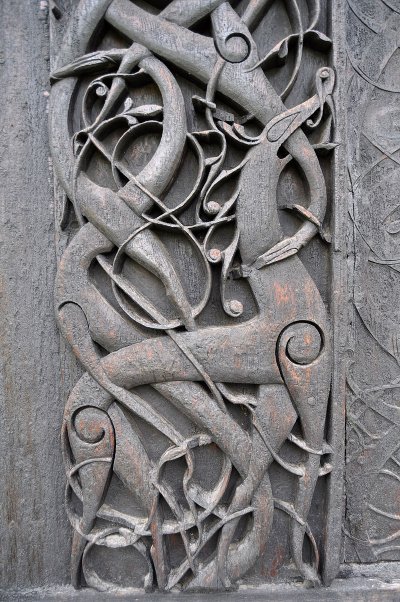
Carving of Niddhog on a church in Norway. Credit: Public Domain
In addition to the killing of Yggdrasil, Nidhogg has also other tasks. In the vision told by a Völva, the dragon Nidhogg bears corpses on his wings:
“From below the dragon | dark comes forth,
Nithhogg flying | from Nithafjoll;
The bodies of men on | his wings he bears,
The serpent bright...”
The beast feeds on the blood from the bodies of losers and those unfortunate humans who were not allowed to enter Valhalla, a paradise for warriors.
Nidhogg will survive Ragnarok, the battle at the end of time between gods and men, giants, and monsters. It will survive the flood and the fire and harvest many new corpses of those guilty of murder, adultery, oath-breaking, and others who committed the worst possible crimes, according to Norse society’s law.
It is said after Ragnarok, Nidhogg will be bearing these corpses on his wings, from one of the worst regions in Niflheim, Nidafjoll located over the Nida Mountains.
Then, he will continue to suck blood from the bodies of the dead on Nastrond, the shore of corpses.

Credit: Adobe Stock - Inkling Design
In "Grimnesmol" (Grimnesmal), one of the mythological poems of the Poetic Edda, this dreadful creature is described as: “he who strikes with malice, with bitter enmity or spite”).
Interesting is also the origin of the name of this frightening mythological creature. The name Nidhogg is most probably derived from the word "níð", (in Old Norse: a loss of honor).
Is Nidhogg A Dragon Or A Snake?
Norse mythology has both dragons and snakes. Nidhogg, however, can be both. It is a snake, but it also has wings.
Like Jormungandr, a son of Loki, also Nidhogg is an enemy of the Aesir gods. During Ragnarok “the twilight of the gods”, the dragon will stand on the side of the giants under the leadership of Loki, and fight with Odin’s forces.
In Norse myths and legends, Nidhogg symbolizes chaos, sin, and destruction.
Updated on May 8, 2023
Written by – A. Sutherland AncientPages.com Staff Writer
Copyright © AncientPages.com All rights reserved. This material may not be published, broadcast, rewritten or redistributed in whole or part without the express written permission of AncientPages.com
Expand for references
More From Ancient Pages
-
 Late Roman-Era Rooms, Offering Vessels Unearthed At Ancient City Of Antiocheia, Southern Türkiye
-
 Vatican Secrets – Extraterrestrial Life And Genetically Engineering Of Humans By Advanced Alien Species
-
 Hundreds Of Highly Unusual Burial Gifts Found In Special Viking Chamber Belonging To Woman In Norway
-
 New Last Ice Age Findings In Palawan Cave
-
 Huginn and Muninn: Powerful Ravens Of Odin, Supreme God In Asgard In Norse Mythology
-
 Unexplained Visions Of Airmen – Strange Presence And Disturbances – Part 1
-
 How Did People Go To The Toilet In The Past Before The Invention Of The Flush Toilet?
-
 Cave Of The Stone Sepulcher – ‘Actun Tunichil Muknal’ And Its Dark History
-
 New Massive Duck-Billed Dinosaur Species Identified
-
 Unexplained Old Cases Of People Who Saw The Past And The Future – Time Travel Mysteries
-
 The Spread Of Weighing Systems Across Western Eurasia 4,000 Years Ago
-
 London’s Oldest Theater Red Lion Discovered Beneath Whitechapel
-
 Unique 4,000-Year-Old Board Game – Unearthed In Oman
-
 The Mysterious Books Of Prophecies Of The Knights Templar – Where Are They Hidden?
-
 Tomb Of A 1,000-Year-Old Sican Surgeon Wearing A Golden Mask Discovered In Peru
-
 Fascinating Legend Of The Seven Sleepers Of Ephesus
-
 Evidence Norse Greenlanders Imported Timber From North America
-
 On This Day In History: Gerardus Mercator Famous Mapmaker Of All Time Died – On Dec 2, 1594
-
 Unusual Ancient Winged Half-Human And Half-Animal Divine Creature With Supernatural Powers
-
 The Faery Grail Of Hospitality And Accord – Secrets Of The Elucidation – Part 2

