
Enmerkar: Legendary Sumerian Founder And Ruler Of Uruk And Grandson Of God Utu
A. Sutherland - AncientPages.com - Enmerkar is a mythological, semi-historical character from Sumerian legends. He represents the first dynasty (3500 - 2750 BC), including great Mesopotamian heroes, Meskiaggasher (his father), Lugalbanda, Dumuzi, and Gilgamesh.
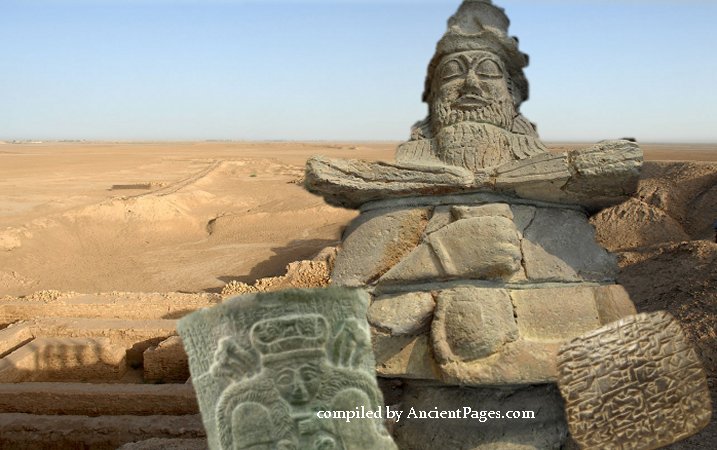
In the Sumerian King List, Enmerkar appears as the second king of the First Dynasty of Uruk. His father was Meskiaggasher (Mesh-ki-ang-gasher), the son of the god Utu (the twin of the goddess Inanna, the Queen of Heaven), later worshipped as Shamash, the Mesopotamian Sun god associated with justice, truth, and morality. Utu, on the other hand, was Enmerkar's grandfather.
King List adds that Enmerkar brought the official kingship with him from the city of E-ana after his father, Meskiaggasher, son of Utu, had "entered the sea and disappeared." Enmerkar founded Uruk, the largest settlement in southern Mesopotamia, around 4500 BC, and was said to have reigned for "420 years" (some versions even propose "900 years").
In "Sumerian Mythology," Samuel Noah Kramer writes that one (unpublished) tablet that was found in Nippur says that "hero Enmerkar ruled in the city of Erech sometime during the fourth millennium BC."
Was Enmerkar Real Figure Or Legendary One?
Not much is known about this obscure ruler. Still, a few Sumerian legends provide some information about his existence, and "the legendary dynasty of Uruk, which, according to the Sumerian King List, included three great Mesopotamian heroes, Enmerkar, Lugalbanda, and Gilgamesh, was the inspiration for mythopoetic narrative." 1
There are two narrative poems dedicated to the legendary king Lugalbanda, another two about Enmerkar, and five about Gilgamesh. These legends later circulated in the court of the Neo-Sumerian kings.
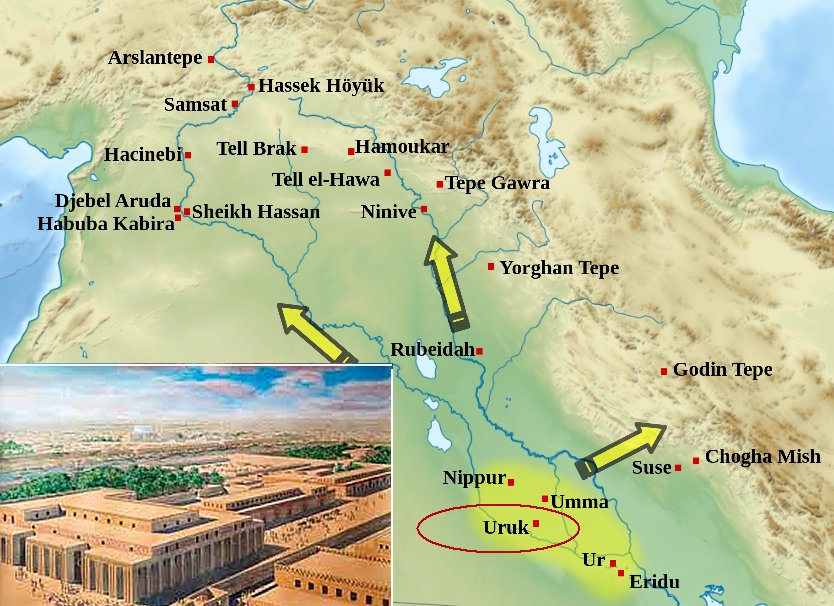
Unfortunately, archaeological and historical studies have not been able to provide evidence of whether he was a real figure in the history of Sumer or a legendary character.
In historical terms, his genealogy is insufficient, which means the origin of Enmerkar, his parents, and where he came from is shrouded in mystery.
Enmerkar Is Mentioned In Some Sumerian Epics
A legendary Sumerian epic, "Enmerkar and the Lord of Aratta," dated to about the 21st century BC, says Enmerkar was of divine origin. He was born in the "heart of the mountains," known as the "mountains of the pure ME." A few other ancient texts describe Enmerkar's reign, his continued diplomatic rivalries with Aratta, and his later campaign against the city. A Sumerian mythological account, "Lugalbanda and the Anzu Bird," also tells about Enmerkar's year-long siege of Aratta.
Enmerkar was famous for his war against the prosperous city of Aratta, which was hundreds of kilometers east of present-day southern Iran, ancient Persia. It has long been hypothesized that Jiroft is the legendary land of Aratta, a 'lost' Bronze Age kingdom of renown.
According to texts dating from around 2100 BC, Aratta was a beautifully decorated and flourishing capital with a citadel fashioned with green lapis lazuli and lofty towers of bright red brick. Aratta's artistic production was famous and highly regarded.
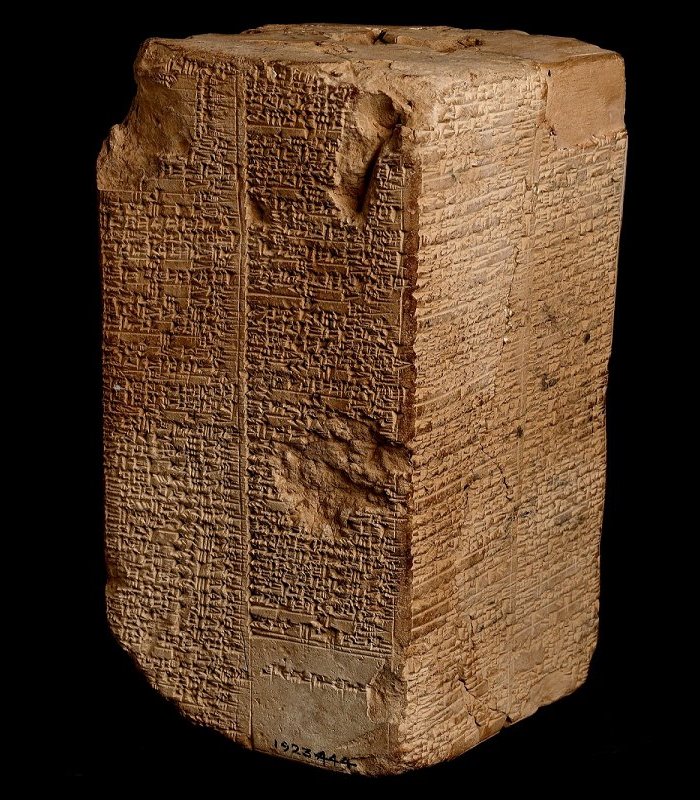
Sumerian King List - This is the Sumerian King List, an ancient stone tablet listing cities in Sumer and its neighbouring regions, their rulers and the length of their reigns. It contains a reference to the flood myth and mythological origins of Kingship, with the details of the later kings listed on the tablet having more realistic reigns than the excessively long ones of the earlier entries. The artefact is a prism, with its cuneiform writing in the Sumerian language. Its production is dated to approximately 1800 BC and it is believed to originate from Larsa, an ancient city in Sumer whose ruins now lay within the Dhi Qar Governate of Ira. Photo: Ashmolean Museum
The small city had developed a prosperous trade of metals and precious stones, which were abundant in that region.
According to the epic "Enmerkar and the Lord of Aratta," this Sumerian ruler founded Uruk and constructed the House of Heaven for the goddess Inanna in the Eanna District of Uruk. About 2500 BC, he sent a message to the ruler of Aratta requesting that artisans and architects be dispatched to his capital, Uruk, to build a temple to honor Inanna, the goddess of fertility and war.
It's worth mentioning that one of Enmerkar's war chiefs and heroic companions during the struggle with Aratta was Lugalbanda. According to the Sumerian king list, this Lugalbanda, "the shepherd," eventually succeeded Enmerkar to the throne of Uruk.
In both Sumerian and Akkadian versions of the "Epic of Gilgamesh," Lugalbanda is named as the father of Gilgamesh, a later king of Uruk, who built the walls of Uruk.
Enmerkar And Inanna
There is a story that refers to the conflict between Enmerkar of Uruk and Ensuhkeshdanna of Aratta. This conflict had to do with Inanna, the great goddess Inanna (Ninin, Ishtar), the Phoenician Astarté, the Greek Aphrodite, or the Roman Venus), who lived in the splendid Iranian city and had his eyes set on the mighty Uruk, capital of the god of the sky, Anu.
The goddess begged the current king, Enmerkar (her nephew), to defeat Aratta and move her home to Anu's temple. Enmerkar won more favor in Inanna's eyes than Ensuhkeshdanna who later said:
"You are the beloved lord of Inanna, you alone are exalted.
Inanna has truly chosen you for her holy lap, you are her beloved.
From the south to the highlands, you are the great lord, and I
am only second to you." 1
Written by – A. Sutherland - AncientPages.com Senior Staff Writer
Updated on February 12, 2023
Copyright © AncientPages.com All rights reserved. This material may not be published, broadcast, rewritten or redistributed in whole or part without the express written permission of AncientPages.com
Expand for referencesReferences:
- Leick G. The Babylonian World
More From Ancient Pages
-
 Alexander The Great And The Prophecy Of The Tree Of The Sun And Moon
-
 Incredible Trove Of 100,000 Ancient Coins Tied Together In Bundles Uncovered In Japan
-
 Unsolved Mystery Of The Aleppo Codex And Its Missing Pages: One Of The World’s Most Precious Ancient Books
-
 Why Was This Eerie Castle With Frightening Underground Secrets Really Constructed?
-
 Chaco Canyon Mystery Solved By Scientists Hauling Logs On Their Heads
-
 Mystery Of Monte d’Accoddi: Was It An Ancient Step Pyramid, Altar Or Astronomical Observatory?
-
 On This Day In History: The Peace Of Etaples Signed Between Kings Of France And England – On Nov 3, 1492
-
 Female Pharaoh Twosret Was Exploited, Used And Almost Erased From History
-
 Master Kong Confucius: Great Philosopher And ‘Teacher Of All Teachers’ Ahead Of His Time
-
 Hellenistic Decorated Tombs And Tombstone Probably Used As A False Door Unearthed In Egypt
-
 Unique 4,000-Year-Old Board Game – Unearthed In Oman
-
 Mystery Of The Stone Of Destiny Solved – It Was Originally A Doorstep!
-
 Unique Temple Of The Condor In Machu Picchu: 3D Spectacular Inca Stonemasonry
-
 On This Day In History: John Dee, English Mathematician, Occultist, Astrologer, Astronomer Was Born – On July 13, 1527
-
 Unusual Tukuturi Statue On Easter Island Remains An Unexplained Mystery
-
 1,700-Year-Old Vase For Olive Oil And Wine Unearthed At Historic Site Of Diyarbakir Fortress, Turkey
-
 Karnak: One Of Largest Temple Complexes In The World And Its Spectacular View
-
 Ancient “Mona Lisa Mosaic Of Kadirli” – Discovered
-
 Ancient Gymnasium Discovered In Egypt
-
 Mystery Of Doppelgangers And Spirit Doubles – From Ancient To Modern Times

