
Why Are Statues Of Mythical Yeti Dividing People In The Himalayas?
Jan Bartek – AncientPages.com – Yeti has always been a troublesome mythical creature. People have argued over his existence for years and many claim they've sighted this elusive giant ape-like creature roaming the Himalayas.
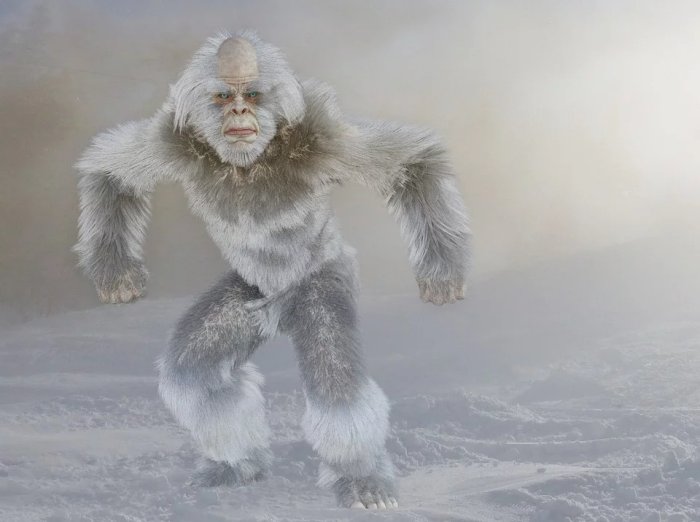
Yeti is believed to be a large snowman roaming the Himalayas. Credit: Public Domain
A large number of Yeti sightings hasn’t impressed scientists who argue Yeti cannot be real. Some years ago, a science team traveled to the Himalayas looking for Yeti. They investigated, wrote a report and made all Yeti believers disappointed. The science team led by geneticist Charlotte Lindqvist said the rare Himalayan brown bear is one possible origin of the Yeti legend.
Is Yeti A Large Bear?
In a study, Lindqvist and her colleagues described how they used DNA to examine nine alleged Yeti samples. Among them was a thigh bone discovered by a spiritual healer in a cave, hair from a mummified animal kept at a monastery, a tooth from a stuffed animal found in by Nazis in the 1930s, and other less significant samples. The results of Lindqvist’s DNA study led to the conclusion that Yeti was just a bear. Previous genetic studies led to similar conclusions. Bryan Sykes, a geneticist at Oxford examined alleged Yeti DNA samples and declared this mythical creature was an ancient 40,000-year-old polar bear, and possibly a hybrid bear.

To promote tourism, new statues of Yeti will be placed across the country and people don't like them. Credit: BBC
But devoted Yeti believers refuse to listen to the scientific community and claim Yeti is a mythical beast because it is described as such in folktales.
“The yeti is known throughout the Tibetan plateau and into the Trans-Himalaya regions of the Kun Lun Mountains and Altai Himalaya.
See also:
European Mythical Creatures Encountered In The Witcher Series
Makara – Legendary Sea-Creature With Many Incarnations In Hindu Mythology
In Mongolia he is known by the name “wildman” or “wild people“— almas (singular) or in other dialects, almasty or almasti. The most common name in Tibet for the yeti is dremo. In eastern Tibet, near Bhutan, they are called nydag shidag, and are thought to be guardians of certain areas.
Apes do not live in the high plateau mountain regions of Tibet, Mongolia, Russia and Central Asia, so the yetis of this region have usually been associated with wildmen, rather than with some sort of giant ape, as in Nepal, Bhutan and Southeast Asia. Almases are usually described as human-like with their bodies covered with reddish-brown hair. They are said to be between five and six and a half feet tall, with anthropomorphic facial features including a pronounced browridge, flat nose, and a weak chin. In many ways they are identical to the yeti.” 1
Yeti Statues Upset People
This time, however, people are not arguing over Yeti’s existence but the creature’s appearance.
Nepal’s government ordered more than 100 statues made in the image of Yeti. When people saw the first statue, they were furious because it looks like a sumo wrestler and not a mythical ape-like creature.
These Yeti statues are meant to be placed at various tourist locations across the country. The goal was to turn Yeti into a mascot and attract tourists, but people are not impressed, and even cultural historians say these depictions are disrespectful towards the nation’s popular mythological creature.
However, the Yeti Art Committee that is responsible for the production of these new Yeti statues defends itself stating that this is a mythical character, and there must be room for creative freedom.
"Our aim is to produce the yeti as an emblem of peace, reconciliation, and humility rather than a fear-creating feature," he told the BBC.
"People around the world should not only know Nepal as the land of Everest or Lord Buddha or Gurkha. The yeti can represent our uniqueness as well."

Another Yeti statue. The creature doesn't look like people imagined. Credit: BBC
Ang Tsherin Sherpa, the man responsible for the controversial design is equally defiant.
"I did not make yeti's sketch by reading any book," he explained. "On the basis of stories that I heard in my childhood and having Lord Buddha at the back of my mind, I made the design."
These arguments may be valid, but people are still not happy about these new statues.
What do you think? Should the Yeti statues be considered a good promotion tool making tourists curious about Himalayan folklore or are the unusual depictions of Yeti insulting?
Written by Jan Bartek - AncientPages.com Staff Writer
Copyright © AncientPages.com All rights reserved. This material may not be published, broadcast, rewritten or redistributed in whole or part without the express written permission of AncientPages.com
Expand for references- David Hatcher Childress - Yetis, Sasquatch & Hairy Giants
- Kamal Pariyar - Visit Nepal's yeti: How mythical creature divided Himalayan nation, BBC
- Tianying Lan, Stephanie Gill, Eva Bellemain, Richard Bischof, Muhammad Ali Nawaz and Charlotte Lindqvist - Evolutionary history of enigmatic bears in the Tibetan Plateau–Himalaya region and the identity of the yeti284Proc. R. Soc. Bhttps://doi.org/10.1098/rspb.2017.1804
- Bryan C. Sykes, Rhettman A. Mullis, and Michel Sartori - Genetic analysis of hair samples attributed to yeti, bigfoot and other anomalous primates, https://www.ncbi.nlm.nih.gov/pmc/articles/PMC4100498/
More From Ancient Pages
-
 Why Was Lovesickness A Feared Disease During The Middle Ages?
-
 On This Day In History: Battle Of Sinop Took Place – On Nov 30, 1853
-
 Antediluvian Discoveries In Britain, Germany And France That Could Re-Write History
-
 Partial Skull Fossils Found In China Could Be A New Species -‘A Kind Of Unknown Or New Archaic Human’, Researcher Says
-
 Ancient Hebrew Inscription Reveals Location Of Biblical Mount Sinai
-
 Treasure Trove Of Arabic Coins Dated Back 1,000 Years Unearthed In Graveyard In Poland
-
 Why Did Ancient Romans Cut Off Their Thumbs?
-
 Mysterious Engraved Bones Discovered On The Island Of Janitzio In Michoacán, Mexico
-
 On This Day In History: Great Fire Of Rome Recorded – On July 18, 64 AD
-
 A 2000-Year-Old Jewish Settlement Near Bet Shemesh – Unearthed
-
 Rare 1,000-Year-Old Viking Wooden Bowl Found By Young Boy
-
 Surprising Discovery Of Oldest Decoratively Carved Wood In Britain
-
 Three Roman Shipwrecks Discovered Off Tunisian Coast – One Is 2,000-Year-Old
-
 Crosby-Schøyen Codex: Ancient Coptic Manuscript Reveals Sermon That Spurred Violence Against Jews
-
 Ice Mummies Of Pazyryk Culture In Siberia Had Complex Tattoos On Their Bodies
-
 Why Didn’t The Spartans Build City Walls?
-
 Viking Age Shields From The Gokstad Ship Burial – Re-Examined
-
 Ancient Artifacts With Foreign Inscriptions And Unknown Signs Discovered In The American Southwest Reveal An Epic Story
-
 Susanoo-no-Mikoto – Shinto God Of The Sea And Storms Was Banished From Heaven
-
 Astronomer Johannes Kepler Saved His Mother From Being Burned As A Witch

