AncientPages.com - The Crosby-Schøyen Codex, an important early Christian book containing five distinct texts all copied by the same scribe, is going up for auction in June at Christie’s in London.
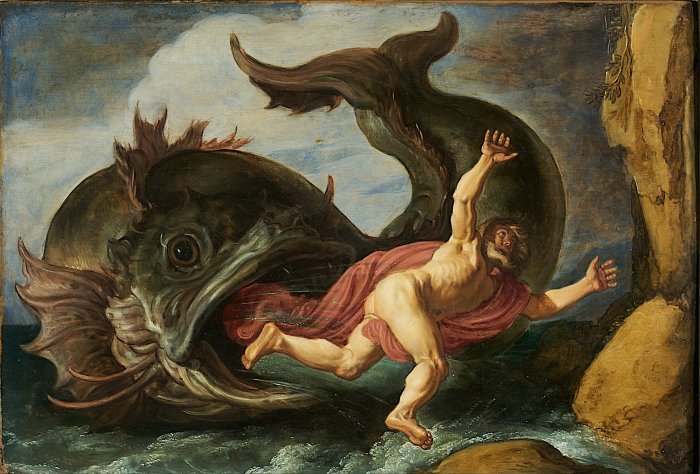
Jonah and the Whale (1621) by Pieter Lastman. Image credit: Pieter Lastman (1583–1633) - Public Domain - IAFT8IfCTfplRQ at Google Cultural Institute
If you have a spare £2 million or £3 million, don’t miss this opportunity to own a key example of the birth of Christian culture and literature.
Most news coverage of this 1700-year-old book focuses on claims that it includes the oldest complete text of two biblical books: Jonah and I Peter. But the ancient manuscript is all the more fascinating if you look at the other documents it includes, the social and political context that produced it and the theology it reveals.
The codex, currently owned by Norwegian collector Martin Schøyen, contains 104 pages and was found in Egypt in 1952 among some other manuscripts buried in a jar in the sand. The book is made of papyrus and written in Coptic, an Egyptian language in which many important early Christian texts are preserved.
It was likely produced in one of the Pachomian monasteries in the vicinity of Faw Qibli, near Dishna in eastern Egypt. These monasteries were operational in the 4th century AD. This matches the radiocarbon analysis carried out on the manuscript, as reported by Christian literature academic Hugo Lundhaug. Author and academic Brent Nongbri suggests a date range of 330 to 350 AD for the text. This makes it the oldest book privately owned and not held by a museum.
What makes the codex so remarkable, apart from its age and completeness, are its contents. Together, the works preserved in the the Crosby-Schøyen Codex shed light into a fascinating, dynamic period of early Christianity that indelibly marked the religion’s theology and culture.
A unique window into early Christianity
The book contains five different texts originally composed by five completely different authors. The oldest is the biblical Book of Jonah, found among the prophetic books of the Hebrew Bible.
Jonah was an important figure for early Christians because he was famously swallowed by a huge fish (mistranslated as whale in the authorised version) while reluctantly heeding God’s call to deliver his prophetic warning to the Ninevites.
Ninevah is depicted as a very wicked city, but Jonah’s message of repentance is successful. This is taken as an example of divine mercy, referenced again in New Testament texts such as Matt 12:41 and Luke 11:30-32. The three days Jonah spent in the belly of the fish was read allegorically by early Christians to foreshadow the time between Christ’s death and resurrection.
A portion of the apocryphal book II Maccabees is also preserved in the codex. The section reproduced details of some vignettes of Jewish resistance to the oppression by Antioches IV Epiphanes, who tried to force Jews under his rule to give up their ancestral customs.
In this account, vulnerable people like old men and mothers and their children boldly choose death rather than violate the Torah – Jewish laws – hoping for resurrection as their reward.
In contrast to Judaism in the 3rd and 4th century AD, Christianity had developed a reverence for martyrs, perhaps especially in the aftermath of the Emperor Diocletian’s reign, which ended with Constantine’s legalisation of Christianity in 313 AD. The Jewish martyrs in II Maccabees would therefore be attractive early examples of martyrdom for early Christians.
I Peter, one of the many letters in the New Testament, also appears in the codex. While it’s unlikely that Peter himself composed the letter, it nevertheless became an important document for early Christians.
It gives encouragement and advice for Christians whose withdrawal from non-Christian public life made them targets, not necessarily for state persecution, but certainly for social isolation. It’s easy to see how such a letter would appeal to those living a monastic life.
Rise of antisemitism
While one of the texts in The Crosby-Schøyen Codex is an otherwise unknown piece –perhaps a sermon – another is notorious: Melito of Sardis’ homily on Passover (known as Peri Pascha). Originally composed between 160 and 170 AD in Asia Minor, this chilling sermon spares no detail in its antisemitic hatred and disgust for Jews. It is explicit in identifying Jews as responsible for the crucifixion of Jesus.
Beyond this, it argues that Judaism should be destroyed outright in light of the new covenant, Christianity. This text represents the earliest example of a Christian accusing the Jews as a people of deicide – the antisemitic belief that Jews murdered God.
The charge of deicide spurred Christian violence against Jews for centuries after Melito’s sermon, with far-reaching consequences from Easter pogroms, to the crusades, the expulsion of Jews from Europe (including England) and even current antisemitic campaigns.
That this document is included in the codex is curious until we recall that at the time it was constructed, Christianity had been legal for perhaps a decade or two, and in the next few decades was about to become the official religion of the Roman empire.
Antisemitism had been growing for some time as Christianity gained more and more gentile (non-Jewish) followers, and Romans were no longer the “bad guys”.
Another scapegoat, other than Rome, needed to be found for the death of Jesus. Antisemitic ideas like Melito’s vicious accusations about Jews solved that problem for many Christian communities, as it seems to have for whoever compiled these diverse texts into a single book.
What the Crosby-Schøyen Codex gives us is a unique window into the social and theological world of 4th-century Christianity. It preserves a compilation of texts which all speak to the huge changes taking place in the Mediterranean world at that time.
From persecutions to the legalisation of Christianity, to the construction of the earliest monasteries, early Christianity was undergoing rapid transformations. This priceless book preserves a true moment in time.
Provided by The Conversation
This article is republished from The Conversation under a Creative Commons license. Read the original article.