
Great Lady Of Champagne – Barbe-Nicole Clicquot Ponsardin: Widow, Mother, Skilled Businesswoman
A. Sutherland - AncientPages.com - Legend has it that champagne was invented by Dom Perignon, a monk from the Benedictine order, who in 1668 was lucky to taste this drink and he was so happy of his experience that he began to cry.
The most famous champagne brand was named in the monk’s honor - Dom Pérignon.
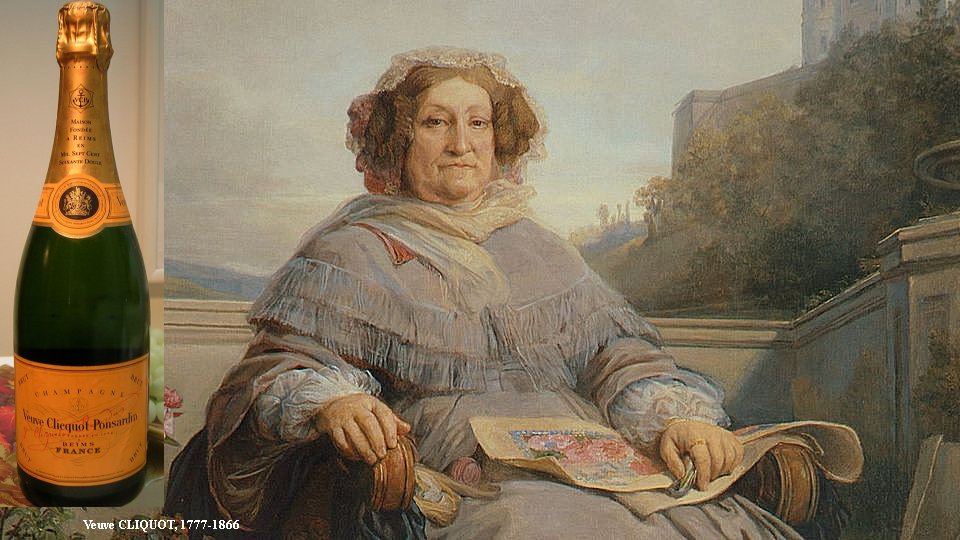
However, the method of producing champagne invented by Benedictine definitely needed an improvement, and Madame Barbe-Nicole Clicquot, known today as the ‘Great Lady of Champagne’ or ‘Widow Cliquot" (‘Veuve Cliquot’) contributed with a new method that significantly improved the quality of the drink.
Tough Decision Of 27-Year-Old Woman
For more than two centuries ago, the then 27-year-old French woman, Barbe-Nicole Clicquot decided to take over the production of champagne that she started with her husband François Clicquot. It was said that the fever took her husband’s life when he passed away on October 23, 1805.
Many people had hard to understand his cause of death because he and his wife Barbe-Nicole were dealing with the production of champagne, known for its high quality. Many people then, believed that champagne was the most effective ‘medicine’ for high fever.
Another version suggested that at the time of the death, François suffered from severe depression.
Madame Clicquot Takes Over The Family Business
After the death of her husband, Madame Clicquot was left alone with a small child. In the beginning, there was no one in the Clicquot Company who expected, the young Barbe-Nicole to take over the family business established 33 years earlier, but she did it.
In the early 19th century, it was an unprecedented decision. The women had no authority and it wasn’t accustomed to trading with them. Widow Cliquot not only stood up to the challenge of maintaining her husband's project but also modernized the company.
Fascinated by the complicated production process of champagne, she introduced several improvements.
Process Of ‘Riddling Table’ Invented
Among others, "Grande Dame du Champagne" invented the process of "the riddling table". In 1816, she discovered that by storing bottles of champagne at an angle and gradually turned them upside-down, the sediment would fall to the necks, near the cork (riddling), and from there it could be removed, leaving clear champagne.
 The Riddling Table invented by Veuve Clicquot.
This resourceful young woman used her dining room table, which she turned on its side and drilled holes through the top so that the corks in her champagne bottles lay at a declining angle towards the floor.
Known today as the ‘the riddling table’ for sedimentation, this simple device is still used in the production of champagne.
She also created the formula of pink champagne, now highly valued among experts.
On February 10, 1806, she signed the business agreement, in which she invested her entire wealth, to start a huge business development. Barbe-Nicole was a remarkably skilled businesswoman; she knew how to run her business and she succeeded. She transformed the family production of champagne into an internationally renowned company that produced 100,000 champagne bottles a year.
She also founded a house of champagne - a company dealing with successful production and sale of this drink.
Building A Champagne Empire Was A Tough Ambition
Barbe-Nicole had many impressive ideas, which efficiently contributed to the increasing popularity of her family business.
She gave up the fight for the local market; she did not care too much about the English market.
Intuition prompted her to try to develop less dense markets. So she looked far to the east and first of all to Russia.
 Champagne Veuve Clicquot, Reims. Source
In 1814, warned of the victory of the coalition against Napoleon (Napoleonic War (1803–1815), she ordered shipping of significant transport of 10,550 bottles to St. Petersburg, Russia, by boat. Apparently, they sold out immediately and were empty during a week. The success was such that the house could not satisfy orders.
In his novel "Eugene Onegin", Aleksandr Pushkin (1799-1837), a Russian poet and novelist, rewarded champagne and called it "blessed wine of the Gods" and Russia remained the largest importer of champagne until the October Revolution (Nov. 6–7, 1917).
Interestingly, not all deliveries of Madame Cliquot’s champagne were successful. In 2010, a shipwreck was located at the bottom of the Baltic Sea, with a few dozen bottles of the delicious and famous Veuve Clicquot champagne, dated back to around 1840.
Barbe-Nicole’s champagne business experienced both ups and downs in those tumultuous times with wars and restrictions, and the difficult political situation in Europe. One year, the company’s situation was so critical that she made attempts to sell her jewelry to cover losses but no one had enough money to pay during this time. Once again, this brilliant businesswoman coped well with the problems and lifted the company.
During the 1820s, Veuve Clicquot & Cie exported approximately 175,000 bottles of champagne, and for about ten years, she expanded her empire even more.
She died in 1866 at the age of 88.
Today, Veuve Clicquot produces more than 10 million bottles of champagne, which goes to probably all the markets around the world.
Written by - A. Sutherland - AncientPages.com Senior Staff Writer
Copyright © AncientPages.com All rights reserved. This material may not be published, broadcast, rewritten or redistributed in whole or part without the express written permission of AncientPages.com
Expand for referencesMore From Ancient Pages
-
 Acheulian Culture Of Ethiopian Highlands And Their Prehistoric Tool Selection To Make Society’s Life Easier
-
 William The Conqueror: Ruthless And Powerful Ruler Who Changed Britain Forever
-
 Magnificent Ancient Egyptian Gold And Soapstone Jewelry Discovered At Tell El-Amarna Necropolis
-
 The Knap Of Howar: One Of The Oldest And Well-Preserved Neolithic Complexes Orkney, Scotland
-
 Extremely Rare Roman Cavalry Parade Mask Discovered In Romania
-
 Sacred Number Four – Perfect Number And Deep Meaning Behind It
-
 Astonishing Lunar And Solar Calendars Created 30,000 B.C.
-
 Human Migration Out Of Africa To Middle East Through Corridors Provided By Monsoons
-
 Mysterious Advanced Underground Civilization And A Secret Society – Technology, History, Language And Goals – Part 2
-
 Unusual And Well-Preserved Skeleton Discovered In Ancient Pompeii Sheds New Light On The Cultural Life Of The City
-
 Queen Teuta: Power-Hungry Villain Who Underestimated The Romans
-
 Ancient Settlement Inhabited By Urartian People – Unearthed
-
 Was Princess Tadukhipa Of The Mitanni Kingdom Queen Nefertiti?
-
 Prehistoric Humans Cooked 780,000 Years Ago – Oldest Evidence Of Controlled Fire Discovered
-
 3,000-Year-Old History Of Tea: World’s Second Most-Consumed Drink After Clean Water
-
 Spir Mountain Cairns: Prehistoric Ancient Monuments To The Dead In Northern Sweden
-
 Early Expansion Of Homo sapiens: Underwater Caves Give New Clues About Sicily’s First Residents
-
 Incredible Cave With Secret ‘Door’ Discovered In The American West – Fascinating Underground Mystery
-
 How Far South Did Prehistoric Highly Skilled Polynesian Seafarers Sail?
-
 ‘Cosmic Monster’ Zoomorph At Quiriguá Ruled By Cauac Sky, Great Maya Leader

