
Secret Police In Ancient Rome – Frumentarii: Who Were They And What Was Their Role?
A. Sutherland - AncientPages.com - Frumentarii' was a special military elite in Roman Empire that served as the emperor's secret police.
At the turn of the second and third century AD, they watched the actions of senators, high-ranking military men, and Christians.
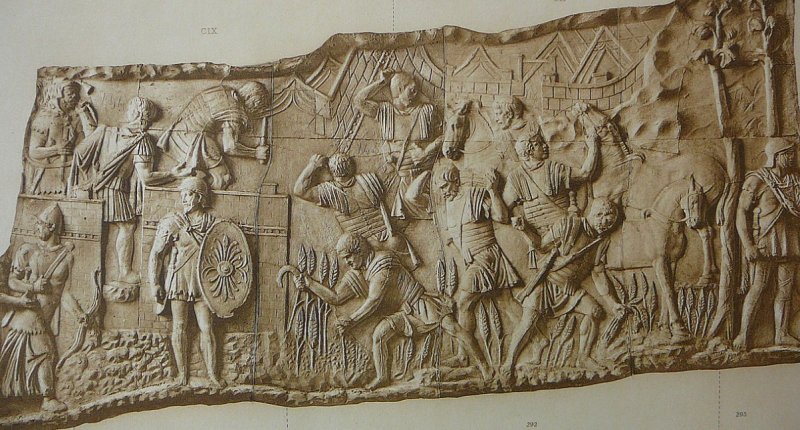
Some frumentarii take care of the supplies, harvesting the wheat ( Colonna di Traiano , relief n.81). Image credit: Conrad Cichorius: "Die Reliefs der Traianssäule" - Public Domain
Initially, however, they were collectors of wheat in the Roman Empire. They dealt with tax collection and were responsible for controlling and regulating grain deliveries to the capital.
However, their role evolved during Hadrian's reign (117-138 CE); they expanded and focused on internal stabilization. Their tasks also involved arrests of suspected individuals.
The frumentarii' was Emperor Hadrian's special unit of the Praetorians to control the political situation in Rome during the emperor's absence.
His secret police unit had to protect the emperor from possible conspiracies and investigate significant individuals and their lives.
Hadrian wanted to know much, and as he once said, "he wanted to know things that should not be known," which probably applied to the private lives of individuals in his vicinity.
According to Hadrian, knowledge – of whatever sort – was power.
There is very little information about this unit, but ancient inscriptions on gravestones confirm that frumentarii, who always worked in uniforms, were usually attached to individual legions.
They carried out particular tasks in different places and were stationed at the Castra Peregrina in Rome. They did not hide themselves and lived openly. Their uniforms determined their affiliation.
According to studies, the frumentarii unit had high moral and social status and was very proud. The inscriptions on their gravestones attest to it.
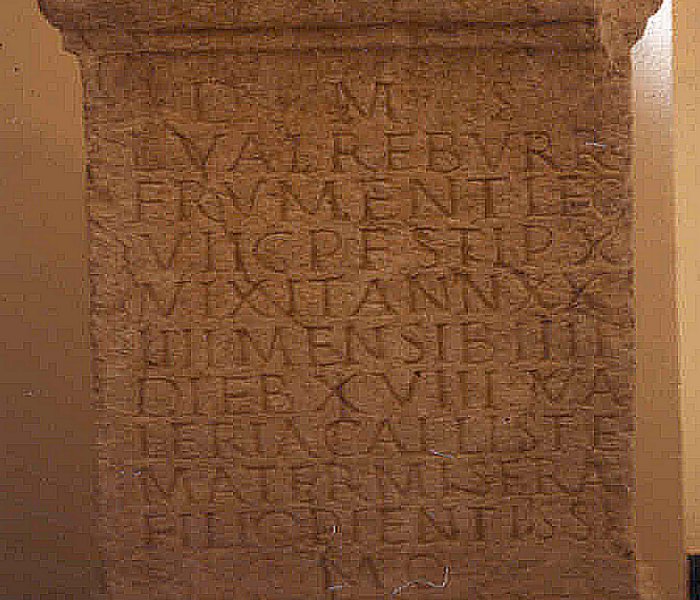 Inscription about a frumentarius from Legio VII Gemina. Image credit: Caligatus - Public Domain
Frumentarii Were Not Entirely Innocent
These officers were disliked by Roman society because, among others, they spied on people.
Due to abuses committed by this secret police, the emperor Diocletian (284-305 CE) dissolved the unit and replaced it with the so-called agentes in rebus ("general agents"). This change was based on the fact that they were recruited from civilians, not military men. The unit contained from 200 to 1000 men.
The changes introduced by Diocletian were unsuccessful, and abuses committed by the frumentarii agents continued. They entirely operated in the Byzantine Empire until the 8th century.
Many were very privileged; as a control organ superior to the local governors, they monitored the entire Roman province.
They were feared depending on their relations, and at the same time, their work was highly appreciated by the emperors who gave them promotions to hold important government positions.
Senior officers who served well and impeccably had opportunities to work in the Praetorian prefectures, where they exercised their control over the bureaucracy.
They had civil and criminal judicial immunity; for example, inspectors performed their functions above the provinces.
Written by - A. Sutherland - AncientPages.com Senior Staff Writer
Updated on October 6, 2023
Copyright © AncientPages.com All rights reserved. This material may not be published, broadcast, rewritten or redistributed in whole or part without the express written permission of AncientPages.com
Expand for referencesReferences:
Speller E. Following Hadrian
Goldsworthy A. The Complete Roman Army
More From Ancient Pages
-
 Tomb of the 26th dynasty vizier of Upper Egypt discovered in South Assassif, Luxor
-
 Milk Enabled Massive Steppe Migration
-
 Surprising Discovery In Valsgärde Viking Boat Graves – Scandinavian’s Oldest Down Bedding Found
-
 Mysterious Rock Inscription Found In Brittany Baffles Experts – Reward If You Can Decipher It
-
 Chromium Steel Was First Produced In Ancient Persia
-
 Ancient Venetian Merchants Were Always Prepared For The Worst
-
 On This Day In History: 4000 Defenders Of Pilėnai Commit Mass Suicide When Attacked By Teutonic Knights – On Feb 25, 1336
-
 Unknown Lost Civilization Of Ancient Megalithic Super-Builders In The Middle East – Can Prehistoric Rock Art Solve The Mystery?
-
 Advanced Heating System Discovered In Ruins Of Metropolis ‘City Of Mother Goddess’
-
 Is This The Face of Queen Elizabeth I?
-
 Sibylline Books: Ancient Prophecies Destroyed By Fire
-
 Clay Tablets Reveal Sumerian Doctors Treated Disease With Spells Of Magic And Medicine
-
 Deeper Look Into Chinese Swords Throughout The History Of The Dynasties
-
 Bastet: Protector And Punisher – She Was Among The Most Majestic Egyptian Deities
-
 Why Was Dorset Ancient Mega Henge Built In Such A Hurry?
-
 Ancient Ingapirca: Largest And Best Preserved Inca Ruins In Ecuador
-
 Ancient Papyrus Reveals Millennia Old Astronomical Secret: The ‘Demon Star’ Algol Does Exist
-
 Elusive Gate Holds The Keys To Europe’s Secret Mountain
-
 Prehistoric Quarry, Stelida, Naxos: Early Human Moved Through Mediterranean Much Earlier
-
 On This Day In History: First Experimental Hydrogen-Filled Balloon Reaches A 900m Altitude – On August 27, 1783

