
Ancient Children Played Marbles Thousands Of Years Ago
Conny Waters - AncientPages.com - Kids will be kids, no matter what country, place or time. Some things are ageless and never go out of fashion.
Many modern children play with computer games, but some of the simplest toys are still as popular as they were thousands of years ago. It seems today’s children enjoy the same things as ancient kids did.
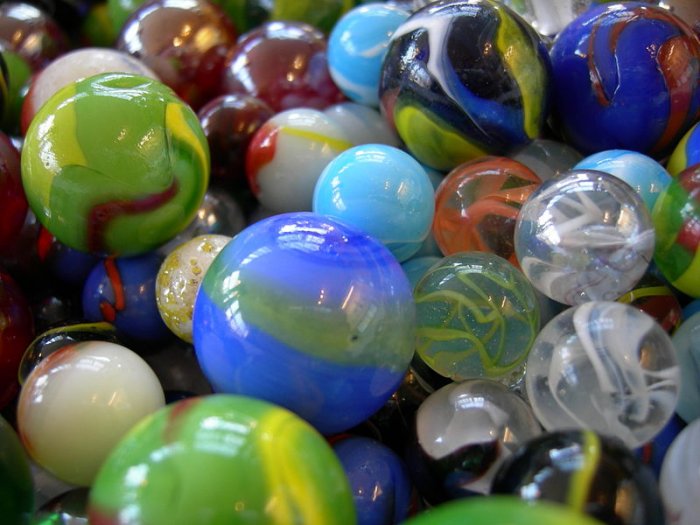
Marbles. Credit: Joe Mabel. CC BY-SA 3.0
Marble is a small spherical toy often made from glass, clay, steel, plastic. These balls are of different size and type. It’s fair to say it’s one of the simplest toys ever produced, but historical records show playing marbles can be fun.
It is unknown where marbles were first manufactured, but there is archaeological evidence that many games played today were enjoyed by children thousands of years ago. The first original marbles, the ones we are today familiar with were produced by a German glassblower in 1846.
Scientists have discovered small, colorful balls in pyramid tombs, and it seems marbles were part of the daily play of Egyptian children a long time ago. The oldest marble set was unearthed buried with an Egyptian child around 3,000 B.C. in a gravesite at Nagada.
Marbles made of clay have been discovered in prehistoric pueblo ruins in the southwestern United States, and in ancient Mexican ruins. Historians think the Aztecs enjoyed playing with marbles.
See also:
Ancient Egyptian Toys And Games In Focus
World’s Oldest Toy Car – Could This 7500-Year-Old Discovery Be The Earliest Evidence Of The Wheel?
What Was Life Like For Children In Ancient Athens?
It is thought that the Aztecs played a form of marbles. Clay marbles have been found in prehistoric pueblo ruins in the southwestern United States, in the classic periods Valley of Mexico ruins, and in the northern plains.
Small, ancient stone balls, identified by archaeologists as marbles have been unearthed near Mohenjo Daro, India and similar artifact have been discovered at prehistoric sites associated with Chaldeans of Mesopotamia.
In ancient Greece and Rome, children loved to play marbles. “On the Greek island of Crete, Minoan youths played with highly polished marbles of jasper and agate as early as 1435 B.C. And it is the Greeks, from their term for a polished white agate, marmaros, who gave us the word “marble.”
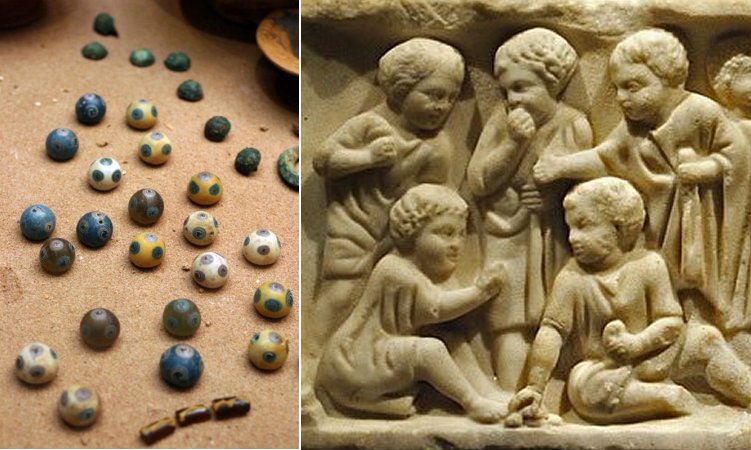
Left: Roman marbles. Credit: grandvoyageitaly.com - Right: Ancient Roman children. Credit: Public Domain
Marbles was a popular game among Roman children. The first Roman emperor, Caesar Augustus, would descend from his litter in order to join street children shooting marble pebbles and galls. Even clear glass marbles, fused from silica and ash, were manufactured in ancient Rome.
Despite the numerous marble artifacts obtained from ruins and the many references to the sport in extant texts, rules on how the game was played do not exist.” (Panati, Charles. Extraordinary Origins of Everyday Things)
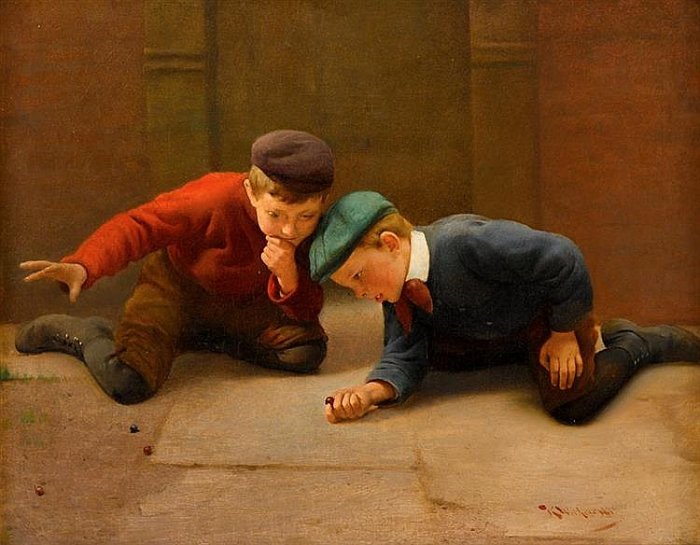
Game of Marbles, Karol D. Witkowski. Credit: Public Domain
Celtic, Saxon and African children did not have such beautiful glass balls, but they used nuts and olives to play marbles.
We can add that marbles are mentioned in ancient literature and depicted on historical paintings.
It’s fascinating to see how this game developed independently in virtually every ancient culture, and it’s still popular in modern times.
Written by Conny Waters – AncientPages.com Staff Writer
Copyright © AncientPages.com All rights reserved. This material may not be published, broadcast, rewritten or redistributed in whole or part without the express written permission of AncientPages.com
More From Ancient Pages
-
 Strange Engraving Made By Knights Templar In French Village – It Doesn’t Make Sense Or Does It? – Part 2
-
 Inchbrayock Stone: Pictish Samson Stone Carved With Biblical Symbols And Scenes
-
 New DNA Study Reveals How The Black Rat Colonized Europe In The Roman And Medieval Periods
-
 Ancient Ruins Of Quilmes: Largest Pre-Colombian Settlement In Argentina
-
 Why Was Europe’s Oldest Battle Fought At Tollense Valley 3,000 Years Ago?
-
 Supernatural Beliefs Of Medieval People – From Elves And Fairies To Abductions And The Undead
-
 Search For Noah’s Ark Continues – The ‘Inside Mount Ararat’ Research Project
-
 Historians Search For A Frightening Ancient Underground Secret In One Of Tampa Bay’s Cities
-
 When And Why Negev Highlands’ Agricultural Settlement Was Abandoned? – Researchers Have Answers
-
 Puzzling Huge Ancient Sayhuite Monolith In Peru Remains An Unsolved Mystery
-
 The Vinland Map Is A Fake – New Evidence Uncovered By Scientists
-
 Ancient Riddle Solved – Why Was Roman Concrete So Durable?
-
 Melusine: Charming Water Fairy In European Legend About Taboo And Broken Promise
-
 Immigrants In Prehispanic Cancun Were Treated Just Like Maya Locals
-
 Selene – Greek Goddess Of The Moon And Myth About Love, Jealousy And Punishment
-
 Petroglyphs Hold Secrets To 14,000 Years Of Human Life In Iran
-
 Ancient Ruins Of Nero’s Theater Discovered Under Garden Near Vatican
-
 Mysterious People Who Appeared Out Of Nowhere
-
 Weird Archaeological Discovery In Ancient Scottish Cave – A Neolithic And Celtic Mystery
-
 Amazing Finds At Rutland Roman Villa Reported By Archaeologists

