
Ancient Nanotechnology Knowledge Inspired A Modern 3D-Printable ‘Lycurgus Cup’
Conny Waters - AncientPages.com - The magnificent Lycurgus cup is a stunning ancient artifact that offers evidence our ancestors were familiar with nanotechnology.
Nowadays it’s no secret that people of the past were much smarter than we previously thought, but this ancient object, currently kept at the British Museum is very valuable because it’s the only surviving complete example made from dichroic glass, which changes color when held up to the light.
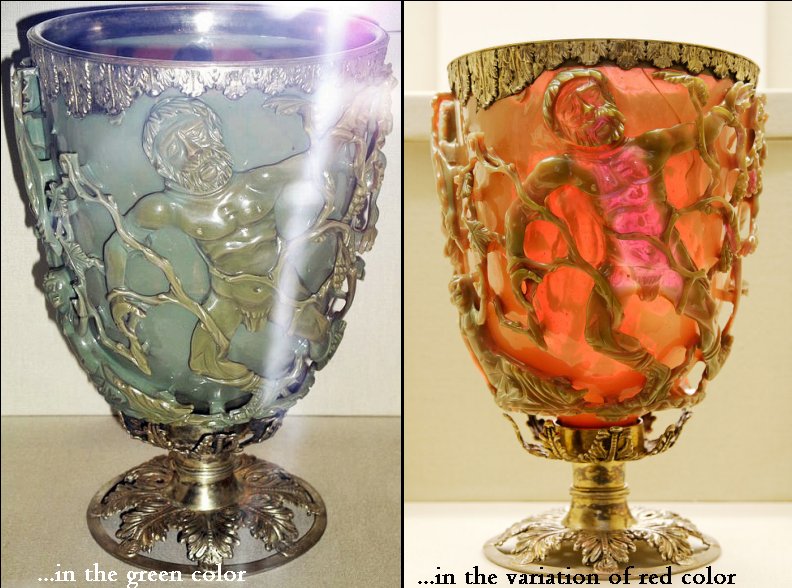
Lycurgus cup, variations of color. Image credit: British Museum
As previously discussed on Ancient Pages, “knowledge about metallic nanoparticles have already been used since ancient times, especially regarding the unusual colors seen in the ancient glass and ceramic objects. It is believed that the use of metallic nanoparticles started with the beginning of glass-making in Egypt and Mesopotamia that dates back in the fourteenth and thirteenth centuries BC.
The most remarkable example of the use of metallic nanoparticles is Lycurgus Cup, a piece of Roman glasswork dating from the fourth century CE, showing a mythological scene depicting the legend of King Lycurgus.”
Modern scientists from the Wageningen University and Research in the Netherlands, have now taken advantage of our ancestors’ knowledge about nanotechnology and produced a fantastic 3D-printed cup that changes color. The cup is dichroic, which means it reflects color depending on the light conditions. It can be either purple or brown.
Humans have always been fascinated by colors. The color blue, for example have captivated ancient civilizations. The Egyptian blue, the world’s oldest artificial pigment has extraordinary properties and will enable us not only to reconstruct the past, but also possibly to shape the technological future. Not long ago scientists announced they discovered ancient Egyptian blue powder makes fingerprints glow and will be used by crime scene investigators.
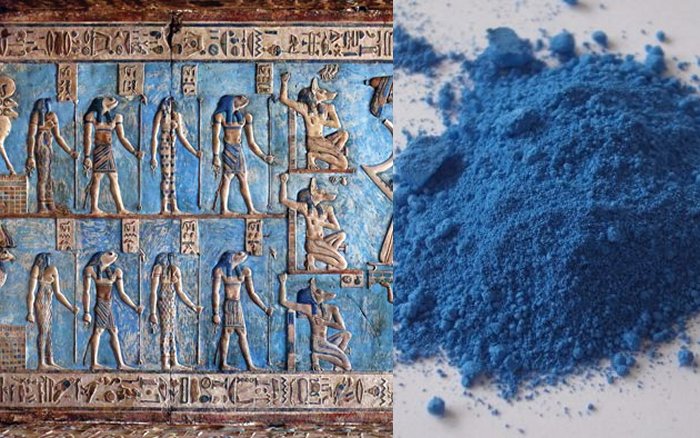
The Egyptian blue is world's oldest artificial pigment. Read more
The Maya were also familiar with artificial pigments. The Maya Blue has been a scientific puzzle mainly due to its unusual chemical composition. Maya blue is an extremely resistant artificial pigment. Despite time and the harsh weathering conditions, paintings colored by Maya blue have not faded over time.
See also:
Flexible Glass – Lost Ancient Roman Invention Because Glassmaker Was Beheaded By Emperor Tiberius
Hypocaust – First Central Heating Invented By Ancient Romans 2,000 Years Ago
There are many examples showing ancient people used colors in a variety of ways. The use of colors depended on the time period. Prehistoric painters decorated the caves’ walls using earth pigment. Later, ancient people discovered that color that came from iron oxide deposits in the earth would not fade with the changing environment. Our ancestors experimented with colors and more sophisticated technology soon emerged.
As Vittorio Saggiomo and his colleagues explain, “copper nanoparticles, for example, have been found in red glass from the late Bronze Age, 1200–1000 BCE. The use of nanoparticles as a colorant boomed around the 4th century CE within the Roman empire, where craftsmen, unaware of the existence of surface plasmon resonance, used metallic nanoparticles for coloring mosaic tiles, pottery and glass.”
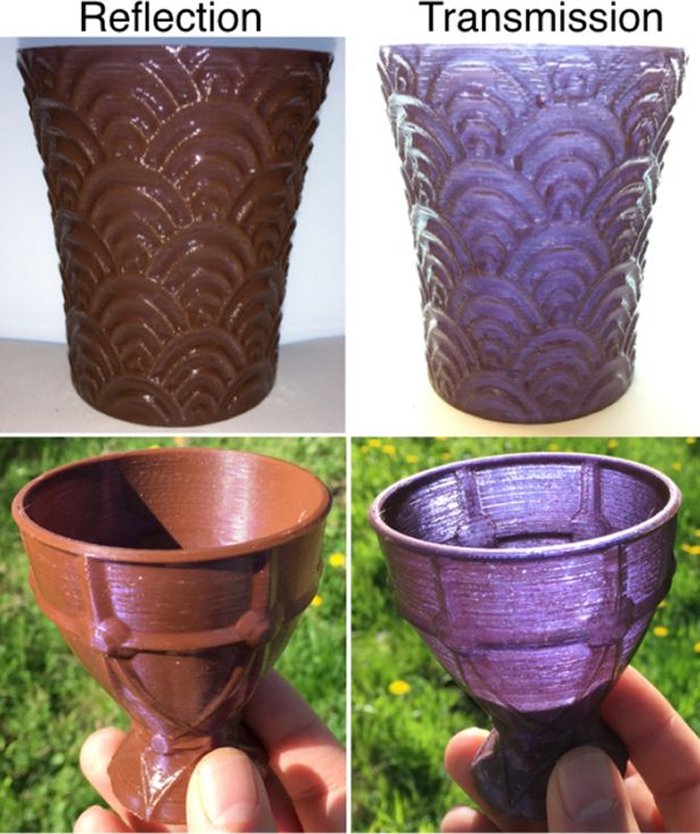
This color-shifting 3-D printable cup was inspired by the ancient Lycurgus cup. Credit: Vittorio Saggiomo
To create this color-shifting cup, Saggiomo and his team used gold nanoparticles and a 3D-printable clear plastic. The nanoparticles were mixed citrate, a weak organic acid that occurs naturally in citrus fruits. After a while, the plastic dissolved in the liquid. When it had dried out, researchers produced the 3-D printed shape.
Scientists understood the cup couldn’t be used for drinking water as it will dissolve after a few minutes. To fix this, they “coated the 3D-printed cup with a layer of polydimethylsiloxane (PDMS), a flexible, nontoxic and food-safe transparent elastomer”. The end results were astonishing. The cup was now able to withstand water without any leakage, but of course it isn’t really practical for drinking. Producing such a cup isn’t expensive. Plastic and 3-D printing machine are available to most, and the cup’s gold atoms is only 0.07 per cent.
Researchers explain this technology “can be used not only by artists, but also for studying the optical properties of nanoparticles or, for example, for the 3D fabrication of optical filters.”
Written by Conny Waters – AncientPages.com Staff Writer
Copyright © AncientPages.com All rights reserved. This material may not be published, broadcast, rewritten or redistributed in whole or part without the express written permission of AncientPages.com
Expand for referencesKool, L.; Bunschoten, A.; Velders, A. H.; Saggiomo, V. Beilstein J. Nanotechnol. 2019, 10, 442–447. doi:10.3762/bjnano.10.43
More From Ancient Pages
-
 Windover Pond – Remarkable 8,000-Year-Old Underwater Cemetery In North America
-
 House Of Dragons – Stories And British History That Inspired The Beasts Of Westeros
-
 Incredible Roman Necropolis With Dressed Skeletons Buried In Ornate Tombs Discovered Close To The Ancient City Of Tarquinia
-
 Beware Of The Night Marchers – Deadly Ghosts Of Warriors Who Kill With Just One Look
-
 Scottish Settler’s Ominous Encounter With A Mysterious Being In West Virginia
-
 Ancient Maya Built Sophisticated Water Filters To Obtain Drinking Water
-
 2,500-Year-Old Tibetan Medical Text Describes A Coronavirus-Like Outbreak In Surprisingly Accurate Details
-
 Whose Ancient Burials Are Hidden Inside The Vatican City’s Walls?
-
 Enigmatic Ancient ‘Unknown Kushan Script’ Deciphered By Scientists
-
 Glima – Ancient Martial Art Practiced By The Vikings Is Still Popular Today
-
 Ancient Treasure Hidden In Perplexing Secret Underground Labyrinth In France – Dangerous Search – Part 1
-
 Major Discovery Of A Complete Ancient Roman City In Luxor, Egypt
-
 On This Day In History: Myth Says Ancient Rome Was Founded By Romulus – On Apr 21, 753 BC
-
 Burial Chambers In The Pyramids Of Tombos Change Our Understanding Of Ancient Egyptian Civilization
-
 Secrets Of Mona’s Caves: Rock Art Reveals Ancient People Were Ahead Of Their Time Long Before The Arrival Of Columbus
-
 Clovis Burial At Anzick Site And New Questions About Early Inhabitants Of North America
-
 Hot-Tempered Shield Maiden Freydis Eiriksdottir’s Unusual Adventures In Vinland And Greenland – Trouble Followed in Her Footsteps
-
 7,000-Year-Old Unique Artifacts Discovered Under Melting Ice In Canada
-
 1.5-Million-Year-Old Hominin Fossil Reveals Missing Link In Human Evolution
-
 Scientists Use Ancient DNA To Explore Early European Adaptation

