
Geri And Freki: Two Wolves ‘Greedy’ And ‘Ravenous’ Were Loyal Companions Of Odin In Norse Beliefs
A. Sutherland - AncientPages.com - In Norse mythology, we often encounter Odin sitting on his high seat, Hlidskjalf, a position that allows him to see into all realms.
Odin had two loyal wolves at his feet, Geri ('greedy') and Freki ('ravenous'). These two animals keep him company, guarding the border against the giants, who were sworn enemies of men and the Aesir gods.
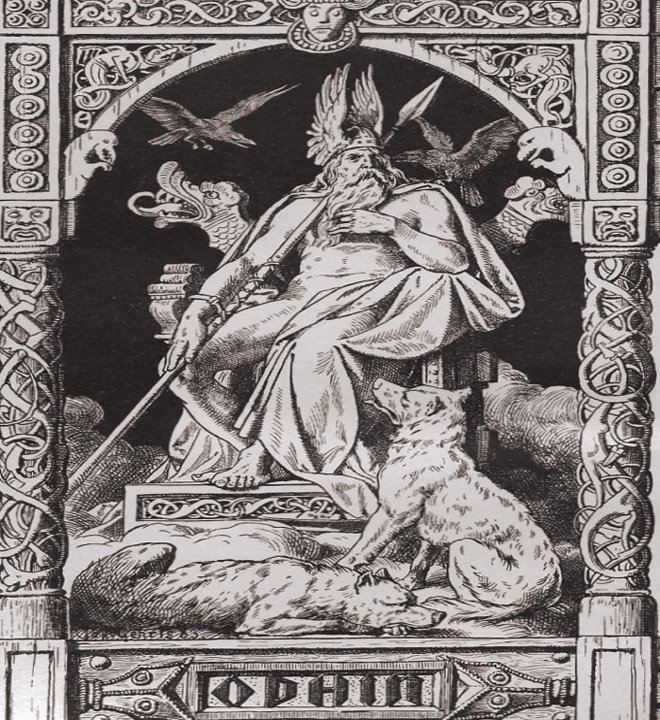
Odin, his two ravens (Huginn and Muninn), and his two wolves (Geri and Freki). Scan from the book "Walhall" by Felix und Therese Dahn, 1888. Image via Wikipedia
The wolves Geri and Freki attended Odin at his high throne and also at Valhalla, the residence of Odin, which was the most beautiful of all the Asgard's palaces and dwellings of the gods.
While one of the wolves slept, the other was awake and watched; therefore, it was impossible to surprise their master and the most powerful of the Aesir.
Geri and Freki were the god's personal guardians.
Odin also owns Sleipnir (or Sleipner), an amazing, eight-legged horse of supernatural strength that could Odin through the sky, over lands, and seas. His other two companions were the two ravens - Huginn ('thought') and Muninn ('memory').
Perched one on each god's shoulders, these two amazing magic birds travel long distances across the universe every morning and gather all important events, news, and even gossip. Then they return at supper to report all they had seen and heard.
Geri And Freki Attested In Snorri's 'Prose Edda'
From the 13th century Prose Edda book, "Gylfaginning" we learn that Odin fed his wolves, Geri and Freki, with hunks of the best meat. He did not need to eat, and wine alone was enough for his own needs.
In Norse mythology, wolves were both friends and enemies of the gods. As mentioned earlier, the two wolves were companions of Odin, but it does not mean they were friends of others in Asgard, the home of the gods.

The god Odin enthroned and flanked by the wolves Geri and Freki and the ravens Huginn and Muninn as illustrated (1882) by Carl Emil Doepler. Credit: Public Domain
Geri and Freki wandered throughout the great hall, walking among the souls of human warriors. Generally, a gray wolf seen on the battlefield was a positive sign to warriors because they believed the animal would guide their spirits to Valhalla if they died in the battle. Therefore, humans in battle considered Geri and Freki to be signs of Odin's presence.
In Norse mythology, the wolves of Odin were not only his 'home pets'. They were courageous and loyal and joined their divine master in battles.
Ancient Norse people believed the wolves were creatures who assisted the Valkyries in transporting the fallen warriors to Valhalla and the slain's afterlife hall.
Updated on June 7, 2022
Written by – A. Sutherland - AncientPages.com Senior Staff Writer
Copyright © AncientPages.com All rights reserved. This material may not be published, broadcast, rewritten or redistributed in whole or part without the express written permission of AncientPages.com
More From Ancient Pages
-
 Rare Bulla (Seal) And 2,600-Year-Old Stamp With Biblical Name Unearthed In City Of David
-
 Disappearance Of Neanderthals: Were Inbreeding And Demographic Shifts Responsible?
-
 Tomb Of Pharaoh Ramesses II Treasurer Ptah-M-Wia Discovered In Saqqara
-
 Ancient Giants In Ecuador Were Killed By Fire From The Sky – Indian Legends Reveal
-
 Location of Roman Ballista Machines During The Siege Of Jerusalem – Uncovered
-
 Butterfly: Powerful Ancient Symbol Of Beauty, Transformation, Hope, Rebirth And Happiness Featured In Myths And Legends
-
 On This Day In History: The Great Fire Of London – On July 10, 1212
-
 First Genomic Evidence Of Early Migration From New Guinea Into The Wallacea Archipelago – New Study
-
 Extraordinary Find: The Oldest Neanderthal DNA Of Central-Eastern Europe
-
 What Is The Giant Neolithic Circular Structure Near Durrington Walls Henge?
-
 New Huge Viking Ship Discovered By Radar In Øye, Norway – What Is Hidden Beneath The Ground?
-
 3,000-Year-Old Stela Challenges Assumptions Of Gender And Social Roles In Prehistoric Times
-
 Gigantic Viking Age Burial Ground With Artifacts And 50-Meter-Long Shipwreck Unearthed In Tvååker, Halland, Sweden
-
 Unearthing Vadnagar And The Search For Hueng Tsang’s 10 Monasteries
-
 Ancient Hand Grenades: Explosive Weapons In Medieval Jerusalem During Crusades
-
 Unique Ancient Makeup Mixture Based On Black Powder Discovered In The Kani Koter Cemetery
-
 8,600-Year-Old Bone Needles Found In Denizli Closely Associated With Old Textile Tradition
-
 Immortal Mimi Spirits In Beliefs Of Aborigines Of Arnhem Land
-
 Real Giant Kojomkul Who Became A Folk Hero In Kyrgyzstan
-
 1.5 Million-Year-Old Human Vertebra Discovered In Israel’s Jordan Valley Sheds New Light On Migration From Africa To Eurasia

