
Ancient Village Of Monsanto, Miraculously Balanced Giant Boulders And Knights Templar Connection
A. Sutherland - AncientPages.com - Monsanto is a very ancient and remote village made of stone. Here, most of the homes are built into the rocks! The whole place is truly astonishing.
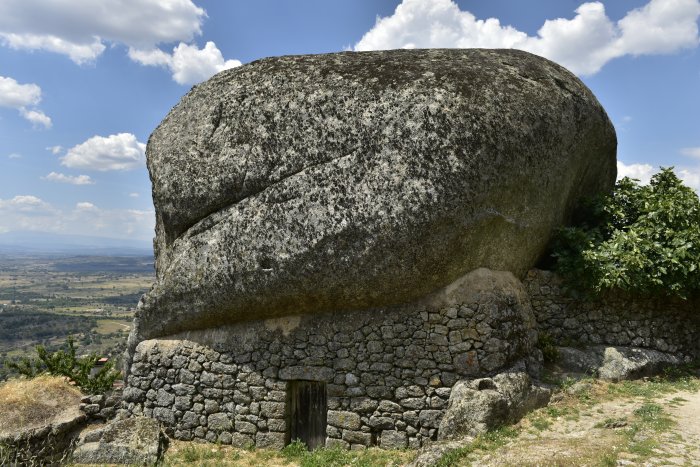
Monsanto Village. Credit: Adobe Stock - LaureanoJesus
Monsanto is located southeast of Serra da Estrela, the highest mountain range in mainland Portugal. The region has a rich history. People lived there in the Paleolithic Era, and archaeologists have found evidence of Roman, Visigoth, and Arabian occupations.
A Lusitanian fortress in the area was conquered and improved by the Roman Army, and it was then occupied by the Visigoths, the Alans, and others during the 8th century.
Finally, the place was conquered by the Christian Army of the first king of Portugal, Afonso Henriques, also known as Afonso the Conqueror.
The Lusitanian fortress was entrusted to Gualdim Païs, Master of the Templar Order in Portugal, who rebuilt it to protect the new kingdom's southern border. He finished the works in 1171, that is to say, two years after building the fortress of Tomar.
Tomar was originally a 12th-century Templar stronghold, but when the order was dissolved in the 14th century, the Portuguese branch became the Knights of the Order of Christ.

Left: 19th-century depiction of King Afonso I Henriques of Portugal, on the ceiling of the Kings' Room, Quinta da Regaleira, Sintra, Portugal. Image credit: via Wikipedia; Right: Dom Gualdim Pais (1118 – 13 October 1195), a Portuguese crusader, Knight Templar. Image credit: Jornal de Sintra
King Afonso Henriques conquered Monsanto from the Moors, and in 1165, the city was given military orders to maintain the reconquered city with Christian hands.
King Alfonso granted it to the Templar monks, who built the Castle under the orders of Gualdim Pais, Grand Master of the Order of Knights Templar.
King Sancho I (1190) and King Afonso III (1217) confirmed the Charter. King Sancho I of Portugal reconstructed and repopulated the fortress because it was severely damaged during the wars with the king of Leonese, an independent kingdom founded in AD 910 and situated in the northwest region of the Iberian Peninsula.
In 1308, King Dinis granted it a Charter, which allowed a fair to occur near the Chapel of São Pedro de Vir-a-Corça. King Manuel I granted it a New Charter in 1510, giving it the right to be a 'town.'
However, Monsanto and its inhabitants could not contemplate a quiet life.
In the middle of the 17th century, Luis de Haro, Minister for Filipe IV, tried to siege Monsanto, but his attempts were unsuccessful.
Later, at the beginning of the 18th century, the Duke of Berwick also laid siege to Monsanto. Still, the Portuguese Army, commanded by the Marquis of Minas, defeated the invader on the slopes of the hill. In 1758, Monsanto was a municipality, having kept this privilege until 1853.
Unfortunately, the impressive medieval Castle of Monsanto was destroyed in the nineteenth century because of an accidental explosion in the ammunition depot of the Castle.
In 1938, Monsanto bestowed the "most Portuguese Village of Portugal." It might seem a little odd because most villages in Portugal don't have houses squeezed between gigantic boulders.
The ancient population carved dozens of narrow streets and passageways right through the center of the boulders. The passages lead the residents upwards and downwards over the rocks and through the village.
One can easily say that this unique village is frozen in time. Its appearance hasn't changed in centuries.
Written by – A. Sutherland - AncientPages.com Senior Staff Writer
Updated on May 29, 2024
Copyright © AncientPages.com All rights reserved. This material may not be published, broadcast, rewritten or redistributed in whole or part without the express written permission of AncientPages.com
Expand for referencesMore From Ancient Pages
-
 Spir Mountain Cairns: Prehistoric Ancient Monuments To The Dead In Northern Sweden
-
 Denisovan Genetic Heritage Could Affect The Mental Health Of European And Asian Populations
-
 Did The Dogon Tribe Have Knowledge Of Theoretical Physics 5,000 Years Ago?
-
 Freemasons Secrets – American Democracy Is Part Of An Ancient Universal Plan – Egyptian Temple And Legendary Expedition Hold The Clues – Part 2
-
 Mada’in Saleh: Spectacular Rock-Cut Tombs And Monuments Reflect Great Skills Of Nabataean Builders
-
 A Seal Impression Dated To Persian Period Discovered In The City Of David
-
 Naqsh-e Rostam: Spectacular Tomb Complex With Rock Reliefs From Elamite To Sasanian Times
-
 Secret Ancient Knowledge Of The Toltecs Examined
-
 The Hidden Face Of The Elusive Master
-
 Unknown Purpose Of The Mysterious Huge Iron Age Ceramic Sharjah Jar Puzzles Scientists
-
 Can You Solve The Mystery Of The Nessglyph? Archaeologists Ask
-
 Rare 17th Century Wreck Of Dutch Fluit Ship Found In The Baltic Sea By Finnish Divers
-
 Kültepe: Once Part Of The Kingdom Of Hittites And The Center of a complex network of Assyrian trade colonies in the 2nd millennium B.C.
-
 Griffins Were Mythical Gold-Guarding Hybrid Creatures Known For At Least 5,000 Years
-
 41,500-Year-Old Ivory Pendant Is The Oldest Evidence Of Humans Decorating Jewelery In Eurasia
-
 Yali – Divine Protector And Guardian Of Temples Warding Off Evil Forces In Hindu Mythology
-
 Neanderthal Hunting Camp Discovered In The Center Of The Iberian Peninsula
-
 Perperikon – Ancient Secrets Of Bulgaria’s ‘Machu Picchu’ And Europe’s Largest Megalithic Sanctuary
-
 Historic Shipwreck Mentor Reveals Its Underwater Secrets
-
 A 1.3 kg Heavy Bronze Sword Unearthed On Funen Island, Denmark

