
Cernunnos ‘Horned One’ – Powerful Continental God Preserved In Celtic Beliefs As Master Of Animals
A. Sutherland - AncientPages.com - Cernunnos is one of the greatest and most ancient Celtic gods. He is the Lord of the Animals, the “Horned One.”
The 'cer' part of his name, relating to his antlers, means ‘horned.’

Cernunnos, Celtic horned god. Image credit: Wikipedia
His name, depictions, and cult are widely attested in ancient Romano-Celtic worship sites. Cernunnos’ significant role as a hunter and animal god is preserved in Celtic folklore under different names and representations. In British mythology, Cernunnos resembles Herne the Hunter, the horned God and Lord of the forest.
The worship of Cernunnos is believed to go back to the fourth century BC.
Only his depictions exist, but there are no myths of this great, mighty, though somewhat mysterious deity.
The name “Cernunnos” (“the horned one”) is only known from a single inscription found in Paris, France. This deity probably had several names; therefore, the inscription remains controversial.
Appearance Of Antlered God Cernunnos
The most common depiction of Cernunnos shows him with the horns; however, these horns are not related to domesticated animals but rather to a stag, suggesting the god’s strong connection with the powers of the wildwood and its mighty animals. In Norse beliefs, the branching antlers of a stag are associated with the Tree of Life, Yggdrasil, and the animal lives among the ash branches and eats its leaves. The stag was also held sacred by the Greek goddess Artemis.
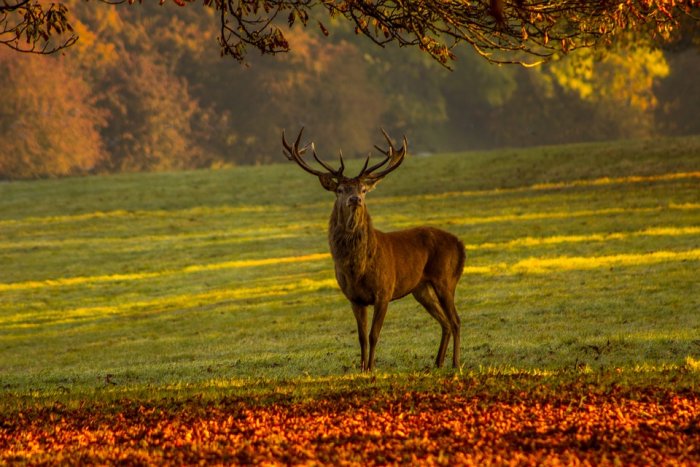
The stag has been held sacred by many ancient civilizations. Image credit: Public Domain
Frequently depicted with one or more ram-headed serpents, Cernunnos bears a torch about his neck, a symbol of high status and holiness.
A well-known depiction of Cernunnos is that found on the silver votive Gundestrup Cauldron dated to the second century AD. His sitting cross-legged posture recalls that of the Buddha. The very frequent conventional pose has many statues of seated Hindu deities.

Cernunnos on the Pillar of the Boatmen, from the Musée national du Moyen Âge (Museum of the Middle Ages), in Paris, France. Image via Wikipedia
His images have been found in carved statues and reliefs dated to ancient Gaul (today modern France). As domesticated and wild animals always accompany him, Cernunnos is often called the Master of Animals.
Cernunnos is also known as the continental Celtic god of wilderness and is considered the spirit of the sacrificed stag-god, a nature deity to whom sacrifices were dedicated to preserving the cycles of nature and the wilderness creatures with the god’s holy blood.
Ancient Horn Dance That Has Survived Until Now
In "Celtic Mythology and Folklore," Patricia Monaghan mentions Abbots Bromley, a British folkloric site. It is a place of old worship of the horned god Cernunnos.
Abbots Bromley is located where the Celtic tribe called “horned ones” (the Curnovii) once lived. The old tradition is still alive in the village, and early each September, men decorated with antlers are “hunted” through the town streets, and finally, the "Horn Dance" is performed.
Cernunnos Was Not Particularly Liked By Christianity
Cernunnos’ appearance inspired Christian iconography of the devil, with his horns and partly animal body. Cernunnos is often depicted with goat’s legs.
He ruled the active forces of life and death, giving and taking in nature. In Romano-Celtic culture, he was associated with wealth and prosperity due to his role as Guardian of the Gateway to the Underworld, where all potential forces and events originated.
Updated on August 30, 2024
Written by – A. Sutherland - AncientPages.com Senior Staff Writer
Copyright © AncientPages.com All rights reserved. This material may not be published, broadcast, rewritten or redistributed in whole or part without the express written permission of AncientPages.com
Expand for referencesMore From Ancient Pages
-
 Rare Pre-Columbian Archaic Settlement Discovered In The Dominican Republic May Solve A Caribbean Mystery
-
 Exceptional Collection Of Well-Preserved Stucco Masks Of The Mayan Kingdom Reveal Their Secrets
-
 Carian Princess’ Tomb, Golden Artifacts – Now On Display In Renovated Hall Of Bodrum Castle
-
 Huge Pre-Viking Longhouse Discovered At Sem In Norway May Confirm A Scandinavian Myth – A King’s Home?
-
 Incredible Shipwreck With Fascinating Cargo Found 1,200 Years After Sinking In Holy Land
-
 World’s First Diva Was Livia – Wife Of Emperor Augustus
-
 Cyrus The Great: Founder Of Achaemenid Empire Who Conquered Medians, Lydians And Babylonians
-
 Codex Gigas – The Devil’s Bible – Ancient Secrets Of The World’s Largest Book
-
 ‘Impossible’ Ancient Traces Of Humans – No, We Are Not The First
-
 Tomography And Radiocarbon Dating Used To Examine Australian Aboriginal Knife
-
 12,000-Year-Old Human Face Depicted On The T-Shaped Pillar – Discovery At Karahantepe, Turkiye
-
 Baffling Sanxingdui Civilization: Why Did These People Have Fascination For Eyes?
-
 Pyrgi Gold Tablets: A Rare Ancient Bilingual Treasure
-
 Garamantes: 3,000-Year-Old Sophisticated North African Society Built 3,000-Mile Network Of Underground Irrigation Canals
-
 Arsinoe II Rose To Power Through Manipulations, Murder, Conspiracies And Became Worshiped As A Goddess
-
 Isaac Newton Believed Egyptian Pyramids Held Key To The Apocalypse – Unpublished Manuscripts Reveal
-
 Ancient DNA Reveals Some Northern Europeans Came From Siberia
-
 How Neanderthal Language Differed From Modern Human – They Probably Didn’t Use Metaphors
-
 Memory Of Palmyra’s Ancient Ruins Preserved Thanks To One Man’s Dedication And Mini Models Of Lost Temples
-
 Mysterious Bones May Re-Write History Of North America – Humans Were Present On The Continent 10 Times Earlier

