
Secret Catacombs With Incredible Ancient Skeletons Covered In Priceless Jewelry
A. Sutherland - AncientPages.com - These ancient skeletons are said to be remains of Catholic martyrs dug up from Roman catacombs.
The bodies are covered in priceless ancient treasure and they are a truly gruesome sight.
The bodies were discovered by art historian Paul Koudounaris who hunted them down in secret Catholic vaults in Rome and churches across Europe.
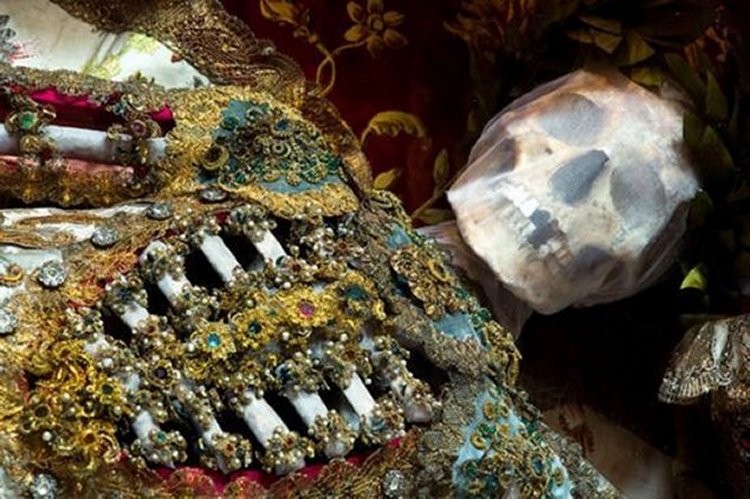
The bodies were discovered by art historian Paul Koudounaris who hunted them down in secret Catholic vaults in Rome and churches across Europe. Image: Paul Koudounaris
Incredibly, some of the skeletons, said to be the remains of early Christian martyrs, were even found hidden away in lock-ups and containers.
In his book, Heavenly Bodies: Cult Treasures and Spectacular Saints from the Catacombs, Paul Koudounaris offers an intriguing visual history of the veneration in European churches and monasteries of bejeweled and decorated skeletons.
"Death has never looked so beautiful. The fully articulated skeleton of a female saint, dressed in an intricate costume of silk brocade and gold lace, withered fingers glittering with colorful rubies, emeralds, and pearls-this is only one of the specially photographed relics featured in 'Heavenly Bodies'.
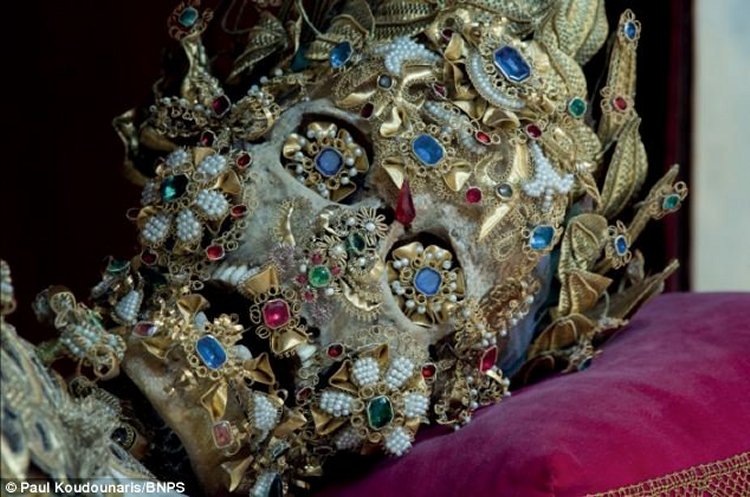
St Benedictus: Thousands of skeletons were dug up from Roman catacombs in the 16th century and installed in towns around Germany, Austria and Switzerland on the orders of the Vatican
In 1578 news came of the discovery in Rome of a labyrinth of underground tombs, which were thought to hold the remains of thousands of early Christian martyrs.
Skeletons of these supposed saints were subsequently sent to Catholic churches and religious houses in German-speaking Europe to replace holy relics that had been destroyed in the wake of the Protestant Reformation.
The skeletons, known as "the catacomb saints," were carefully reassembled, richly dressed in beautiful and fantastic costumes, wigs, crowns, jewels, and armor, and posed in elaborate displays inside churches and shrines as reminders to the faithful of the heavenly treasures that awaited them after death. Read more.
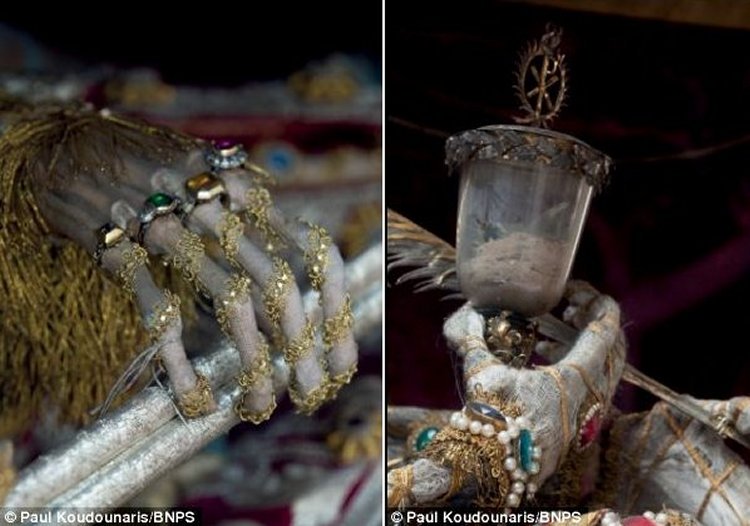
Long dead: The hand of St Valentin in Bad Schussenreid, Germany (left) and St Munditia, in the church of St Peter in Munich (right).
Paul Koudounaris gained unprecedented access to religious institutions to reveal these fascinating historical artifacts. He believes that it's impossible to put a modern-day value on the skeletons.
Hidden for over a century as Western attitudes toward both the worship of holy relics and death itself changed, some of these ornamented skeletons appear in publication here for the first time."
"After they were found in the Roman catacombs the Vatican authorities would sign certificates identifying them as martyrs then they put the bones in boxes and sent them northwards.
The skeletons would then be dressed and decorated in jewels, gold and silver, mostly by nuns.

St Benedictus: Thousands of skeletons were dug up from Roman catacombs in the 16th century and installed in towns around Germany, Austria and Switzerland on the orders of the Vatican
They had to be handled by those who had taken a sacred vow to the church - these were believed to be martyrs and they couldn't have just anyone handling them. They were symbols of the faith triamphant and were made saints in the municipalities.
One of the reasons they were so important was not for their spiritual merit, which was pretty dubious, but for their social importance.
They were thought to be miraculous and really solidified people's bond with a town. This reaffirmed the prestige of the town itself.
Written by – A. Sutherland - AncientPages.com Senior Staff Writer
Copyright © AncientPages.com All rights reserved. This material may not be published, broadcast, rewritten or redistributed in whole or part without the express written permission of AncientPages.com
Expand for referencesReferences:
P. Koudounaris, Heavenly Bodies: Cult Treasures and Spectacular Saints from the Catacombs
More From Ancient Pages
-
 On This Day In History: Germany Invades Poland – On Sep 1, 1939
-
 Enigmatic Green Lady In British Folklore
-
 Vikramashila: India’s Main Intellectual And Learning Center Of Tantric Buddhism
-
 Giant Circular Roman Burial Site With No Bones Discovered – Was It A Cenotaph?
-
 Secrets And Lies: Spies Of The Stuart Era Played A Dangerous Game In The Shadows Of An Unstable Europe
-
 Magnificent 2,000-Year-Old Marble Head Of God Dionysus Discovered In Rome
-
 Mansehra Rock Edicts – Last Words Of Emperor Ashoka
-
 Magnificent Hattusa: Capital Of The Hittite Empire
-
 The Hobbit – An Ancient Hominin Species May Still Be Living In The Forests Of Flores Island – Anthropologist Says
-
 Jason And The Argonauts – Hate, Sorcery, Love And Jealousy Reign In This Famous Greek Story
-
 Achaemenid Empire Was The World’s Largest Ancient Empire
-
 The Hittites, Mysterious People Of A Thousand Gods – Collapse Of The Hittite Empire
-
 Dracula: Cruel, Ruthless And Bloodthirsty Ruler But Not A Vampire
-
 Easter Island May Offer Proof Of An Alien Apocalypse
-
 6,000 Years Ago, Europe’s Oldest Cities Relied On Fertilizer And Plant Protein, Isotope – Analysis Shows
-
 8,200-Year-Old Needles Unearthed In Turkey’s Izmir
-
 Traces Of Ancient Maya In Europe? Controversial Theory Examined
-
 Surprising Discovery Of Ancient Silver Coin Depicting Viking King Harald Hardrada In Hungary
-
 Remarkable Man-Made Underwater Structures Could Rewrite History Of Wisconsin
-
 Astronomer Johannes Kepler Saved His Mother From Being Burned As A Witch

