
Famous Philosopher Plato: One The Greatest Thinkers Of All Time And His Concept Of Soul
A. Sutherland - AncientPages.com - The earliest systematic concept of mind and body stems from the philosophy of the Greek philosopher Plato (429-347 BC).
Plato is considered one of the greatest thinkers of all time. He is also one of the world's most widely studied and read philosophers.

Plato - the son of wealthy and influential Athenian parents – is described by historians as a young man who was always present among people surrounding Socrates. We know that Socrates wrote nothing himself; it was Plato who kept recording the theories of his master.
Plato was Socrates' most outstanding student, and his works date to the middle of the fourth century BC in ancient Greece. He wrote in the middle of the fourth century B.C.E. in ancient Greece.
After the death of his teacher, Plato stayed in Athens only for a short time. Then, he took refuge with one of Socrates 'disciples, Euclid, in Megara to avoid the persecution that affected Socrates' disciples in Athens. For the next 12 years, he traveled to Africa, Italy, Egypt, and greater Greece. With Euripides, a tragedian of classical Athens, he travelled to Egypt "to the priests and prophets". He became acquainted with "the methods of divination".
"From the priests and soothsayers of Memphis - according to Guarino Guarini - he leaned of the rising and setting of the stars, of their movements and their various operations, the mysteries of divine Affairs, and the principles.
During his stay in Italy, he came into contact with the Pythagoreans, and Eurytus and Archytus, taught Plato mathematics. He also planned to travel "to the Land of the Indians and to the Magi," i.e. the Zoroastrians in Persia; however, hese plans were thwarted by war. When he returned , he established in Athens the so-called Platonic Academy in 387 BC. His prestigious academy became the first higher learning in the Western world and survived for almost 1000 years.
For twenty years, Aristotle was Plato's student. He learned much from the master. However, he became famous for rejecting Plato's theory of forms. Plato had a strong influence on the great minds of antiquity. He saw the mind as identical to the soul. Unlike Descartes, Plato argued that the soul both pre-existed and survived the body, going through a continual process of reincarnation or "transmigration."
Plato recognized the duality of the world: the world of ideas - inaccessible to the senses and the material world. Plato believed that our most basic knowledge comes when we return to mind our contact with eternal realities during the previous existence of the soul.
According to Plato, the world of ideas is the only real world; everything else is brief and passing. Before birth, the 'soul' is only present in the world of ideas. There, it acquires knowledge of what is good.
Therefore, this great thinker was particularly interested in the human soul. Some people believe that this spiritual part of a person that some people believe continues to exist in some form.
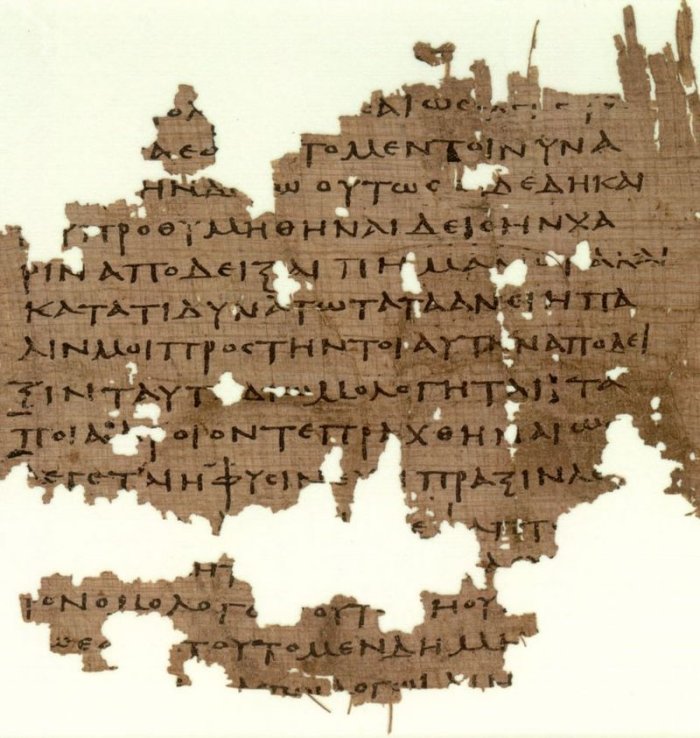
Oxyrhynchus Papyri, with fragment of Plato's Republic. 3rd century - Public Domain
Plato began to ponder the concept of the 'soul' as an ideal, unbreakable factor that lasts beyond death. So, the role of a teacher is not to instruct or/and teach but to help in the extraction of knowledge using question reflection.
The philosophy of Plato, especially the science of the soul and the invisible world of ideas, strongly influenced Christianity.
Plato is also the author of the concept of an ideal state, in which he proposes such a state will be governed by a person who is highly educated, with passion for truth, and has achieved the most incredible wisdom of knowledge of the good. The ruler of this ideal state is called the Philosopher king, a person guided by the ideas of goodness, truth, and beauty.
According to Plato, philosophers stood at the top of the social ladder because they possessed wisdom. Other citizens in the country occupy the position, depending on the achieved perfection. The state should decide on every area of life. His idea of an ideal state, however, was never implemented.
Plato wrote extensively, and most of his writings survived, including the most famous work, the 'Republic,' which includes Plato's philosophy and a major source of information for his teacher, Socrates.
It is not precisely known which of Plato's works are authentic, and due to their antiquity and the manner of their preservation through time, researchers are uncertain in what order his works were written. These are subjects still debated. Nonetheless, Plato's earliest works are regarded as the most reliable of the ancient sources on Socrates.
Socrates' character, we know through these writings, is considered one of the greatest of the ancient philosophers. The works blend ethics, political and moral philosophy, epistemology, and metaphysic. Another essential part of his works is the theory of Forms, in which the world we know through the senses only imitates the pure, eternal, and unchanging world of Forms.
In his works, Plato also writes about the origins of the familiar complaint that the arts work by inflaming the passions and are illusions.
And how about the idea of "Platonic love? According to Plato, love is motivated by a longing for the highest Form of beauty—The Beautiful Itself. Love contributes to the motivational power through which the highest achievements are possible because they distract us from accepting less than our highest potential.
Therefore, Plato mistrusted and generally advised against physical expressions of love.
There have been many suggestions regarding Plato's death. Some suggested Plato died in his bed, whilst a young Thracian girl played the flute to him. Others proposed that Plato died at a wedding feast but according to Tertullian, an early Christian author from Carthage in the Roman province of Africa, Plato simply died in his sleep.
Written by – A. Sutherland AncientPages.com Staff Writer
Updated on May 8, 2024
Copyright © AncientPages.com All rights reserved. This material may not be published, broadcast, rewritten or redistributed in whole or part without the express written permission of AncientPages.com
Expand for referencesMore From Ancient Pages
-
 First 5th Century Mosaic Found Near Cirencester Once The Second-Largest Roman-British Town In England
-
 How On Earth Did The Ancient Egyptians Raise Their Colossal Obelisks?
-
 Large Ancient Roman Necropolis Is Buried Beneath The Gaza Strip – Can It And Other Ancient Treasures Be Saved?
-
 Was The Legendary Tree Of Life Located In The Grove Of Eridu?
-
 Legendary Erlang Shen And His Third Seeing Eye That Could Distinguish Between Truth And Lie
-
 Stunning Images Of Shackleton’s Lost Ship Endurance Discovered Off The Coast Of Antarctica
-
 Sole Survivor Recalls An Incredible Unexplained Mountain Mystery
-
 Bristol Academic Cracks Voynich Code – Century-Old Mystery Solved
-
 Master Kong Confucius: Great Philosopher And ‘Teacher Of All Teachers’ Ahead Of His Time
-
 Castor And Pollux: Dioscuri Brothers Immortalized In The Night Sky In Greek Beliefs
-
 2,700-Year-Old Face Cream For Men Found In Chinese Tomb
-
 Thor: Brave And Mighty Thunder God In Norse Mythology
-
 Unexpected Historical Discovery: Remains Of Famous Sami Woman Recovered
-
 Skaftö Wreck’s Cargo Gives New Answers About 15th Century Trade Routes
-
 Extraordinary Discovery Of 2,000-Year-Old Bronze Statue Rewrites Etruscan-Roman History
-
 When Science, Spirituality and Magic Meet – Re-Discovering Old Ancient Knowledge
-
 How Did St. Nicholas Become Santa Claus? – History, Legend And Tradition
-
 Ancient Medical Machine Ahead Of Its Time Hidden In Emperor’s Temple – Secret Science Knowledge Examined
-
 Evidence Reveals Ancient Saudi Arabia Had A Complex, Thriving Society, Contradicting Notions Of A Struggling Population In Barren Lands
-
 Evidence Scots And Irish Settled Iceland A Century Before The Vikings?

