
AncientPages.com - We're all familiar with the jolly, white-haired and bearded overweight man who sneaks down chimneys on Christmas Eve delivering presents to children. But where did this come from?
With roots in Christianity, the origins of the world's most beloved gift-giver transcend time, culture and religion.

Santa Claus with gifts and a lantern on a city street. Credit: Adobe Stock - Vasilii
St. Nicholas
It all starts with St. Nicholas, a man who lived in the fourth century. No credible historical sources can prove the facts of his life, but according to tradition, St. Nicholas of Myra, later known as St. Nicholas of Bari, lived during the reign of Emperor Constantine the Great.
According to tradition, he was born in Patara, a city in ancient Lycia in Asia Minor, part of what is now Turkey. Nicholas, who would later become the bishop of Myra, was known for his profound Christian faith and extraordinary compassion.
Although historical record does not provide detailed accounts of his life, tradition tells us he traveled to Palestine and Egypt in his youth, further cultivating his deep spiritual conviction.
Nicholas was orphaned when he was young and was left with a substantial inheritance. He chose to use this wealth to help the needy.
His most famous act of generosity was providing dowries for three impoverished sisters.
His acts of generosity meant when he was recognized as a saint, he was acclaimed the patron and protector of children.
St. Nicholas Day
Across Europe, the legacy of St. Nicholas's charity and kindness sparked a variety of traditions, with December 6 becoming his feast day.
In France, particularly in regions such as Alsace and Lorraine, children would leave their shoes out for St. Nicholas, hoping to find them filled with chocolates and gifts the next morning.
This tradition was accompanied by parades in which a donkey would pass through town streets, laden with baskets of biscuits and sweets for the children.
In Central Europe, particularly in Alpine regions, St. Nicholas Day tradition merged gradually with unique local customs when the non-Christian population adopted Christianity as their religion.
Here, St. Nicholas not only rewarded well-behaved children with gifts but was also accompanied by Krampus, a fearsome figure who would "punish" those who had misbehaved.
This tradition underscored the contrasting themes of reward and retribution, integral to the local folklore.
In some regions of Poland, the earlier traditions centered on a figure called Gwiazdor. This "Star Man" dressed in sheepskin and a fur cap, with his face hidden under a mask or smeared with soot, carried a bag of gifts and a rod for naughty children.
The transformation into Santa Claus
The metamorphosis of St. Nicholas into Santa Claus was a gradual process influenced by cultural and religious shifts.
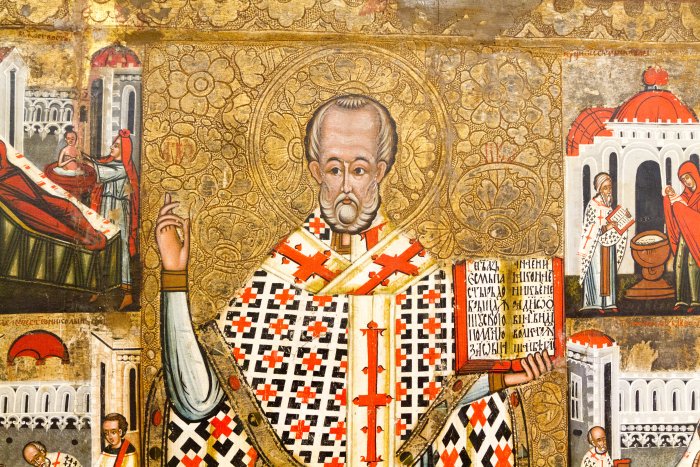
Saint Nicholas of Myra. Credit: Adobe Stock - Adam Ján Figel
In Germany and the Netherlands in the course of the 17th century, the practice of gift-giving in the name of St. Nicholas began to take root. The Dutch called him "Sinterklaas," a term that would eventually evolve into the English colloquial "Santa Claus." This transformation first occurred in Germany and later spread to other European countries.
The tradition of St. Nicholas was brought to North America in the 17th century.
By the 19th century, various iterations of St. Nicholas were emerging in English-speaking communities across the world.
One of the first literary mentions of this figure in the American context was in Washington Irving's 1809 book, Knickerbocker's History of New York, which portrayed Nicholas flying in a wagon, delivering presents to children.
The red Santa suit and all related apparel, so familiar to us today, seem to be the invention of modern-day marketing in the English-speaking world.
Across Europe, St. Nicholas's outfit draws more on the traditional image of the saint, with clothes more closely resembling a bishop's religious attire, complete with a miter, the tall headdress.
The Legacy of St. Nicholas and Santa Claus
Through centuries of transformation, the core values of St. Nicholas—generosity, compassion, and the joy of giving—have remained intact in the figure of Santa Claus. He has gone from being a revered Christian saint to a beloved secular icon.
This evolution reflects the dynamic interplay of religious tradition and popular folklore. English-speaking Santa Claus, with his North Pole workshop, flying reindeer, and elves, may seem a far cry from the historical bishop of Myra. Yet he continues to embody the spirit of giving that characterized St. Nicholas.

The Children’s Friend published in 1821 by William B. Gilley, includes a poem about ‘Santeclaus’ along with eight coloured illustrations. Wikimedia Commons
Today, thanks to global marketing and commercialization, Santa Claus transcends religious and cultural boundaries.
The story of his origin, rooted in the life of St. Nicholas, enriches our understanding of Christmas and connects us to a tradition that spans centuries and continents.
It reminds us that at the heart of these festivities lies a timeless message: the importance of kindness, generosity, and the spirit of giving.
Written by Darius von Guttner Sporzynski, Historian, Australian Catholic University
Provided by The Conversation
This article is republished from The Conversation under a Creative Commons license. Read the original article.





















,_page_1.jpg)