
Kava – Astonishing Ancient Plant That Improves Emotional Intelligence Is Gaining Popularity In The Western World
Conny Waters - AncientPages.com - Kava is an ancient plant that has been used by our ancestors for a very long time. Named after explorer Captain James Cook who encountered the herb on one of his journeys to the Pacific, Kava has been enjoyed long before written history.
Ancient people used the herb to reach a higher level of consciousness and improve their health. In the South Pacific it has been a ritual and celebratory beverage for thousands of years.
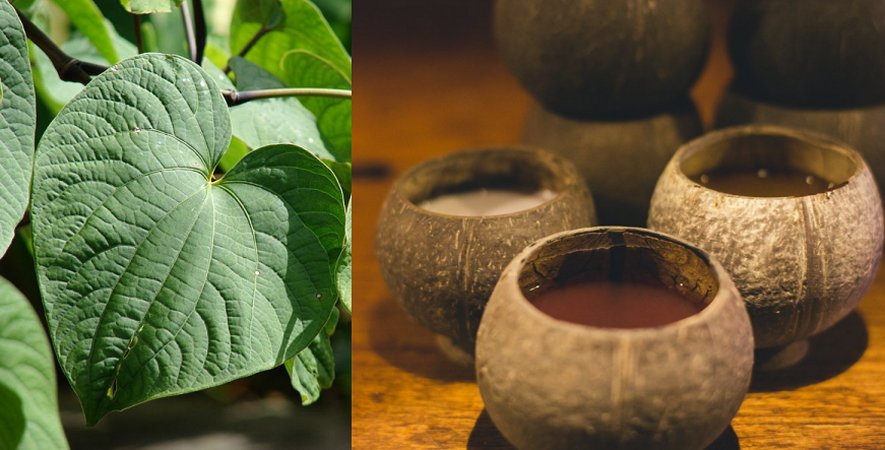
Left: Piper methysticum leaves. Credit: Public Domain - Right: Kava drink. Credit: Chronic Town USA
Modern scientists are now investigating whether the ancient plant is dangerous, but everything seems to indicate Kava is a good herb that eases anxiety, improves mood and concentration, calms the nerves, and on top of everything has an astonishing effect on emotional intelligence.
Peter Salovey and John D. Mayer coined the term ’emotional intelligence’ in 1990 describing it as “a form of social intelligence that involves the ability to monitor one’s own and others’ feelings and emotions, to discriminate among them, and to use this information to guide one’s thinking and action”.
Where Does Kava Come From?
Kava, as a drink is made from a root of a pepper plant called Piper methysticum. The plant is also known by the names Ava, Ava Pepper, Intoxicating Pepper, Kawa Awa, Kawa Kawa, Wati, Yogona, and Waka.

Samoan 'ava ceremony, c. 1900-1930. Credit: University of California Digital Libraries
The origin of the plant has been long debated. Oceanic cultures have an oral rather than written history and finding out where the plant first appeared hasn’t been easy. However, most botanists believe that Kava originated from Vanuatu and was then spread throughout the rest of the Pacific by seafaring islanders.
See also:
Ancient Secrets Of Mistletoe – Sacred Celtic Plant With Magical Powers
Airmid: Irish Goddess Of Healing And Herbs And One Of The Tuatha Dé Danann
The Ebers Papyrus – Most Famous Plant Medicine ‘Encyclopedia’ Of Ancient Egypt
Preserving Ancient Knowledge Of Kava
There is no doubt that Kava was familiar to Oceanic cultures long before Captain Cook discovered this area of the world in the late 1700’s. When Christian missionaries learned about the plant they tried to stop the use of it. Christians argued that Kava’s mind and heart-expanding properties were similar to alcohol. Still, unlike alcohol, Kava is non-addictive, non-inflammatory, and does not affect blood sugar levels. Despite the warnings from Christian missionaries, locals continued to enjoy their Kava and they still do it today. Kava plays a significant role in social gatherings in the South Pacific.

A painting showing women preparing kava. Credit: John LaFarge, Wikipedia
It is consumed at events such as weddings, funerals, naming, and healing ceremonies with the express purpose of bringing people together. Once a group of people drink Kava, it is accepted that they are one.
Kava should not be confused with Ayahuasca, a potent hallucinogenic brew used by Amazonian indigenous groups for centuries. Modern scientists have discovered that Ayahuasca can be used for healing purposes and treatment of eating disorders, but Kava has different benefits.
Whether the plant is good or bad for health is still a subject of debate, but recently there has been a renewed focus on the use of Kava and the herb is gaining popularity in the Western world.
What we should keep in mind is that there could many benefits of ancient herbal medicine that we are still unaware off.
Written by Conny Waters – AncientPages.com Staff Writer
Copyright © AncientPages.com All rights reserved. This material may not be published, broadcast, rewritten or redistributed in whole or part without the express written permission of AncientPages.com
More From Ancient Pages
-
 Unknown Prehistoric Henge Site Detected Near Famous Newgrange In Ireland’s East Coast
-
 Why Did Ancient Romans Destroy The Town Of Fregellae?
-
 Was The Legendary Tree Of Life Located In The Grove Of Eridu?
-
 Mystery Of Viking Ship Burials In Hjarnø, Denmark And Their Unusual Design
-
 Amazing Archaeological Discovery In A Secret Underground Structure In Transylvania Could Rewrite Ancient History
-
 Utukku Lemnutu: Incantations Used As Therapy In Mesopotamia
-
 What Was Pax Deorum And How Important Was It?
-
 Why Has The Leaning Tower Of Pisa Survived Strong Earthquakes Since The Middle Ages?
-
 Large Pre-Columbian Pyramid Discovered Under Highway In Mexico But It Will Not Be Excavated
-
 Ancient Flying Canoes And Magic In The Pacific – Clues In The North – Part 2
-
 Ancient Secrets Of Megaliths And Anti-Gravity Revealed – Examination Of An Unknown Property Of Static Electricity
-
 World’s oldest bible -The Codex Sinaiticus – to be displayed at the British Museum
-
![Horses in the Eurasian steppes: Already 5000 years ago, they served pastoralists as a source of milk and a means of… [more] © A. Senokosov](https://www.ancientpages.com/wp-content/uploads/2021/09/pastoraliststeppe15-307x150.jpg) Milk Enabled Massive Steppe Migration – A New Study
Milk Enabled Massive Steppe Migration – A New Study
-
 Previously Assumed Turkic Origin Of The European Huns – Refuted; They Had Ancient Siberian Roots
-
 Colonnaded Hall Decorated With Captivating Frescoes Unearthed At Pompeii
-
 Tower Of The Winds And Daydreaming Of Andronicus Of Cyrrhus
-
 Large Previously Unknown Roman City Discovered At The Foot Of The Pyrenees
-
 Arimaspians: Mysterious Mighty Warriors With One-Eye
-
 Mesha Stele: One Of The Most Valuable Biblical Artifacts
-
 3,800-Year-Old Two-Headed Toad Figurine With Messages To Future Generations Discovered At Vichama, Peru

