
Ouroboros – Cosmic Serpent And The Self-Devourer – Universal, Powerful Symbol Of Great Antiquity
A. Sutherland - AncientPages.com - Widely known in many religions worldwide from Europe, Asia, and Africa, this mystical, very old symbol means "the end is the beginning." It has the ability to reproduce itself. It mates, impregnates, and destroys itself, and all this happens in the cycle of time.

An ouroboros in a 1478 drawing in an alchemical tract. Anonymous medieval illuminator. Image credit: uploader Carlos adanero - Public Domain
Artifacts in the form of bracelets with this symbol are found in areas occupied by the Slavs beginning with the first European Neolithic cultures. The ancient Greeks considered Ouroboros a serpent or a worm engulfing its tail and forming a circle with the beginning and the end.
The same was also an interpretation of the symbol in other cultures because Ouroboros' means always the same: an eternal cyclic force – both destructive and at the same time, crucial as a part of nature's process of regeneration.
Cosmic cycle - wheel appears half as light and half as darkness; in this form, it is Yang and Yin. Ouroboros means 'life conflict' when life passes and death comes. Still, the end also means the beginning.
It is also a union of opposites, Heaven and Earth working together and consistently in harmony.
Ancient engravings of Ouroboros, dated to the Chou dynasty in China (1200 BC), symbolize the continuity of life with the dragon biting his tail and in a mythical monster called the Midgard serpent—also known as Jormungand, encircled the world, biting its tail.
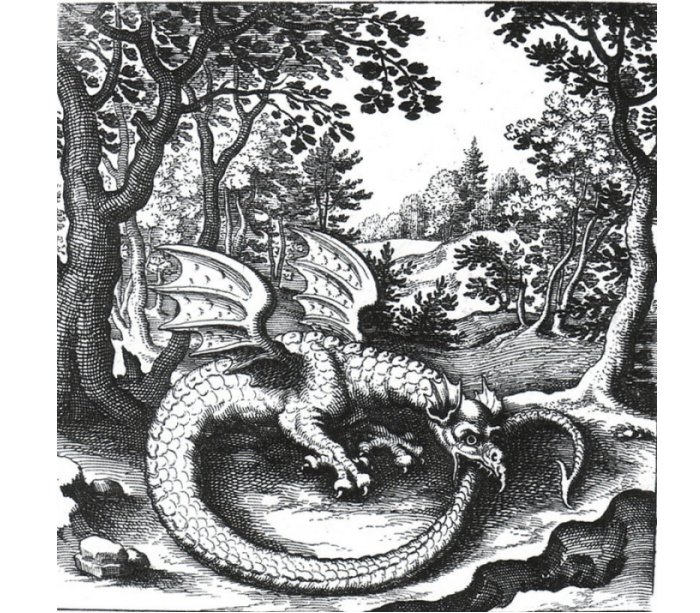
Engraving of a wyvern-type ouroboros by Lucas Jennis, in the 1625 alchemical tract De Lapide Philosophico. The figure serves as a symbol for Mercury. source
The circle is also a symbol of perfection like the halo that is drawn over the heads of the Byzantine images of the saints—believed to be inspired by the Milky Way and described in ancient writings as a luminous serpent (serpent of light) that dwells in high heavens. Ouroboros is associated with Hermetism alchemy. It speaks of purity, wholeness, and infinity. Gnostic belief "passes through all things" as the symbol of the inseparable, the "unchanging law" that applies to all things and connects between them.
Generally, the symbol's meaning remains the same – eternal cyclic force is both destructive and regenerative.
Hermes - the god of alchemy - defines the Ouroboros as: "Serpens cuius caudam devorabit, "a snake that devours its own tail, symbolizes the alchemical Mercury represents the cosmic unity and the circular nature of the work of the alchemist.
Ouroboros, which symbolizes the cyclical nature of the universe and a path to the sun, was already known to ancient Egyptians around 1600 BC. Still, it is likely to be even much older than this.
From there, knowledge about Ouroboros moved to the Phoenicians and to the Greeks and took a distinguished place in myths of Vikings (Norse,) Hindus, tribes of Central America, West Africa, Voodoo beliefs,
The Ouroboros concept appears elsewhere.
Updated on March 7, 2024
Written by – A. Sutherland AncientPages.com Staff Writer
Copyright © AncientPages.com All rights reserved. This material may not be published, broadcast, rewritten or redistributed in whole or part without the express written permission of AncientPages.com
Expand for referencesMore From Ancient Pages
-
 Vikings And The Runic Calendar
-
 Sodré Astrolabe, Found On Portuguese Armada Shipwreck Is The Oldest In The World
-
 Fossils Of Mysterious Homo Naledi Change Our Understanding Of Evolution
-
 Ancient Brewing And Natufian Rituals – What Came First, Beer Or Bread?
-
 Rare Viking Artifacts Hidden Beneath The Ice Discovered By Archaeologists In Norway
-
 Secrets Of Ancient Underwater City Pavlopetri Revealed – Travel Back In Time And See What The City Looked Like!
-
 Ankou: Breton Angel Of Death That Delivers Souls To The Underworld
-
 Bronze Age Burial Site Unearthed By Archaeology Volunteers In Caerau Area Of Cardiff
-
 Ur – One Of The Largest And Most Important Cities Of Ancient Mesopotamia
-
 Ancient Mystery Of The Ladies Of Anavlochos: Bronze Age Art Found On Crete
-
 Mary Boleyn – King Henry VIII’s Other Woman And Sister Of Anne Boleyn
-
 On This Day In History: Battle Of Vincennes, Indiana – On Feb 24-25, 1779
-
 On This Day In History: Battle Of Durnstein Was Fought On The River Danube – On Nov 11, 1805
-
 Why Was Alexander A Great Military Genius?
-
 On This Day In History: Last Inca Emperor Atahualpa Captured By Francisco Pizarro – On Nov 16, 1532
-
 How ‘Listening’ To Archaeological Sites Could Shed Light On The Past
-
 African Kingdom Of Axum – Ancient Ruins Of Early Churches Unearthed
-
 Rare Sphinx Seal Belonging To Roman Emperor Discovered In India Confirms Existence Of Legendary Muziris
-
 Expressive Beautiful And Celebrated Bowls Created By Mimbres Artisans From Distant Past
-
 Mysterious Melchizedek: ‘King Of Righteousness’ And Heavenly High Priest In Bible And Dead Sea Scrolls


