
City Of Sais: Prehistoric Prestigious Cult Center Of Northern Egypt
A. Sutherland - AncientPages.com - Millennia ago, a beautiful Egyptian city existed in the western Egyptian delta along the Rosetta branch of the Nile River. Its name was ‘Sa’, known from its Greek name: ‘Sais’ (Saïs).

History of Sais goes back to Egypt’s pre-dynastic times (prior to 3100 BC) but the only visible ruins are not older than the 11th century. At the ancient site, there is now a village of Sa al-Hagar (‘Sa - means stone’ in Arabic). There are today no surviving traces of this town prior to the Late New Kingdom (c.1100 BC)
 According to Herodotus and some other sources, Sais was a prestigious cult center of northern Egypt about 3100 BC, full of great and luxurious buildings and royal sepulchers.
The city suffered damage at the hands of Cambyses, who four years after ascending the throne, marched against Egypt, where he ruined the tomb of Amasis (also known as Ahmose II, which means "The Moon is Born, Son of Neith").
Amasis was probably the 5th ruler of Egypt during the 26th Dynasty and has been called the last great Egyptian Pharaoh. He ruled 44 years and made many contributions to the country.
He established himself at Sais in Northern Egypt and there – like in many other places in Egypt – he ordered to build huge buildings including his tomb at Sais, which was unfortunately never discovered, but according to Herodotus’ description was beautiful:
‘It is a great cloistered building of stone, decorated with pillars carved in the imitation of palm-trees, and other costly ornaments. Within the cloister is a chamber with double doors, and behind the doors stands the sepulchre…"
In the age of the Ptolemies (B.C. 323 to 30), Sais was an important center.
Ancient Sais was the center of the cult of the goddess of war and hunting, Neith, who was the patron goddess of Sais, a great protector of the people of the land and the most accomplished mediator between humanity and the gods. From the Late Period (1000 BC onwards), the Neith temple was a center of pilgrimage.
See also:
Sobek – Enigmatic Crocodile God Of Ancient Egypt
Who Was King Menes? Mystery Of This Legendary Ruler May Go Back 20,000 Years
Unusual Double Temple Of Kom Ombo Dedicated To Crocodile God Sobek And Falcon-Headed God Horus
However, Sais had several other temples dedicated to the creator god Atum and one dedicated to the Egyptian Lord of the Underworld and Judge of the Dead, Osiris. According to Herodotus, the grave of Osiris was located at Sais and that the sufferings of this god were displayed as a mystery by night on a neighboring lake.
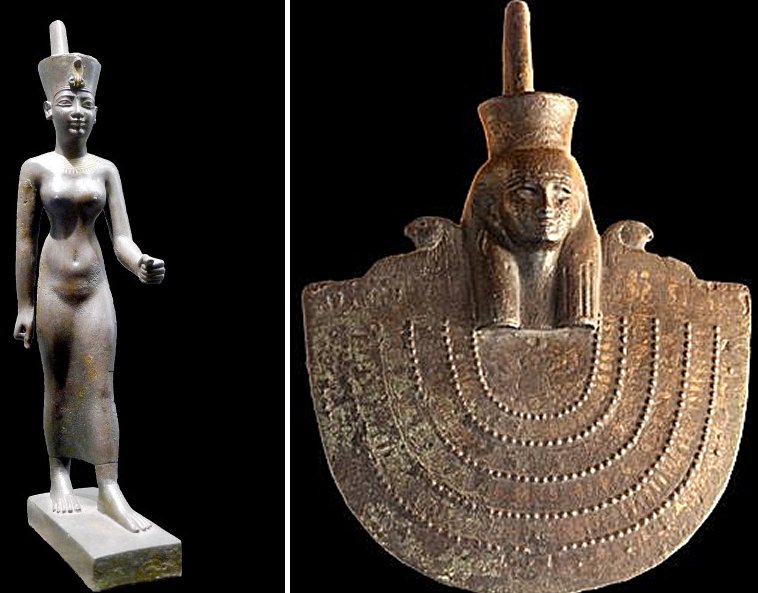
Left: A gilded bronze statuette of the Egyptian goddess of war Neith. 664-332 BCE. (Louvre, Paris); Right: Goddess Neith, the Egyptian goddess of war. Gilded bronze, XXVI Dynasty, c. 664-525 BCE. Museum of Fine Arts, Lyon, France
The Temple of Sais had a medical school associated with it and the medical school at Sais had many female students and apparently women faculty as well, mainly in gynecology and obstetrics.
An inscription from the period survives at Sais, and reads,
"I have come from the school of medicine at Heliopolis, and have studied at the woman's school at Sais, where the divine mothers have taught me how to cure diseases…".

Many kings of Sais were clever men and among them was King Nekau of the Twenty-sixth Dynasty (ruled 15 years) who despatched an expedition that circumnavigated Africa, and he was the king who started the construction of a canal from the Nile to the Red Sea, completed by the Achaemenid king Darius I.
Another ruler of Sais was Psamtek (Psammetichus III) son of Amasis, who was considered Persia's constant enemy. The Persians invaded Egypt in 525 BC just after Psamtek III became king.
The Sais’ fate is not exactly known but it is known by the Persian king Cambyses destroyed much on his way including several temples at Sais.
Written by A. Sutherland - AncientPages.com Staff Writer
Copyright © AncientPages.com All rights reserved. This material may not be published, broadcast, rewritten or redistributed in whole or part without the express written permission of AncientPages.com
Expand for referencesMore From Ancient Pages
-
 Yokai Amabie – Protective Ancient Spirit That Can Ward Off Epidemics
-
 Rio Tinto Bosses Quit Over Destruction Of One Of The Earliest Aboriginal Sites
-
 Mystery Of Ancient Metal Clamps – Advanced Lost Technology Modern Science Still Cannot Explain
-
 Dragon Empress Wu Zetian Challenged Confucian Beliefs Against Female Rulers
-
 Secrets Of A Lake That Could Re-Write Ancient History Of America – Myths And Gods Reveal A Complex Story – Part 1
-
 Scientists Reconstruct The Climate Of The Ancient World Using Small Wooden Artifacts And Mummies
-
 Treasure Trove Of Assyrian Kings Found In Tunnels Excavated And Plundered By Terrorists
-
 Evidence Of Early Metalworking In Arctic Canada – European Technologies Involved
-
 Unexplained Old Cases Of People Who Saw The Past And The Future – Time Travel Mysteries
-
 Socrates: Great Philosopher And Brave Man Who Still Inspires Many People
-
 Gashadokuro: A Terrifying Nocturnal Ghost Yokai With Voracious Appetite For Human Blood
-
 Unusual Neolithic Burial From Grotta Di Pietra Sant’ Angelo Puzzles Archaeologists
-
 Abric Romaní Cave: New evidence indicates Neanderthals used to heat water some 60,000 years ago
-
 Rare Bes Mugs Reveal Ancient Egyptians Drank Hallucinogenic Cocktails During Rituals
-
 New Study: Fossils Reveal Human Ancestors’ Hearing Abilities
-
 Smuggled 1,800-Year-Old Lydian Atonement Inscription Sent Back To Turkey By Italy
-
 Karakorum – Genghis Khan’s Headquarters And Important City In History Of Silk Road
-
 Hird – Viking Warriors And Professional Body Guards Prepared To Die For Their Leader
-
 Giant Pre-Hispanic Jar Used To Make Mexican Traditional Corn Beer
-
 Medieval Mythbusting – New Research Rewrites History Of Glastonbury Abbey

