
Pasargadae: Capital Of Achaemenid Empire Destroyed By Alexander The Great
A. Sutherland - AncientPages.com - Today, Pasargadae are ruins of an ancient city in southwestern Iran, in the village of Mashhad-e Murghab, in the Zagros mountains, at an altitude of 1900 m, northeast of the city of Shiraz.
The fourth king of Anshan and the first king of the Achaemenid Empire, Cyrus II (d. 530 BC), also known as Cyrus the Great ordered the construction of Pasargadae during 559-530 BC, and in this city was located Cyrus’ tomb.

The city was the first capital of the Achaemenid Empire - one of the largest empires in history that covered approximately 5.5 million square kilometers and extended from the Balkans and Eastern Europe to the Hindus River in India.
In addition, this great empire was considered the first known for its cultural diversity of its people.
However, it lost its importance at the end of the sixth century in favor of Persepolis; 330 BC captured and plundered by Alexander III the Great. Some preserved remains of the once flourishing Pasargadae include the famous stone tomb of Cyrus II the Elder in the form of a four-sided eleven-meter high structure with a gable roof, ruins of the palace complex decorated with reliefs, a stone tower - a temple of fire, and 2 monolithic stone altars of fire.
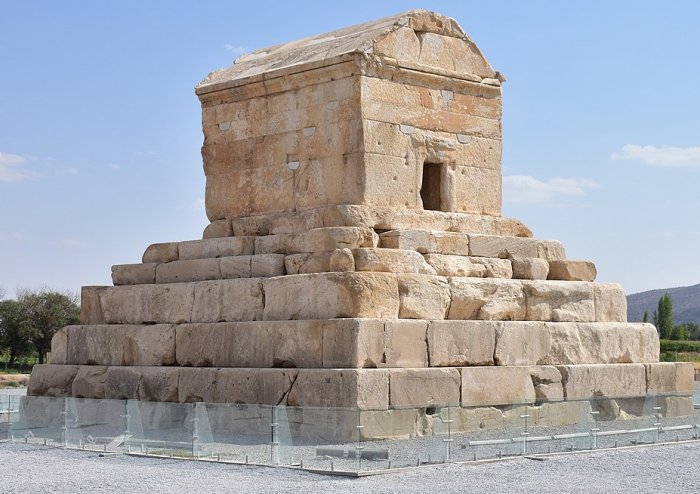
The tomb of Cyrus the Great was also built in Pasargadae and was the most important monument in the city. Image credit: - CC BY-SA 4.0
In antiquity, the city was green. Eight or more dams regulated the river and stored water for irrigation.
Today, the region of Pasargadae is arid but it remains an important archaeological site. Archaeologists paid much attention to Achaemenid stone monuments, the role and design of the garden, and jewelry items.
Unique Techniques Used To Withstand Earthquakes
Not long ago, archaeologists found that Achaemenid engineers built the city of Pasargadae using unique structural techniques to withstand a strong earthquake that would today be classified as 7.0 on the Richter magnitude scale.
Inscription In Tomb of Cyrus the Great
No doubt, the most prominent monument in the city of Pasargadae, was the mausoleum of Cyrus.
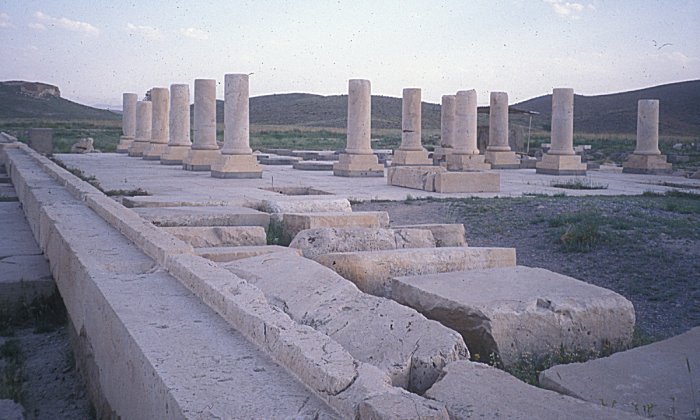
Pasargad audience hall. Image credit: - CC BY-SA 3.0
It has six broad steps leading to the sepulchre, the chamber of which measures 3.17 m long by 2.11 m wide by 2.11 m high and has a low and narrow entrance.
Though there is no firm evidence identifying the tomb as that of Cyrus, Greek historians tell that Alexander III of Macedon believed it really was. So, when Alexander looted and destroyed Persepolis, he visited the tomb of Cyrus and ordered one of his warriors, to enter the monument.
Inside, there was a golden bed, a table set with drinking vessels, a gold coffin, some ornaments studded with precious stones, and an inscription on the tomb.
No trace of any such inscription exists today and only Strabo reports that it read:
“Passer-by, I am Cyrus, who gave the Persians an empire and was king of Asia. Grudge me not, therefore, this monument…”
The Roman geographer Strabo of Amasia confirms in his ‘Geography’ that Pasargadae was built on the site where King Cyrus defeated the leader of the Medes, Astyages, in 550 BC. Building inscriptions found in the palace also confirm that Cyrus was indeed the builder of the town.
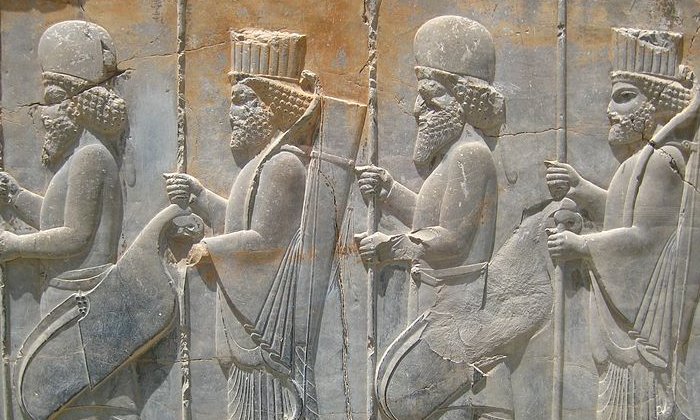
Persepolis stairs of the Apadana. Image credit: Taranis-iuppiter - CC BY-SA 3.0
After King Darius I the Great (522-486) built a new capital, Persepolis, Pasargadae remained an important place, and probably was some kind of religious capital of the Achaemenid empire. The tomb of Cyrus probably played a role in ceremonies taking place at Pasargadae.
Citadel And Audience Hall Among Oldest Monument Of Pasargadae
Pasargadae contained palaces and many other monumental structures; especially impressive and the oldest monument was a citadel Tall-i-Takht ('throne hill') that overlooked a garden ('paradise') in the south, and the palace complex as well. Built during the reign of Cyrus the Great, the citadel was never finished after his death in 530 BC.
Pasargadae represents the first phase of a specific Persian architecture which later found its full expression in the city of Persepolis.

Another historical structure is Apadana - the many columned audience hall that represented the splendid design by Darius I the Great (r. 522-486 BC). Apadana was part of king Cyrus' palace and was approached from the south-east. Apadana structures were influenced by several motifs from Phoenicia and Assyria and sculptures were created by the best stonemasons from Greek Ionia.
The Apadana structure is only mentioned in some building inscriptions; in one of Darius II (424-05 BC) and three of his son, Artaxerxes II (405-359 BC).
Pasargadae represents the first phase of this development into a specifically Persian architecture which later found its full expression in the city of Persepolis.
Written by – A. Sutherland AncientPages.com Senior Staff Writer
Copyright © AncientPages.com All rights reserved. This material may not be published, broadcast, rewritten or redistributed in whole or part without the express written permission of AncientPages.com
Expand for referencesMore From Ancient Pages
-
 DNA From 3,800-Year-Old Individuals Sheds New Light On Bronze Age Families
-
 Ancient Marble Statue Of Sphinx Discovered In Tang Dynasty Tomb
-
 Was A Statue Of Asherah Hidden In The Ark Of The Covenant?
-
 Australia’s Two-Meter-Long And Oldest Known Rock Painting Of A Kangaroo – Revealed
-
 Golden Secrets Of Lake Guatavita And The Muisca People Gave Rise To The El Dorado Myth
-
 First Evidence Common People Drank Wine In Troy (Not Just The Elites)
-
 Mysterious Gigantic Jars Of Unknown Origin Discovered Worldwide
-
 Rare Fossil Of A Dog-Sized Horned Dinosaur From ‘Lost Continent’ Identified By British Scientist
-
 2,550 Submerged Wooden Objects Recovered From The Templo Mayor Of Tenochtitlan
-
 Askeladden – Little Trickster That Succeeds Where All Others Fail
-
 Hundreds Of Thousands Of Sumerian Artifacts Have Been Stolen From Iraq’s Museums And Archaeological Sites
-
 Prehistoric Heavy Machinery Of The Ancient Times Or A Piece Of Jewelry?
-
 Extraordinary 1,000-Year-Old Viking Sword Discovered In Cork, Ireland
-
 Mystery Of The Neanderthals – Search For Traces Of Neanderthals’ Lives And Hints Of Their Demise
-
 Ensisheim Meteorite Is The Oldest Meteorite With A Precise Date Of Impact
-
 Gorgo – Queen Of Sparta And Wife Of King Leonidas Broke A Secret Code And Stopped An Invasion
-
 Indigenous Village Estimated To Be 11,000 Years Old – Discovered Near Sturgeon Lake
-
 Has The Viking Ship Burial Of King Bjørn Farmann Been Found At Jarlsberg Manor, Norway?
-
 Third-Century Sculpture Of Roman Emperor Aurelian Unearthed In Bulgaria
-
 Jelling Stone And Legendary Harald ‘Bluetooth’ King Of Denmark – ‘Who Made The Danes Christian’

