
‘Chac Mool’ – Intriguing Life-Size Figure Carved In Single Stone
A. Sutherland - AncientPages.com - “Chac Mool” (chacmool) is one of the most famous ancient statues throughout Mexico and it has been seen in many important ancient places.
'Chacmool' literally means "red or great jaguar paw" (chac means "large" or "red" and mool means "jaguar paw" in Yucatec Maya, and refers to a large number of three-dimensional and curious male figures in Precolumbian Mesoamerican art.
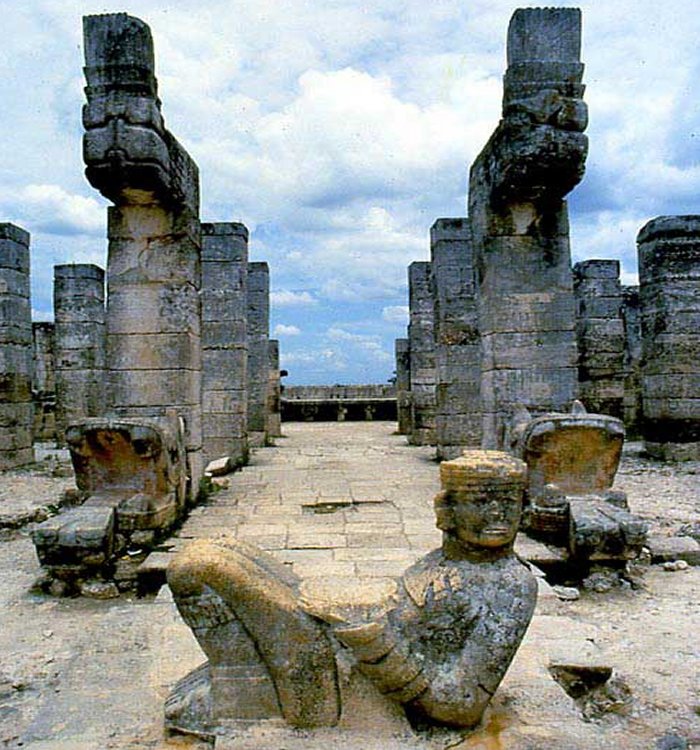
Despite the great number of these figures that are known and recorded, convincing arguments for their origin, dissemination, and meaning have not been proposed. Photo via mexicolore.co.uk
The monumental stone sculpture known as a “Chacmool” first appeared suddenly in Mesoamerica, probably in the 9th century CE.
The most famous statue of this type was excavated in the area of the Platform of the Eagles and Jaguars in Chichen Itza in 1875 by the nineteenth-century explorer Augustus Le Plongeon (1825 – December 13, 1908).
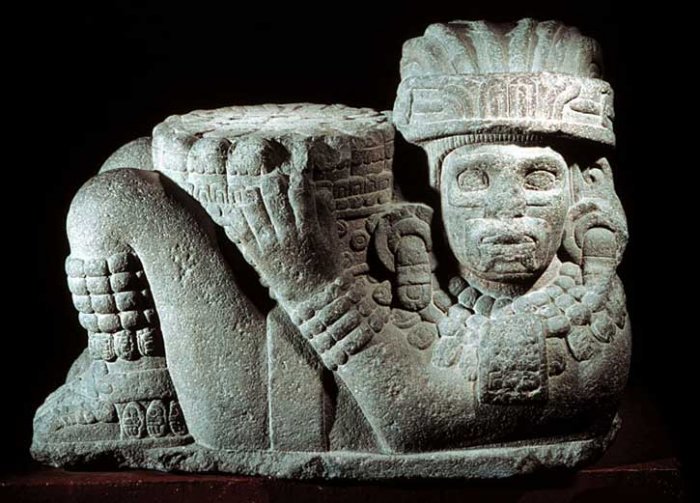
Excavated in 1943 at the corner of Venustiano Carranza and Pino Suarez Streets, Mexico City. Wears a Tlaloc mask and a pendant with an archaistic motif. Photo via latinamericanstudies.org
Le Plongeon named it Chacmol, which he said was Maya for “the paw swift like thunder.” He believed that the statue depicted a warrior prince with that name who once ruled Chichen Itza. However, the first published account of such a statue appeared in 1832.

Modern Mexican silver 5-peso coin depicting the iconic chac mool figure. Photo via mexicolore.co.uk
Altogether, archaeologists have discovered 14 chacmools at Chichen Itza, 12 at Tula, home of the Toltec civilization near present-day Mexico City.
A few other, different forms of chacmools were found in several other such places as Tenochtitlan (Templo Mayor), Quirigua in Guatemala, Tazumal in El Salvador, Michoacan, Tlaxcala near Tula, along with Cempoala, an important Mesoamerican archaeological site located in the state of Veracruz.
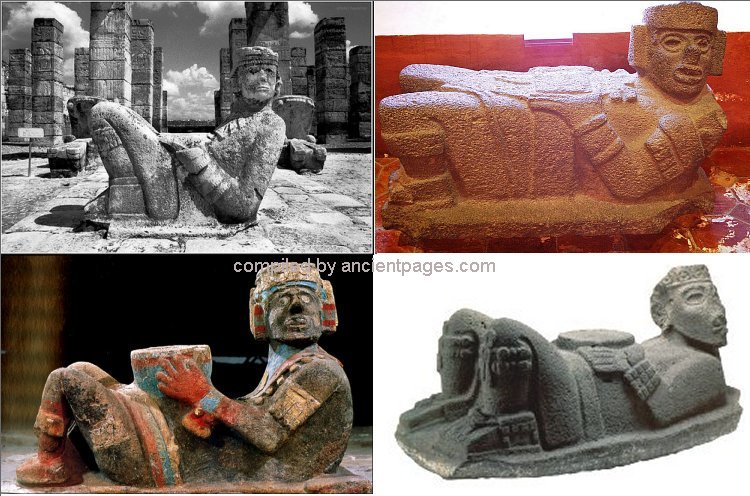
The Chaacmol does not appear to be of Maya origin. The ancient name for this type of sculpture is unknown. It is also uncertain what or who the statue represents or what its purpose might have been.
See also:
Pulque: Ancient Drink Of The Gods Is Popular Again But It Has Odd Side-Effects
The figures have rather a unique posture; they support themselves on their elbows with their heads facing 90 degrees from the front. They hold a bowl or a disk or perhaps plate upon their stomachs.
However, these sculptures were often associated with sacrificial stones or thrones.
Despite the great number of these figures that are known and recorded, convincing arguments for their origin, dissemination, and purpose have yet to be made.
Written by – A. Sutherland AncientPages.com Staff Writer
Copyright © AncientPages.com All rights reserved. This material may not be published, broadcast, rewritten or redistributed in whole or part without the express written permission of AncientPages.com
Expand for referencesReferences:
Yale University, Latin America Studies
Academia
More From Ancient Pages
-
 Can Stonehenge Be Saved From Bulldozers Or Have Druids Been Defeated?
-
 Archaeologists Discover A Secret Escape Tunnel In Copenhagen, Denmark
-
 Chang’e: Chinese Goddess Of Moon And Immortality
-
 Modern Humans Used Favorable Climatic Conditions On Their Long Way From Africa To Europe
-
 Ancient Footprints Offer Evidence Humans Wore Shoes 150,000 Years Ago – Scientists Say
-
 On This Day In History: Seismologist Charles Richter Was Born – On Apr 26, 1900
-
 Ancient Dacian Gold Helmet With Piercing Evil Eyes
-
 Ceibal Is The Oldest Known Ceremonial Site Of The Maya Civilization
-
 Sam Bass – Texas’s Beloved Bandit Who Was Admired By The Poor
-
 Evidence Americas’ Oldest Mine In Wyoming Was Used By Paleoindians 13,000 Years Ago Has Been Found!
-
 Great Heathen Army’s Power Revealed – Previously Unknown Viking Sites And Routes Found In Britain
-
 Megadrought That ‘Killed’ Green Sahara 4,000 Years Ago Crippled Southeast Asia’s Human Settlements
-
 The Inca Empire Was Powerful And Well-Organized – Why Were They So Successful?
-
 Secrets Of Cheops’ Pyramid: Does The Newly Found Chamber Contain An Iron Throne?
-
 Largest Capstone Ever Found In South India
-
 Fenrir: Oldest Of Three Monstrous Children Of God Loki In Norse Mythology
-
 Unique Canterbury Roll – Ancient Manuscript Reveals Its Secrets About History Of England
-
 2,000-Year-Old Lavatory In Turkey’s Denizli Province Will Be Restored
-
 Tahpanhes – Biblical City Where Prophet Jeremiah And King Zedekiah’s Daughters Hid From The Babylonians
-
 Large, High-Elevation Cities Along Asia’s Silk Roads Exposed By High-Res Lidar

