
Ancient Chinese Ball Game Cuju Is Earliest Form Of Football
Conny Waters - AncientPages.com - An interesting question is when and where we started playing football.
There are several references to traditional, ancient, or prehistoric ball games played by indigenous peoples in many parts of the world. The history of football stretches far back in time. According to FIFA, the competitive game cuju is the earliest form of football for which there is scientific evidence.
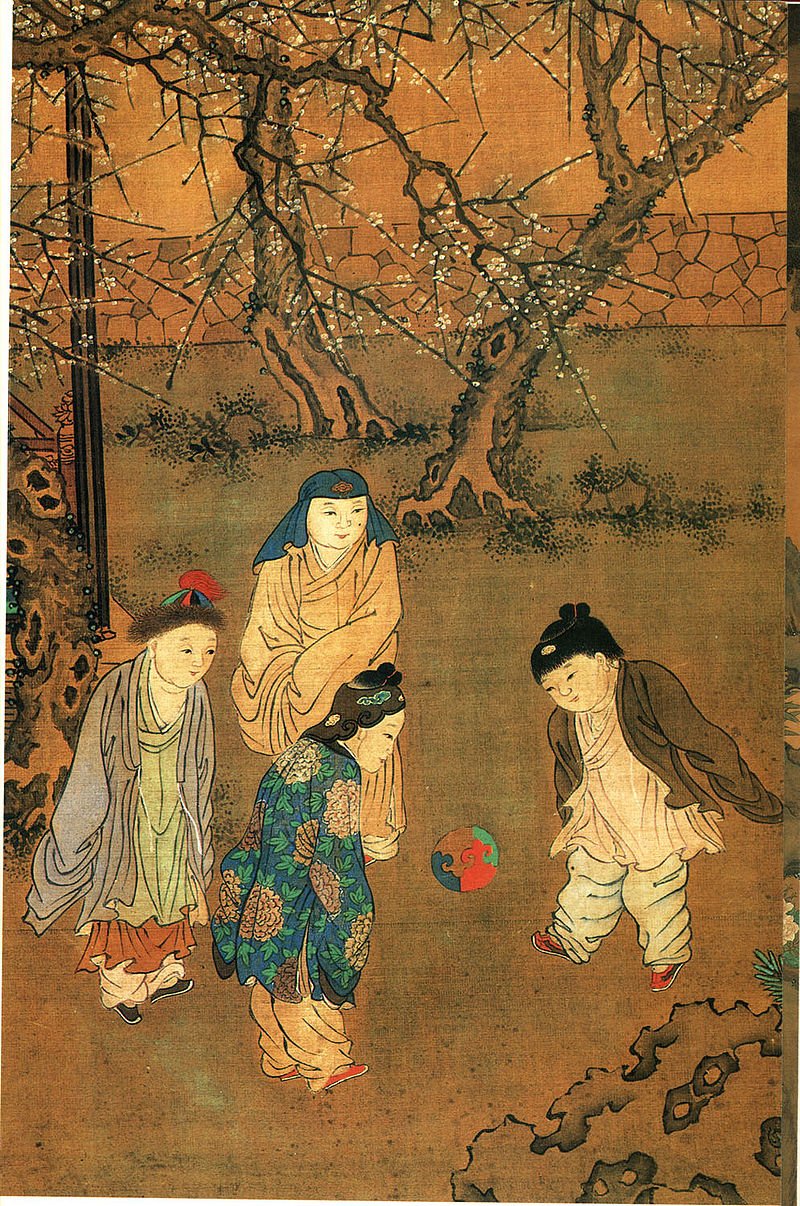
One Hundred Children in the Long Spring, a painting by Chinese artist Su Hanchen, active AD 1130–the 1160s), Song Dynasty. Image credit: Su Hanchen - source - Public Domain
Cuju is an ancient Chinese ball game, Cantonese "chuk-ko". It is a competitive game that involves kicking a ball through an opening into a net. The first mention of cuju in a historical text is in the Warring States era Zhan Guo Ce, in the section describing the state of Qi.
It is also described in Sima Qian's Records of the Grand Historian (under Su Qin's biography), written during the Han Dynasty. A competitive form of cuju was used as fitness training for military cavaliers, while other forms were played for entertainment in wealthy cities like Linzi.
During the Han Dynasty (206 BC-AD 220), the popularity of cuju spread from the army to the royal courts and upper classes. It is said that the Han emperor Wu Di enjoyed the sport. At the same time, cuju games were standardized, and rules were established. Cuju matches were often held inside the imperial palace.
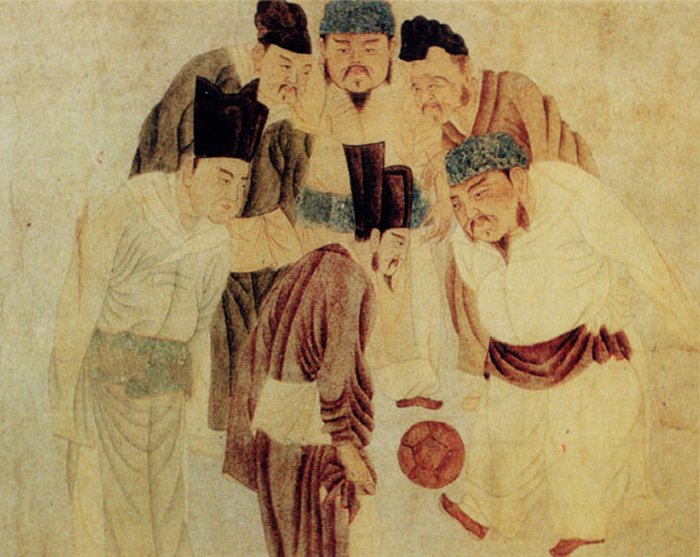
Emperor Taizu of Song playing cuju with Prime Minister Zhao Pu, by the Yuan-era painter Qian Xuan (1235–1305). Image credit: - source - Public Domain
Later, the sport was improved during the Tang Dynasty (618-907). First of all, the feather-stuffed ball was replaced by an air-filled ball with a two-layered hull. The capital of Chang'an during this dynasty was filled with several cuju football fields, which were even established on the grounds of the palaces.
Soldiers in the imperial army and Gold Bird Guard often formed cuju football teams to delight the emperor and his court.
Also, two types of goalposts emerged: One was made by setting up posts with a net between them, and the other consisted of just one goalpost in the middle of the field. The level of female cuju teams also improved. Records indicate that once, a 17-year-old girl beat a group of army soldiers. Cuju football even became popular amongst scholars and intellectuals, and if a courtier lacked skill in the game, he could pardon himself by acting as a scorekeeper.
During the Song Dynasty (960-1279), Cuju flourished thanks to social and economic development, and its popularity reached every class. Cuju organizations were set up in large cities called Qi Yun She or Yuan She - now known as the earliest professional cuju club - whose members were either cuju lovers or professional performers. There was only one goalpost set up in the center of the field.
Non-professional players had to formally appoint a professional teacher and pay a fee before becoming a member.
Cuju began its decline during the Ming Dynasty (1368-1644) due to neglect, and the 2,000-year-old sport slowly faded away. Now it is coming back again, gaining more and more popularity.
Modern football has its origin in the streets of medieval England. Neighboring towns would play each other in games where a heaving mass of players would struggle to drag a pig's bladder by any means possible to markers at either end of town. Football became so violent in England that the king banned it for over 300 years.
Updated on March 3, 2023
Written by Conny Waters – AncientPages.com Staff Writer
Copyright © AncientPages.com All rights reserved. This material may not be published, broadcast, rewritten or redistributed in whole or part without the express written permission of AncientPages.com
Expand for referencesReferences:
Image: A Song Dynasty painting by Su Hanchen, depicting Chinese children playing cuju - Credit: Su Hanchen
More From Ancient Pages
-
 Mystery Greek tomb was dedicated to companion of Alexander – experts say
-
 Controversial Ancient History Of Harappa And Mohenjo Daro – Advanced Indus Valley Civilization Pre-Dates Egypt’s Pharaohs And Mesopotamia
-
 Legendary Epic Of King Gesar Who Descended From Heaven And The Ancient Tarna Monastery
-
 Breakthrough: Oldest Egyptian DNA Extracted From Individual Who Lived During The Age Of The First Pyramids
-
 On This Day In History: King James I Of Scotland Was Assassinated – On Feb 21, 1437
-
 Legend Of The Immortal Wandering Jew Cursed By Jesus
-
 Why Were The Jews Exiled To Babylon?
-
 Baltinglass Hills: Prehistoric Irish Monuments May Have Served As Pathways For The Deceased – New Evidence
-
 Viking Treasures Discovered In Chamber Grave In Denmark
-
 Archaeological Site Along The Nile Reveals The Nubian Civilization That Flourished In Ancient Sudan
-
 Ancient Celtic Necropolis With Magnificent Swords And Artifacts But No Human Remains Discovered
-
 11 Ancient Submerged Canoes Found In Wisconsin’s Lake Mendota – Evidence Of A Lost Village?
-
 Was The World’s Oldest Surviving Garden Created By Ancestors Of The Katzie First Nation 3,800 Years Ago In British Columbia?
-
 El Volcán: Mysterious Volcano-Shaped Pyramid With Never Revealed Secrets In Peru
-
 Necklace Of Harmony – Powerful Ill-Fated Piece Of Jewelry With Curse
-
 Was Tintagel Castle A Fortress Used By Iconic Hero King Arthur?
-
 ‘Phoenician Oil Bottles’ From Mozia, Sicily Tell Us How Societies Perceive, Value, And Use Scents
-
 Ancient Suda: Massive Anonymous Byzantine-Greek Lexicon Dated To 10th Century
-
 Dangerous Magnetic Anomaly And Unexplained Events In Mysterious And Dark Valley Trouble Scientists – Why Must The Stone Gate Not Be Crossed?
-
 Pharaoh Ramses II Comes One Step Closer To The Gods In The Company Of Hathor, Sekhmet and Ptah – Statues Discovered

