
Mystery Of The Candelabrum: One Of The Most Enigmatic Ancient Giant Ground Drawings In The World
Ellen Lloyd - AncientPage.com - A giant mysterious figure, world-renowned under the name "Candelabrum" can be seen from as far as 12 miles out to sea.
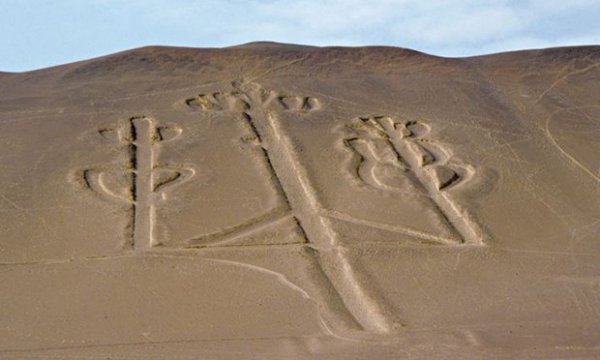
The Candelabra is 595 feet long and resembles a candlestick. The figure "is drawn" on a slope of the huge sandy mountain located opposite the island of Kangalyan in a bay Paracas, Peru.
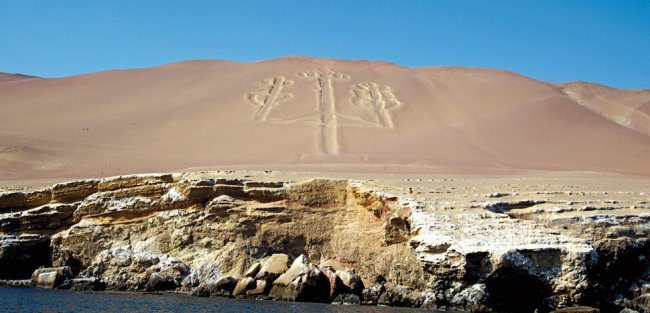
Who made it and why? This is a question no one has been able to answer so far. Obviously, its creators believed it was important that the ground drawing must be clearly visible from the air.
Separated by 130 miles from the Nazca Plain, with its famed giant figures, the Candelabra apparently is not the work of the Nazca people.
It is puzzling why such a figure would be placed where it could be seen best by sailors. Candelabra's makers, purpose, and symbology are in doubt. The Pisco geoglyph really doesn't match the motifs in our books on South American archeology.
Some archeologists say it is only a trident, but whoever saw a trident like this?
Frank Joseph, the author of several alternative history books, like "Before Atlantis" and "Advanced Civilizations of Prehistoric America", thinks the Candelabrum looks like a Jimson weed! Furthermore, he states that there is a miniature version of the Candelabra drawn on a rock in California's Cleveland National Forest, and associates the two candelabras in this way: The ancient inhabitants of Peru voyaged to California to collect Jimson weed and other hallucinatory drugs. When they sailed back to Peru with their cargo, they used the Pisco geoglyph as a navigational aid!
That is one hypothesis, but there are also other ideas behind the purpose of creating the Candelabra.
In ancient times it was believed that "Candelabrum" was put on a mountain slope by the Spanish monk Ramon Rokhason sent to Peru. Making the pilgrimage from the city of Lima, he and his followers reached Parakas where they created the huge figure. Sometimes the figure was called "Three crosses," but contemporaries very seldom use this term.
There was a new version of the emergence of the mysterious "Candelabrum" of Parakas later. Some historians spoke about a figure as about "the Life Tree," serving as the cult image at the time of the most ancient civilizations, which inhabitants of lands of Pisko-Parakas worshipped. Then, there were several versions related to the sea.
Writer Eduardo Garcia Moreno in the book "Code of pirates" argued that ancient "Candelabrum" was left by the filibuster busy with plowing the seas and plundering the cities, and Paracas was the place where pirates could hide from prosecutions.
Some historians and seafarers believed that "Candelabrum" served as a reference point and a precautionary sign for the ships reaching the so-called zone of Bokeron, being considered dangerous because of the stormy sea.
Paracas's "candelabrum" is so large-scale phenomenon that it is hard to imagine a person capable to put such a huge image on a slope of the sandy mountain. Especially, when the mountain slope goes down to the water at an angle of approximately fifty degrees. Ditches of this mysterious image have depth in two meters and four-meter width.
The height of the central figure of "Candelabrum" makes more than a hundred meters.
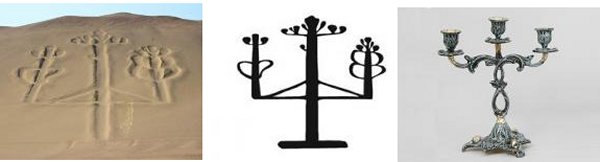
Disputes on the emergence of the surprising "Candelabrum" continue among historians and archeologists of the world, but to solve this mystery has not been possible. Probably, Paracas's "Candelabrum" is simply a geometrical image of a trident or an important ritual sign of ancient civilizations.
In any case, this figure is a valuable cultural heritage.
No one knows for certain the age of the original carving. However, an expedition by the French writer Robert Charroux in 1969, noted that, although the mountainside was exposed to the wind, the wind contained no dust or sand. Charroux thus concluded that the trident carving could have been drawn millennia ago and yet still have avoided any significant erosion.
The trident symbol at Paracas is a major clue to its origin. According to local legend, this carved figure represents the god Viracocha's lightning rod, who was worshiped throughout South America.
Written by - Ellen Lloyd – AncientPages.com
Copyright © AncientPages.com All rights reserved. This material may not be published, broadcast, rewritten or redistributed in whole or part without the express written permission of AncientPages.com
More From Ancient Pages
-
 Pooka: Solitary Spirit And Not Entirely Benevolent Prankster In Irish Folklore
-
 Rare 1,400-Year-Old Temple Possibly Used By East Anglian Kings Discovered In Suffolk, UK
-
 Perperikon, Tomb Of Orpheus And A Small Baffling Stone – Unraveling A Puzzling Connection That May Solve A Mythological Riddle
-
 1,500-Year-Old Roman Settlement Destroyed By The Goths Discovered In Bulgaria
-
 Humans Used Northern Migration Routes To Reach Eastern Asia
-
 On This Day In History: Japanese Raid On The United States Navy At Pearl Harbor – On Dec 7, 1941
-
 Anglo-Saxon Previously Unknown Monastic Or Trading Center – Discovered
-
 Magnificent ‘Sword Pyramid’ Lost By A Sutton Hoo-Era Lord Discovered In Norfolk
-
 Mystery Of The First Dinosaurs Deepens – Is The Supercontinent Gondwana The Answer?
-
 Never-Before-Seen Frescoes From Hadrian’s Time Unveiled At Ancient Roman Baths
-
 Seshat: Goddess of Astronomy Aligned Sacred Monuments To The Stars Long Before Imhotep
-
 Lifestyle And Face Of 7th-Century Anglo-Saxon Teen – Reconstructed
-
 Remarkable ‘Hipposandals’ Found At Vindolanda
-
 Ruins Of Xunantunich – Mayan City That Once Flourished
-
 Huge Ptolemaic/Roman Funerary Structure Unearthed In Egypt’s Fayoum
-
 Unexpected Discovery Of Secret Underground Chamber Reveals Mysterious Neo-Assyrian Rock Panel
-
 Mystery Of Ancient New York Giants – Who Was Really Buried In The Druid Barrow?
-
 Lake Huron Was Home To A 9,000-Year-Old Civilization – Underwater Structures And Artifacts Reveal
-
 Ara Pacis: Altar In Rome Dedicated To Pax, The Roman Goddess Of Peace
-
 Puzzling Case Of An Ancient French Giant Whose Bones Caused Sensation And Controversy

