
Gefjon: Norse Fertility Goddess Who Knew Humans’ Fates, And Plowed Away Part Of Sweden To Give It To Denmark
A. Sutherland - AncientPages.com - Gefjon (Gefion) was the Aesir goddess of fertility, plow, and agriculture in Norse mythology. She also possessed extraordinary mental abilities, and just like Frigg, she knew the secrets of human fates.

The goddess Gefjun plows up Zealand with her oxen sons. Author: Carl Ehrenberg (1840–1914). Public Domain
According to the Prose Edda, she was one of the maidens in the palace of Frigga (Frigg) ("the beloved"), who, in Nordic mythology, was the queen of the gods, Asgard's mistress, the wife of Odin, mother of Balder, and stepmother of Hermod, Vidar and Höder.
Gefjon, a beautiful goddess of the Æsir, had many maidservants; all maidens who died unwedded were entrusted to her. It happened when Gefjon lived in Jotunheim, the country of legendary giants located in the very north of Europe. According to some authors, Gefjon did not remain a virgin forever but married one of the giants, and she had four sons with him.
Today, this region is known as the land of the Sami people.
Gefjon, Disguised As A Beggar Tricked The King Of Sweden
In 'Gylfaginning' by Snorri Sturluson, there is a story about Gefjon, who disguised herself as a beggar. Tradition has it that Odin, who dwelled on the island of Odense, sent Gefjon to visit Gylfi, King of Sweden, and to beg him for some land that she might call her own.
Amused at her unusual request, the king promised her as much land as she could plow in one day and night. He did not believe that she could take much land during such a short time, but he was wrong.
 Promenade at Gefjon Fountain was painted by Paul Fischer (1860-1934). source
In this story, Gefjon is not only a beggar but also an older woman. She needed as much help as possible, so she went up to the mountains and transformed her sons into oxen. They worked hard, plowing up a large part of Gylfe's kingdom. The plow in Sweden's western - flat and fertile region - went deep into the ground and cut out a vast amount of the Swedish territory.
When she and her oxen were ready, they dragged this enormous piece of land down into the sea, where the goddess Gefjon formed a wonderful fertile island that belonged to Denmark. Gefjon gave it a name: Sjælland (Zealand).
There, Gefjon made her home and married Odin's son Skjold (Skiold or Scyld), with whom she lived in the city of Hleidra (or Lethra). She is considered the ancestress of the Danish royal race of Skioldungs. It is said that a noble line of kings and skilled warriors descended from them.
The excavated area created a "hole" in the Swedish soil, which was quickly filled with water, forming a large lake, at first called Logrum (the sea) but was later known as Mälaren (some versions refer to Lake Vänern, located in the southwest of Sweden).
Gefjon Visits King Gylfi Of Sweden
One of them says that Gefjon loved to wander the world. Once, she was invited to visit king Gylfi in Sweden, who wanted to meet the beautiful Gefjon. Together with king Gylfi, she had a pleasant time.
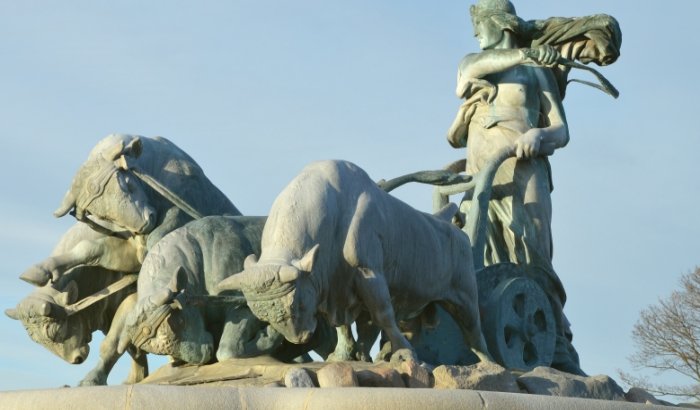 The Gefion Fountain (Gefionspringvandet), located in Langelinje Park, Copenhagen, Denmark. The large stones symbolize the land plowed by the goddess Gefjon and her four oxen. source
Then, he wanted to thank her royally, so he said he would give her as much land as she would plow in one day and one night. Gylfi did not believe Gefjon could get much land during such a short time of plowing.
As we learned, the clever goddess Gefjon surprised him.
Loki Insults Goddess Gefjon At Ægir's Feast
Usually, Loki either assists the gods or misbehaves towards them. His evil side is seen in the poem 'Lokasenna' (Old Norse "Loki's Quarrel"), an Old West Nordic poem in the Poetic Edda recorded in Codex Regius. The poem presents an exchange of insults between the gods and Loki.
Loki, amongst other things, accuses the gods of moralistic sexual impropriety, the practice of sorcery, and prejudice.
In 'Lokasenna,' Loki once again shows his true nature, but this time, he is involved in the exchange of insults addressed to the goddess Gefjon.
Odin at once warns Loki to beware of Gefjon's wrath, "for she knows the destinies of men as well as I."
Gefjon Did Almost Exactly In The Same Way As Dido Of Carthage
The story of Gefjon and the clever way she procured land from Gylfi to form her kingdom of Seeland (Zealand) is much like the Greek story of Dido, who obtained by stratagem the land upon which she founded her city of Carthage.
Dido asked Iarbus, the Berber ruler if she could buy some piece of land to settle and start a new life with her people.
In both accounts, oxen play an essential role. For a while in the Northern myth, these sturdy animals draw the piece of land far out to sea. On the other, Dido, a brilliant woman, instructed her people to cut the animal's skin into skinny strips. Then, her people covered the piece of land with stripes, and thus, they marked its borders.
Written by – A. Sutherland - AncientPages.com Senior Staff Writer
Updated on October 17, 2022
Copyright © AncientPages.com All rights reserved. This material may not be published, broadcast, rewritten or redistributed in whole or part without the express written permission of AncientPages.com
Expand for referencesReferences:
Anders Baeksted, Nordiska Gudar och Hjältar
Sturluson S. Prose Edda
http://www.hovedstadshistorie.dk/
Belton J, An Encyclopedia of Norse Mythology
More From Ancient Pages
-
 Knights Templar – Among The Most Wealthy And Powerful Of The Western Christian Military Orders
-
 Puzzling Jewellery From Grave Of High Status Viking Woman Delivered At Museum’s Door
-
 Unusual 6,000-Year-Old Gold Objects Discovered In Hungarian Tombs – More Mysterious Conical Hats?
-
 Ghostly Appearance Of Weird Ancient City Suspended In The Sky Witnessed By Many People
-
 Ancient Mesoamerican Board Games ‘Patollis’ Discovered In Mexico
-
 8-Year-Old Boy Finds Unusual Viking Age Artifact On Gotland Island, Sweden
-
 Untold Story Of Mexico’s Ancient Giant Indians – Secret Knowledge Of The Aztecs Revealed – Part 1
-
 Rare Trove Of Ancient Metal Objects Unearthed In Mississippi Was Left By The Spaniards When The Chickasaws Attacked
-
 Pandavleni Buddhist Caves: Sculptures, Inscriptions And Sophisticated Water Management System
-
 On This Day In History: Tokugawa Shogunate Begins In Japan After Historical Battle – On Oct 21, 1600
-
 Ancient Inscriptions Of Babylonian King Nabonidus Discovered In Saudi Arabia
-
 Mysterious Ancient Grave With Unusual Artifacts That Belonged To A Völva – Norse Female Shamans Did Exist
-
 Angerona – Goddess Of Silence During Cosmic Crises And Protector Of Ancient Rome
-
 Fenrir Killed At Ragnarok By Vidar Who Avenged His Father Odin’s Death
-
 Ancient Secret Tunnel Discovered Beneath The Pyramid Of The Moon In Mexico’s Teotihuacan
-
 Large Ancient Egyptian Astronomical Observatory In The Buto Temple Discovered In Kafr El-Sheikh, Nile Delta
-
 On This Day In History: Great Siege of Malta: Ottoman Forces Made Attempt To Conquer Malta And Failed – On May 18, 1565
-
 Chauvet-Pont d’Arc Cave And Surrounding Landscape – What Did The Ancient Artists See?
-
 Viking Age Mass Grave Reveals Gruesome Discovery At Historical Village Of Repton, England
-
 Book Of Kells: Illuminated Medieval Manuscript From Monastery On Iona, Scotland

