
Shango: Powerful Thunder God And Symbol Of Kingship Among Yoruba People Of West Africa
A. Sutherland - AncientPages.com - Kingship and weather are strongly associated with Yoruba mythology. Myths and legends of Yoruba say that the greatest warrior-king, Shango, became the god of thunder, lightning, and storms after he died.
 This staff is an emblem of Shango, the Yoruba god of thunder. It combines seemingly contradictory aspects of Shango-the idea that it is Shango who hurls thunderbolts to punish wrongdoers with the belief that he is generous, the giver of children, and the protector of twins. A female devotee kneels in worship while balancing on her head the double ax motif that symbolizes the god's thunderbolts. The axes have been carved into twin heads. As in many African cultures, beauty is linked with moral values-in this case, hard work. The success of the woman also reflects the hard work and achievement of her husband, who supports her generosity. Image credit: Cliff1066 - CC BY 2.0
Among the Yoruba, he is generally known as an ancient king of Oyo and the grandson of Oduduwa, also revered today as the hero, warrior, leader, and father of the Yoruba race.
Shango – Most Powerful Nature God
In the beliefs of the Yoruba people of West Africa, Shango is the most powerful nature god. He is still celebrated in certain parts of the world. Shango has followers and priests responsible for burying anyone killed by lightning. They may also inspect property struck by lightning to find the thunderbolt.
His sanctuaries are decorated with statues of women or mothers and children. Shango has sole control over the thunder and presides at births. His followers believe he advocates justice. His anger reaches everyone who offends him.
He is usually portrayed with horns and a ram's head and holding a double ax. His wives are from three rivers: Oya (the Niger River), Oshun, and Oba. His favorite colors are red and white.
His name is believed to be derived from " shan, "to strike violently," and " go, "to bewilder," and refers to peals of thunder, which are supposed to be produced by violent blows.
Shango Was Once An Earthly King
He was once an earthly king noted for his authoritarian rule among his people. It is said that thunder and lightning shook the earth on the day he was born. Legend has it that Shango was a violent and cruel king whom his people so hated that he finally decided to hang himself in the forest.
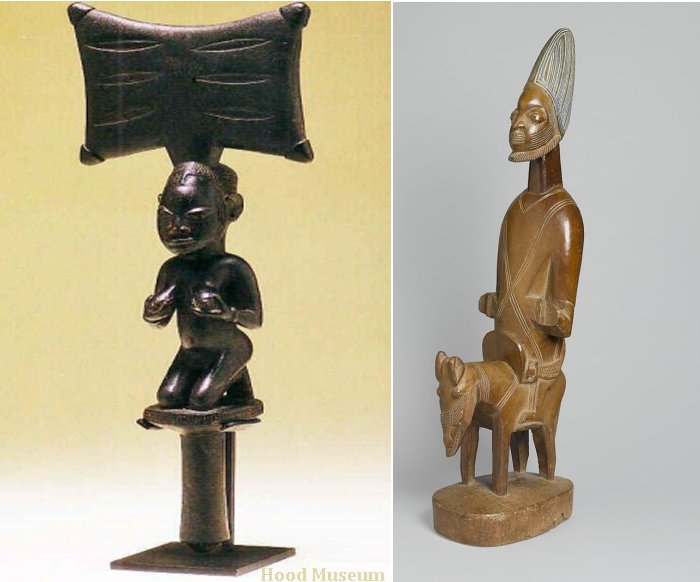 Left: Shango, thunder god of the Yoruba. Image credit: Hood Museum via clarku.edu; Right: Figure of Shango on Horseback. by Yoruba carver Toibo. Image credit: CC BY 3.0
Another variant of the Shango myth also says that he never died but instead ascended to heaven to continue using his terrible powers as the god of thunder, lightning, and storms.
He had both enemies and worshipers who built many shrines and temples dedicated to him after he died.
Officially, Shango's priests used to say that Shango ascended to heaven, but the Yoruba did not want to believe it. As lightning and storms did not cease after Shango's death, the Yoruba held Shango responsible. He sustained his terrifying powers in the afterlife and continued using his double axe to induce lightning storms that devastated the ground and shook the earth.
The Yoruba people believe that Oya, the goddess of the River Niger, often accompanied Shango. Oya was responsible for powerful winds and gusts.
Shango Has Counterparts In Beliefs Of Other Cultures
Storms, thunder, and lightning were often associated with the highest or war gods. In many cultures, thunder was believed to be a creative force and a precursor to a life-giving and fertilizing rain.
The Greek god Zeus had a mighty thunderbolt forged by Hephaestus, the sky-dwelling blacksmith, and vajra, a powerful thunderbolt throwing light belonging to Indra. Meanwhile, 'dorje' was comparable to it in Tibet beliefs. Mjölnir (Mjolnir) is Thor's terrible ax hammer in Norse mythology. In the Inca's beliefs, Catequil (or Apocatequil), the god of thunder and lightning, was believed to create thunder by striking the clouds with his sacred spear and a mighty club.
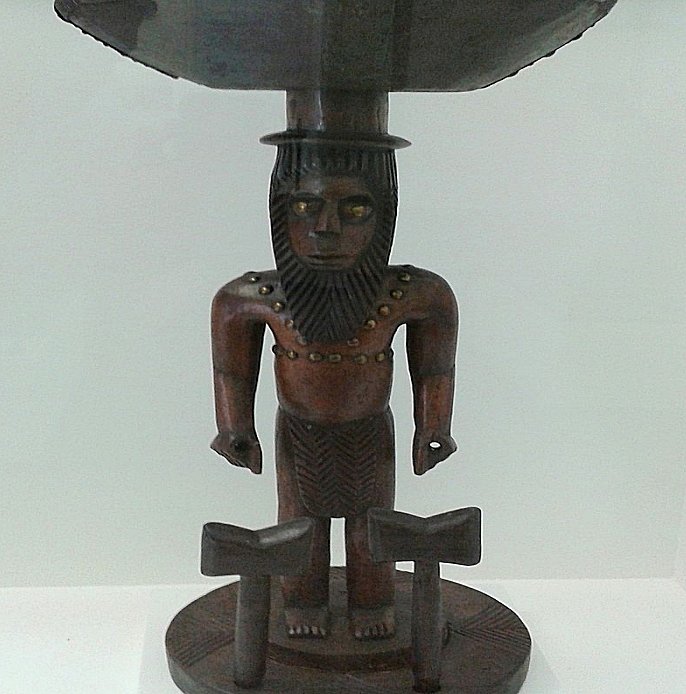 Shango god. Image credit: National Museum of Brazil, Rio de Janeiro. CC BY-SA 4.0
Tradition has it he created so much damage on the ground that terrified Inca sacrificed their children to calm the god's fury.
Storms - Manifestation Of Shango's Wrath
In his 'Traditional Offa Yoruba Religion in Nigeria' T.P. Sunday writes: "Thus, it is not surprising that thunder is seen by the Yoruba as a manifestation of the divine wrath as this aspect of Shango's life is noted for its violent storms, especially in Yorubaland considered to be "the second region in the world for lightning frequency, consisting of "there sounding booms, the deafening sound of the thunderclaps; the blinding, dazzling, crisscrossing; end to end flashes of the lightning" all of which contribute to and affirm the sense of divine presence in the storm; such that the following song is reported as addressed to Shango:
"O Shango, thou art the master!
Thou takest in thy hand the fiery stones,
To punish the guilty!
To satisfy thy anger!
Everything they (the stones) strike is destroyed,
The fire eats up the forest,
The trees are broken down, And all things living are slain…"
Regarding political sense, it may be true that Shango is the great national divinity of the Yoruba in general, although not in the ultimate religious sense..."
Written by – A. Sutherland - AncientPages.com Senior Staff Writer
Updated on Oct 24, 2023
Copyright © AncientPages.com All rights reserved. This material may not be published, broadcast, rewritten or redistributed in whole or part without the express written permission of AncientPages.com
Expand for referencesReferences:
Bouquegneau C, Rakov V. How Dangerous Is Lightning?
Johnson, S, History of the Yorubas
Sunday P. T. Traditional Offa Yoruba Religion in Nigeria
More From Ancient Pages
-
 Mysterious Unknown Caves And Tunnels Discovered Beneath The Olsztyn Castle
-
 New Study: Fossils Reveal Human Ancestors’ Hearing Abilities
-
 Horrible Ancient Massacre On The Island Of Chios Led To Greek Independence
-
 Who Was The Unknown Man Who Influenced Historical Events Shaping America’s Future Before Vanishing Forever?
-
 Extraordinary Gold Treasures Found In A Thracian Warrior’s Grave Near Topolovgrad, Bulgaria
-
 Clay Cylinders With Oldest Known Alphabet Unearthed In Ancient Syrian City Of Umm-el Marra
-
 Ancient Celtic Necropolis With Magnificent Swords And Artifacts But No Human Remains Discovered
-
 Byzantine Greek Inscription Of Psalms 86 Found In Hyrcania
-
 Who Made The Intriguing Wawa Runestone Found In Ontario, Canada?
-
 Subterranean Structure In Medieval Naryn-Kala Citadel: Was It The Christian Temple?
-
 Horus – One Of The Most Important Ancient Egyptian Gods And Symbol Of Rulership and Justice
-
 9,500-Year-Old Baskets And 6,200-Year-Old Sandals Found In Spanish Cave
-
 Ancient Greeks Had Great Understanding Of Weather And Climate
-
 Innocent-Looking Japanese War Fan – Surprise Weapon Used By The Samurai And Female Ninja
-
 Meet SPOT – Robot Dog Deployed To Guard The Ancient Ruins Of Pompeii
-
 Unexplained Historical Mass Disappearances – Lost Without Trace – Part 1
-
 3,000-Year-Old History Of Tea: World’s Second Most-Consumed Drink After Clean Water
-
 Mystery Of The Black Irish People: Who Were They?
-
 Magnificent Treasures From Bronze Age And Roman Era Found In South Wales And Powys
-
 Edward Of Woodstock “Black Prince” – Idol Of The English People And Terror Of The French

