
Diyu – Terrible Chinese Hell And Judgement Of God Yama
Ellen Lloyd - AncientPages.com - When angry with someone, we often say, “Go to hell”. Whether we believe in the existence of hell is unimportant. We have simply been taught that hell is not a place any of us would gladly visit.
The idea that some sort of hell exists is very ancient. Many tend to associate hell with Christianity, but this afterlife destination where a person will be punished for his or her deeds appears in several mythologies, legends, and religions worldwide. In most cases, hell is described as a place of torment and punishment. However, sometimes, it’s only regarded as an abode of the dead or something in between.

The Last Judgement, Hell, circa 1431, by Fra Angelico. Credit: Public Domain
In Norse mythology it is Loki’s terrible daughter Hel who is the goddess of death and a ruler of Niflheim, a dark dwelling place for the dead and one of the Nine Worlds of a cosmic ash tree, Yggdrasil.
According to the Sumerian afterlife belief, people would take a journey to the Underworld, a gloomy and unpleasant realm where goddess Ereshkigal, the sister of Inanna (Ishtar) ruled.
Those who didn’t follow Maat, ancient Egypt’s most important religious concept were thrown to Ammit, the "devourer of the dead" and would be condemned to the lake of fire.
Ancient Greeks believed that Tartarus divided the lands of the living from the land of the dead.
The Christian version of hell is supposed to frighten believers from committing sins and it is defined by the Roman Catholic Church as “a state of definitive self-exclusion from communion with God and the blessed.” If you’re a Christian and find hell frightening, then remember that Diyu is much worse.
Diyu is the Chinese version of hell partly based on the Buddhist concept of Naraka.
Difference Between Christian Hell And Naraka, Buddhist Cosmology Concept
Naraka is the Sanskrit word for the realm of hell in Dharmic traditions. Naraka is mentioned in Hinduism, Sikhism, Jainism and Buddhism.
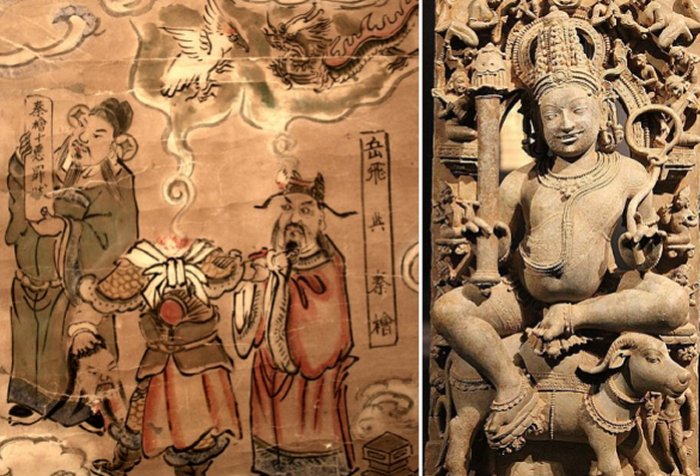
Left: The headless ghost of Yue Fei confronting the recently deceased spirit of Qin Hui in the Sixth Court. The plaque held by the attendant on the left reads: "Qin Hui's ten wicked crimes." From a 19th-century Chinese Hell Scroll. Credit: Public Domain - Right: God Yama. Credit: Public Domain, CC BY-SA 3.0
As many know, Buddhists believe in reincarnation, but this doesn’t imply that a person will be re-born shortly after he or she passed away. Reincarnation can be a very long process. Most students of Buddhism are aware of that Buddha did teach about hell and related how God Yama judged a newly deceased person's destination. These teachings can be found in the Devaduta Sutta. There is a close relationship between the Naraka concept and the traditional Chinese beliefs about afterlife.
It’s important to remember that Naraka differs greatly from the Christian definition of hell.
To begin with, the stay in Naraka is not eternal. It can take an extremely long time before one can leave Naraka. Beings trapped in Naraka may be forced to remain there for hundreds of millions to quintillions of years. Still, eventually, they do depart from this place when karma (accumulated actions) has achieved its total result.
Another thing is that one is not sent to Naraka because of a divine judgment or punishment but karma.
As previously mentioned on Ancient Pages, Yama is the god of the underworld, who rules the hell and judges the dead. God Yama also guards the Akashic records. Legend has it that before Yama became the lord of the dead; he walked much around the world and experienced many adventures. Once he discovered a way up to heaven and unfortunately, in consequence, he spread mortality over the world, and eventually, he became the ruler of the dead.
In Chinese mythology, the Jade Emperor put Yama in charge of everything in Diyu.
Chinese Diyu Has Ten Courts Of Hell
According to Chinese beliefs, avoiding going to Diyu is impossible. Everyone who dies must end up in Diyu, but the length of the visit depends on the severity of the sins one committed. Once punishment has been served, reincarnation takes place, and one is free to begin a new life in a new physical body or form. God Yama decides when the being’s soul passes from one stage to another.
In Diyu, there are ten courts of hell, and each one of them is overseen by a Yama King. Chinese believe there are many hells spread across our planet and in the universe. As many as 12,800 hells are supposed to be located below Earth’s surface. There are 8 dark hells, 8 cold hells, and 84,000 miscellaneous hells that can be found at the edge of the universe.
Diyu And The 18 Levels Of Hell
The most horrifying description of Diyu can be traced to the Tang Dynasty. In this underground maze, there are 18 levels with awful chambers where people are tortured and constantly suffer pain. No matter how much a person suffers, it’s impossible to ‘die’ from the torture because the body is always restored to its original state, and the agony is repeated. Which chambers a person ends up in depends on the sin he or she committed.
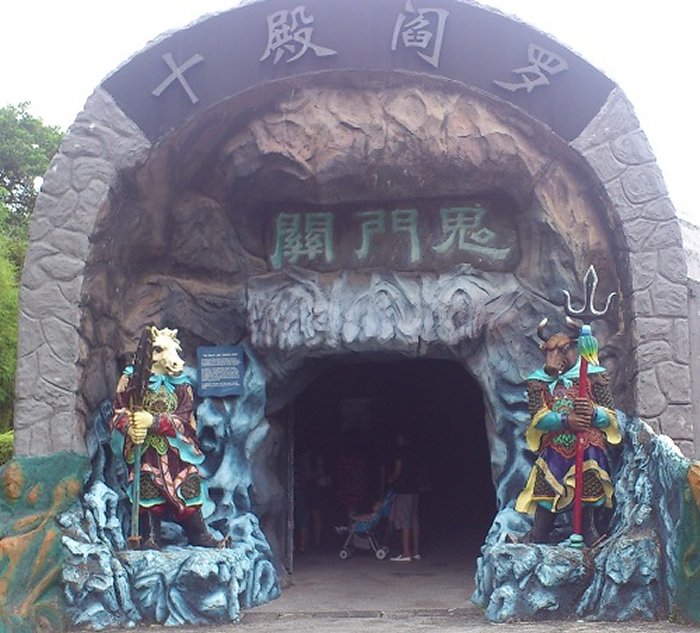
Entrance to the "Ten Courts of Hell" attraction in Haw Par Villa, Singapore. The Ox-Headed (right) and Horse-Faced (left) Hell Guards stand guard at the entrance. Credit: Public Domain, CC BY-SA 4.0
Gossipers, for example, are sent to the chamber of tongue ripping. Those who break others’ marriage are tortured in the chambers of scissors where their fingers are cut off. Hypocrites and troublemakers go to the chamber of steamer. Arsonists can be found in the forest of copper column where they are bound to columns of glowing copper. On the mountain of knives, there are those who killed an innocent person with a knife. As punishment, the murderer is forced to climb a mountain with sharp blades sticking out. The lowest level in Diyu is Avīci and this place is reserved for those who have committed truly wicked crimes, including the Five Grave Offences which are:
- Deliberately murdering one’s father
- Deliberately murdering one’s mother
- Killing an Arhat (fully enlightened being).
- Shedding the blood of a Buddha.
- Creating a schism within the Sangha, the community of Buddhist monks, nuns and pariṣā who try to attain enlightenment.
One can say that all forms of torture take place in Diyu. The Chinese perception of hell certainly does encourage people to be good beings and avoid sins.
Updated on August 20, 2024
Written by Ellen Lloyd – AncientPages.com
Copyright © AncientPages.com All rights reserved. This material may not be published, broadcast, rewritten or redistributed in whole or part without the express written permission of AncientPages.com
Expand for referencesRosalie David - Religion and Magic in Ancient Egypt
Ganany Noga. “Baogong as King Yama in the Literature and Religious Worship of Late-Imperial China.” Asia Major 28, no. 2 (2015): 39–75.
More From Ancient Pages
-
 Number 13: Coincidence Or Bad Luck – Are We Still Superstitious?
-
 New Large Sphinx Still Embedded In Soil Discovered In Luxor, Egypt
-
 Dian Cécht – Celtic Healer Who Cured Many But Killed His Own Son Of Professional Envy
-
 First Scandinavian farmers were far more advanced than previously thought
-
 On This Day In History: Battle Of Gaugamela – Alexander The Great Defeats Darius III Of Persia – On Oct 1, 331 BC
-
 World’s First Recreated Ancient Egyptian Garden Is Now Open To The Public
-
 Mystery Of The First Dinosaurs Deepens – Is The Supercontinent Gondwana The Answer?
-
 Tribe Recalls Ancient Contact With An Extraterrestrial In The Amazon Jungle And A Strange Beam Of Light
-
 Triglav (Trzygłów) – Powerful Three-Headed Slavic God Of Vigilance, Sea Storms Who Supervised Sky, Earth, And Underworld
-
 Gold Coins Shed Light On The Mystery Of Sandby Borg And Massacre On The Swedish Island
-
 Ancient Mesopotamian Discovery Changes Our Understanding Of Early Agriculture Practices
-
 New Study Shows How The Ancient World Adapted To Climate Change
-
 Ancient Mesoamericans Drank Tobacco In Healing Rituals – Ceramic Vases From Cotzumalhuapa, Guatemala Reveal
-
 Modern Humans Used Favorable Climatic Conditions On Their Long Way From Africa To Europe
-
 Stunning Discovery Of 1,000-Year-Old Knight’s Sword From Reign Of Poland’s First King Bolesław The Brave
-
 ‘Umeda Graves’ Dated To Edo Period Discovered At Osaka, Japan
-
 Cosmic Impact 12,800 Years Ago Forced Hunter-Gatherers In The Levant To Adopt Agricultural Practices
-
 Four Magical Treasures Of Tuatha De Danann
-
 Underground City And Pyramid Discovered At Tiahuanaco, Bolivia
-
 Huge Round Ancient Sewer System Covering 160,000 Square Meters Discovered In Ancient City Of Mastaura

