
Cernunnos ‘Horned One’ – Powerful Continental God Preserved In Celtic Beliefs As Master Of Animals
A. Sutherland - AncientPages.com - Cernunnos is one of the greatest and most ancient Celtic gods. He is the Lord of the Animals, the “Horned One.”
The 'cer' part of his name, relating to his antlers, means ‘horned.’

Cernunnos, Celtic horned god. Image credit: Wikipedia
His name, depictions, and cult are widely attested in ancient Romano-Celtic worship sites. Cernunnos’ significant role as a hunter and animal god is preserved in Celtic folklore under different names and representations. In British mythology, Cernunnos resembles Herne the Hunter, the horned God and Lord of the forest.
The worship of Cernunnos is believed to go back to the fourth century BC.
Only his depictions exist, but there are no myths of this great, mighty, though somewhat mysterious deity.
The name “Cernunnos” (“the horned one”) is only known from a single inscription found in Paris, France. This deity probably had several names; therefore, the inscription remains controversial.
Appearance Of Antlered God Cernunnos
The most common depiction of Cernunnos shows him with the horns; however, these horns are not related to domesticated animals but rather to a stag, suggesting the god’s strong connection with the powers of the wildwood and its mighty animals. In Norse beliefs, the branching antlers of a stag are associated with the Tree of Life, Yggdrasil, and the animal lives among the ash branches and eats its leaves. The stag was also held sacred by the Greek goddess Artemis.
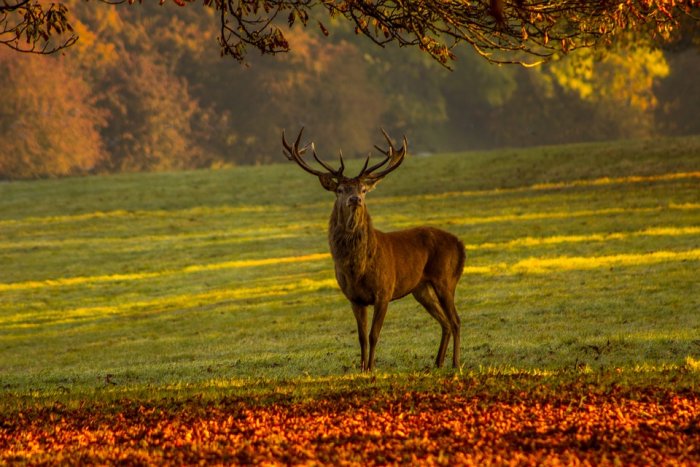
The stag has been held sacred by many ancient civilizations. Image credit: Public Domain
Frequently depicted with one or more ram-headed serpents, Cernunnos bears a torch about his neck, a symbol of high status and holiness.
A well-known depiction of Cernunnos is that found on the silver votive Gundestrup Cauldron dated to the second century AD. His sitting cross-legged posture recalls that of the Buddha. The very frequent conventional pose has many statues of seated Hindu deities.

Cernunnos on the Pillar of the Boatmen, from the Musée national du Moyen Âge (Museum of the Middle Ages), in Paris, France. Image via Wikipedia
His images have been found in carved statues and reliefs dated to ancient Gaul (today modern France). As domesticated and wild animals always accompany him, Cernunnos is often called the Master of Animals.
Cernunnos is also known as the continental Celtic god of wilderness and is considered the spirit of the sacrificed stag-god, a nature deity to whom sacrifices were dedicated to preserving the cycles of nature and the wilderness creatures with the god’s holy blood.
Ancient Horn Dance That Has Survived Until Now
In "Celtic Mythology and Folklore," Patricia Monaghan mentions Abbots Bromley, a British folkloric site. It is a place of old worship of the horned god Cernunnos.
Abbots Bromley is located where the Celtic tribe called “horned ones” (the Curnovii) once lived. The old tradition is still alive in the village, and early each September, men decorated with antlers are “hunted” through the town streets, and finally, the "Horn Dance" is performed.
Cernunnos Was Not Particularly Liked By Christianity
Cernunnos’ appearance inspired Christian iconography of the devil, with his horns and partly animal body. Cernunnos is often depicted with goat’s legs.
He ruled the active forces of life and death, giving and taking in nature. In Romano-Celtic culture, he was associated with wealth and prosperity due to his role as Guardian of the Gateway to the Underworld, where all potential forces and events originated.
Updated on August 30, 2024
Written by – A. Sutherland - AncientPages.com Senior Staff Writer
Copyright © AncientPages.com All rights reserved. This material may not be published, broadcast, rewritten or redistributed in whole or part without the express written permission of AncientPages.com
Expand for referencesMore From Ancient Pages
-
 Clay Tablets Of Assyrian ‘King Of The World’ Esarhaddon Found Beneath Biblical Tomb Of Jonah
-
 Ming-Era Two Shipwrecks With 100,000 Ancient Relics Examined By Scientists
-
 Ancient Bronze Ring Bearing The Image Of St. Nicholas May Have Been Worn For Protection
-
 King Offa Of Mercia And The Murder Of King Ethelbert – Revenge Or Jealousy?
-
 Mysterious Fossilized Antarctic Forest May Offer Evidence Of The Great Flood – But Some Facts Speak Against This Theory
-
 Why Is Roulette Called The Devil’s Game?
-
 Mystery Of The Ancient Okunev Culture: Skeleton Of 4,500-Year-Old Noblewoman With Links To Native Americans Discovered In Siberia
-
 Human Footprints Dating Back 800,000 Years Discovered In Norfolk UK
-
 Warrior Uesugi Kenshin And His Nagamaki Special Guards
-
 Sumerians Built A Huge ‘Anti-Drought Machine’ To Save Ancient City Of Girsu From Destruction
-
 The 426-Km-Long Roman Aqueduct Provided Water For Constantinople – New Study
-
 Eriu: Powerful Irish Goddess And Sacred Uisneach Hill Where She And God Lugh Are Buried
-
 Unique Viking Silver Treasure With Beautiful Jewelry And Rare Coins Found In Täby Outside Stockholm, Sweden
-
 Sam Bass – Texas’s Beloved Bandit Who Was Admired By The Poor
-
 Inca Communication: Mailmen Of The Inca Empire Were Fast Roadrunners
-
 King Seqenenre Taa II Was Killed By Hyksos Invaders – Mummy Scans Reveal His Wounds
-
 Unusual Tukuturi Statue On Easter Island Remains An Unexplained Mystery
-
 Why Was This Eerie Castle With Frightening Underground Secrets Really Constructed?
-
 Cave Lion Figurine Made Of Woolly Mammoth Tusk Found At Denisova Cave
-
 3rd-Century Statue Discovered In Ancient City Of Perge, Antalya, Turkey

