
Rare Minoan Sealstone Is A Miniature Masterpiece Unearthed In 3,500-Year-Old Tomb Of Powerful Mycenaean Warrior
A. Sutherland - AncientPages.com - A rare Minoan sealstone in the treasure-laden tomb of a Bronze Age Greek warrior has been discovered by University of Cincinnati archaeologists.
The grave itself - located in an olive grove near the ancient city of Pylos was discovered in 2015 by Jack L. Davis and Sharon R. Stocker, archaeologists at the University of Cincinnati who had excavated the site for more than 25 years.
The 3,500-year-old tomb belonged to a powerful Mycenaean warrior or priest buried around 1500 BC in southwest Greece. In the undisturbed and intact tomb, there were found four gold signet rings that have challenged accepted wisdom among archaeologists about the origins of Greek civilization.
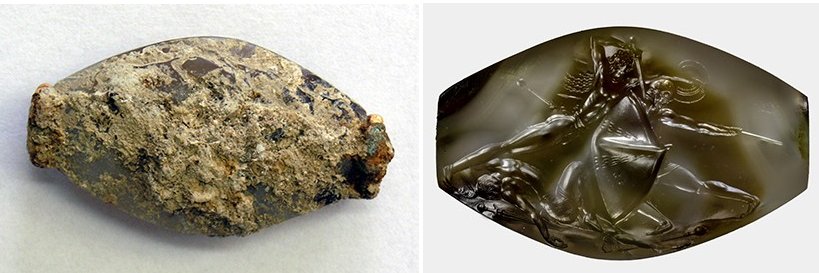
Left: The limestone-encrusted sealstone was discovered lying face-down near the right arm of the Griffin Warrior. Courtesy of The Department of Classics, University of Cincinnati; Right: Due to the seal's small size and veining on the stone, many of the miniature details are only clearly visible via photomicroscopy. Courtesy of The Department of Classics, University of Cincinnati
After this discovery about a year later, excavations revealed another treasure, the so-called “Griffin Warrior”, an intricately carved gem, or sealstone, one of the finest prehistoric masterpieces of miniature Greek art ever discovered.
The “Pylos Combat Agate” that comes from tomb of the Griffin Warrior, which was hailed as the most spectacular archaeological discovery in Greece in more
Dig leaders Shari Stocker, a senior research associate in UC's Department of Classics, and Jack Davis, the university's Carl W. Blegen professor of Greek archaeology and department head said that it took a year of conservation works, and finally the seal revealed all its intricate details and the fierce prehistoric hand-to-hand battle.

An enlarged drawing of the stunningly detailed combat scene captured on an agate sealstone discovered by the University of Cincinnati's Sharon Stocker and Jack Davis. Tina Ross/Courtesy Department of Classics, University of Cincinnati. Color illustration/Ben Gardner, UC Creative Services
Davis and Stocker also said the Pylos Combat Agate’s craftsmanship and exquisite detail make it the finest discovered work of glyptic art produced in the Aegean Bronze Age. Some of the details on the sealstone are only a half-millimeter big.
“What is fascinating is that the representation of the human body is at a level of detail and musculature that one doesn’t find again until the classical period of Greek art 1,000 years later,” explained Davis. “It’s a spectacular find.”
The miniature masterpiece depicts a victorious warrior who, having already vanquished one unfortunate opponent sprawled at his feet, now turns his attention to another much more formidable foe, plunging his sword into the shielded man’s exposed neck in what is sure to be a final and fatal blow.
The scene conjures the sweeping and epic battles, larger-than-life heroes and grand adventures of Homer’s “The Iliad,” the epic Greek poem that immortalized a mythological decade-long war between the Trojan and Mycenaean kingdoms.

Left: The seal artist's attention to detail and use of stylized faces make the Pylos Combat Agate one of the finest works of prehistoric Greek art ever discovered. Courtesy of The Department of Classics, University of Cincinnati; Right: Many of the seal’s details, such as the intricate weaponry ornamentation, become clear only when viewed via photomicroscopy. Courtesy of The Department of Classics, University of Cincinnati
While the researchers can’t say that the image was intended to reflect a Homeric epic, the scene undoubtedly reflects a legend that was well known to Minoans and Mycenaeans, said Stocker.
The seal – most probably made on Crete - and other burial riches found within the tomb suggest that the man, known as the Griffin Warrior after the mythical animal depicted in his grave, was buried around 1450 BC.
See also:
Sophisticated Lenses Of Minoans Discovered In The Sacred Idaion Cave
Minoans: Mysterious, Advanced And One Of The Oldest Bronze Age Civilizations Of Europe
Genetic Mystery Solved: Ancient DNA Reveals Greeks Descended From The Minoans And The Mycenaeans
He held a respected position in Mycenaean society in times when the Minoan civilization of Crete was being transferred to cities of the Greek mainland.
An expert on Aegean art at the University of Vienna, Fritz Blakolmer, said that the sealstone is a miniature copy of a much larger original, probably a stucco-embellished wall painting like those found at the Palace of Knossos on Crete.

A specialized team reconstructed the face of the Griffin Warrior by layering facial tissue over his skull.
According to Blakolmer, the artist created this seal and used a magnifying glass, even though none has been found, and dismissed the possibility that people of that era had sharper eyesight than today.
In the spring of 2016, a UC-based team made a rich and rare discovery of an intact, Bronze Age warrior’s tomb dating back to about 1500 B.C. in the Pylos region of Greece. The Greek Culture Ministry declared the find the “most important to have been discovered [in continental Greece] in 65 years” by the Greek Culture Ministry.
The tomb revealed a remarkably intact skeleton, which UC researchers dubbed the “Griffin Warrior” for the discovery of an ivory plaque adorned with a griffin — a mythical beast with the body of a lion and the head and wings of an eagle — buried with him.
The 3,500-year-old shaft grave also revealed more than 3,000 objects arrayed on and around the warrior’s body, including four solid gold rings, silver cups, precious stone beads, fine-toothed ivory combs and an intricately built sword, among other weapons.
Written by - A. Sutherland - AncientPages.com Senior Staff Writer
Expand for referencesreferences
More From Ancient Pages
-
 Moll Cutpurse – London’s Queen Of Thieves
-
 Anglo-Saxon Harpole Treasure Reveals More Secrets – Unique Medieval Silver Cross Found
-
 Ancient People In Chaco Canyon Who Had Six Fingers And Six Toes Were Special – Researchers Say
-
 Why Didn’t Alexander The Great’s Body Show Signs Of Decomposition For Several Days? A Never-Before Suggested Explanation – From Scientists
-
 Rare, Well-Preserved Medieval Bone Flute Found In Kent
-
 Ancient City Of Hippos-Sussita And The Mysterious Disc-Shaped Copper Plates
-
 Surprising Discovery Of Ancient Roman Salt Factory In England
-
 Drone Reveals 3,000-Year-Old ‘Mega Fortress’ Dmanisis Gora In The Caucasus Mountains Is Much Larger Than Previously Thought
-
 Great Flood Myth Told By Klallam People Of Washington’s Olympic Peninsula – Confirmed
-
 They Spoke The Language Of The Gods – Keepers Of Sacred Ancient Knowledge – Part 1
-
 LIDAR Disovers 2,000-Year-Old Roman Temple Under Church In Danilo, Croatia
-
 Huge Rare Runestone Found Under The Kitchen Floor In Randers Investigated
-
 Ancient Mystery Of The Oghars – An Unusual And Little-Known Lost Race
-
 Amazing Adventures Of Örvar-Oddr And Encounter With The Mysterious Ögmundr Flóki
-
 Mysterious Great Underground City In The Jungle Inhabited By The Old Ones And Guarded By White-Skinned Indians
-
 Dazu Rock Statues Of Clairvoyance And Clairaudience: Is One Of them Holding A Snake Or ‘Telephone Receiver” In His Hand?
-
 Forbidden High-Tech Knowledge Of A Controversial Ancient Lost Super Race
-
 2,700-Year-Old Ceramic Sculpture Of Goddess Found In Aegean Sea
-
 Ancient Circular Mound Villages Hidden In The Amazon Jungle Represent Native American Cosmos – New LIDAR Discovery
-
 Peterborough Petroglyphs Could Offer Evidence Ancient Celts Visited Canada 2,000 Years Ago

