
Tomb Of Senenmut And Earliest Known Star Map In Ancient Egypt
A. Sutherland - AncientPages.com - The earliest known star map in Egypt was discovered more than eighty years ago and represented the central part of the tomb's decoration; inside the grave, a sketch of the tomb's owner was also found, later identified as Senenmut (Senemut).
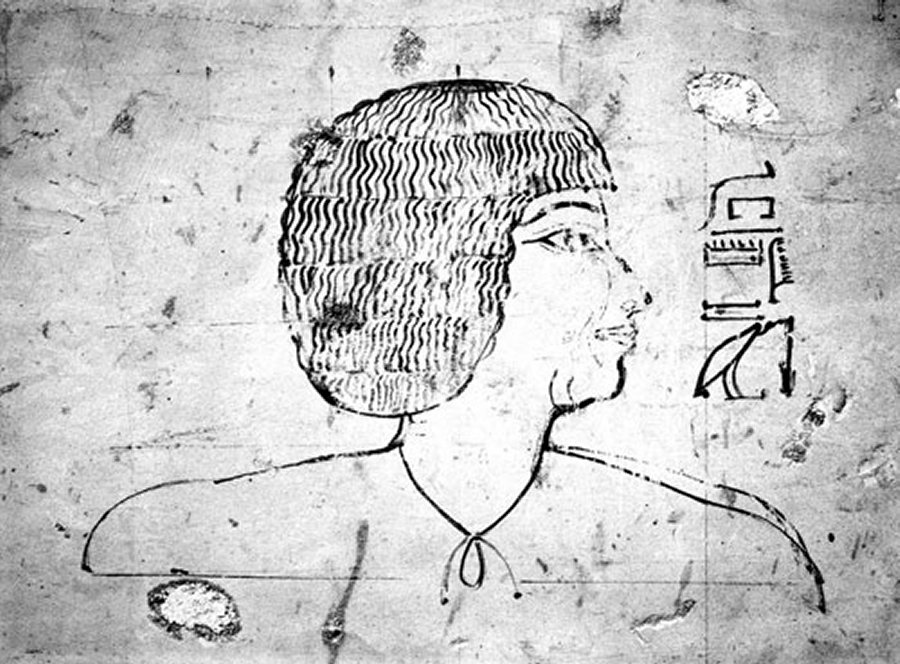
Portrait of Senenmut, steward of Amun, in his Deir el-Bahri tomb (TT 252). Photograph by Harry Burton, 1926–27 (M8C 173). Archives of the Egyptian Expedition, Department of Egyptian Art. Credits: The Metropolitan Museum of Art
Senenmut was the steward of Amun, Senenmut, one of the most influential courtiers in the reign of the female pharaoh Hatshepsut and, in fact, her favored courtier.
The tomb (TT 353) is located north of the causeway leading to Hatshepsut's temple at Deir el-Bahri at Thebes on the West bank of the Nile. It was built during the 18th Egyptian dynasty (ca. 1473 BC).
The astronomical ceiling in Senenmut's tomb remains an imposing decoration, divided into two sky panels: southern (depicts decanal stars (small constellations), was often used in ancient Egyptian astronomy. There are also constellations such as Orion and Canis Major.
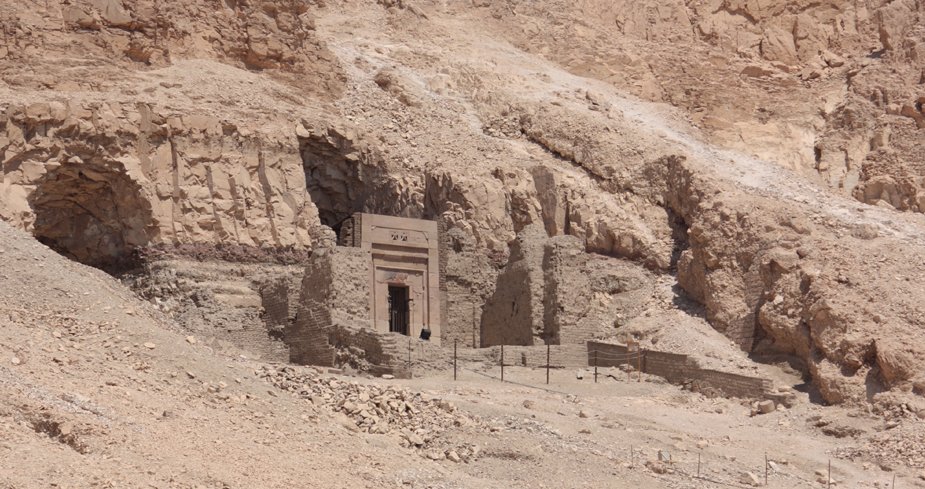 TT 353 of Sen-en-Mut (Senenmut tomb) - a hypogeum built by the order of Sen-en-Mut, 97.36m long and 41.93m deep. Image credit: - CC BY-SA 3.0
Over the sky, planets Jupiter, Saturn, Mercury, and Venus are all related to them, sailing in small boats across the sky. The southern part of the ceiling – means the hours of the night.
The northern part (lower part) shows Ursa Major's constellation; the other constellations remain unidentified. On the right and left of it, there are 8 or 4 circles, and below them are several deities, each carrying a sun disk towards the center of the picture.
The inscriptions associated with the circles mark the original monthly celebrations in the lunar calendar, whereas the deities mark the initial days of the lunar month.
Besides the astronomical ceiling in his tomb at Qurna, excavations also revealed 150 ostraca, including drawings, various lists, reports, and calculations.
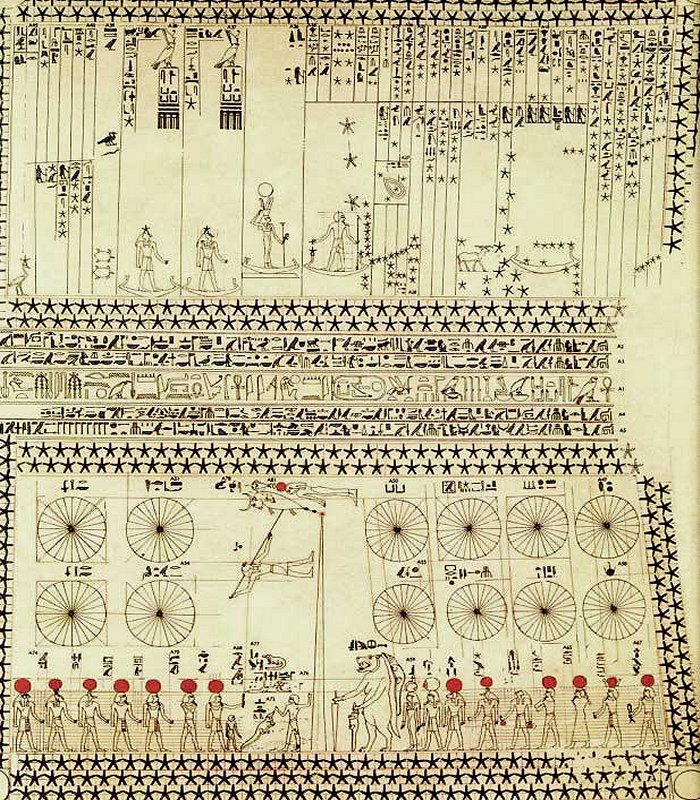
The astronomical chart on the ceiling from Senenmut's tomb. Creator of the image: : Charles K. Wilkinson - CC0
The history of Senenmut's tomb is relatively obscure. Until the 16th year of Hatshepsut/Thutmosis III's reign, Senenmut still held his offices; then, something happened. His tracks were lost, and his unfinished tomb (TT353) was closed and partially destroyed.
Did he fall out of favor, or perhaps he retired? Maybe he died from natural causes.
His real burial place is unknown. The fascinating ceiling decoration makes us wonder what kind of person Senenmut was. He was born to literate, provincial-class parents, Ramose and Hatnofer. Yet, he rose to prominence during Hatshepsut's regency and became the king's influential and highly respected vizier.

Ostracon found from the dump below Senenmut's tomb chapel (SAE 71) thought to depict his double profile. Now residing in the Metropolitan Museum.
It is believed that Senenmut had more than 80 different titles.
He entered his career as the "Steward of the God's Wife" (Hatshepsut) and "Steward of the King's Daughter" (Neferure), which was confirmed when archaeologists found a statue carved into a deep niche above the façade of Senenmut's offering chapel.
The figure depicted Senenmut with Hatshepsut's daughter Neferure, whom he served as a tutor.
Was Senenmut also an astronomer? What kind of relationship did he have with Queen Hatshepsut? He was in charge of her money, buildings, and campaigns. His access to her was closer than any other person. In more than 20 statues, he is shown hugging Hatshepsut's daughter as a young child.
But just because they were close doesn't mean they had a sexual relationship.
Written by – A. Sutherland AncientPages.com Staff Writer
updated on June 14, 2022
Copyright © AncientPages.com All rights reserved. This material may not be published, broadcast, rewritten or redistributed in whole or part without the express written permission of AncientPages.com
Expand for referencesReferences:
More From Ancient Pages
-
 Ten Ancient Jugs May Reveal The Location Of The Biblical Tabernacle
-
 Underground Civilizations – True Rulers Of Earth – Part 1
-
 On This Day In History: Richard The Lionheart Arrives To The Holy Land – On June 8, 1191
-
 South Africa ‘s Blombos Cave: Ochre Was A Tool For Stone Toolmaking During The Middle Stone Age
-
 Indian Black Earth And Biodiversity Of The Amazon – New Study
-
 Ancient Skulls From Ukraine Reveal Early Modern Humans Came From The East
-
 1,300-Year-Old Mayan Maize God Sculpture Found in Palenque, Mexico
-
 Biblical Mystery Of The Forbidden Fruit And The ‘Deep Sleep’
-
 Terrifying Buggane: Demonic And Tyrannical Celtic Demon That Hated Churches And Set Them On Fire
-
 Giant Pre-Hispanic Jar Used To Make Mexican Traditional Corn Beer
-
 Mysterious Pyramid Of Menkaure Remains An Ancient Puzzle
-
 Rare Bes Mugs Reveal Ancient Egyptians Drank Hallucinogenic Cocktails During Rituals
-
 More Greek Gods’ Heads And A Life-Sized Statue Of A Man Unearthed In The Ancient City Of Aizanoi
-
 Mysterious Code Hidden In Antique Silk Dress Bought In Maine Finally Deciphered!
-
 ‘Spectacular’ New Find: Roman Military Camps In Desert Found By Archaeologists Using Google Earth
-
 Why Is The Yarm Viking Helmet Special?
-
 6,000-Year-Old Bizarre, Mouthless ‘Alien’ Mask Unearthed In “The Salt Pit” Settlement In Northeast Bulgaria
-
 Was Megalithic Stone Circle Of Mzoura The Tomb Of Giant Antaeus?
-
 Secrets Behind 2,000-Year-Old Roman Water Management Revealed
-
 Ancient Warming Event May Have Been Trigged By Changes In Earth’s Orbit

