
How The Hyksos Invasion Of Ancient Egypt Changed History
Ellen Lloyd - AncientPages.com - In 1650 B.C., Egypt was invaded by a group of foreigners who, according to the Jewish historian Flavius Josephus called themselves Hyksos.
The Hyksos people were mixed, West Asian people. The Hyksos established a powerful empire in large parts of ancient Egypt that lasted over 100 years before the pharaoh Kamose, the last king of the Theban Seventeenth Dynasty, started a war of liberation from his seat of power in southern Egypt.
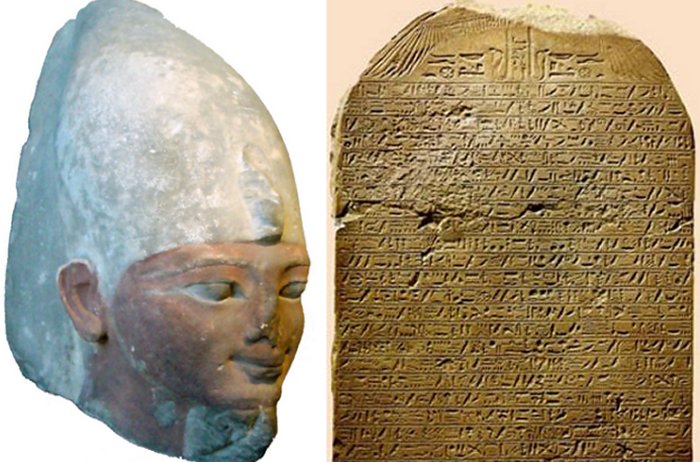
Ahmose I and Tablet Records. Credit: Wikipedia - Brooklyn Museum - CC BY-SA 2.5
Josephus mistranslated Hyksos as "Shepherd Kings," but Hyksos was most likely an Egyptian term for “rulers of foreign lands” (heqa-khase), and it almost certainly designated the foreign dynasts rather than an ethnic group. Modern scholarship has identified most of the Hyksos kings’ names as Semitic.
The Hyksos occupation was later described as a highly traumatic event for the Egyptian people, but it is not clear whether this was actually the view of contemporary Egyptians who lived under their control.
From Avaris, the Hyksos 15th dynasty ruled most of Lower Egypt and the Nile valley as far south as Cusae. The 16th Dynasty rulers, who were minor Hyksos kings, ruled in Upper Egypt simultaneously with those of the 15th dynasty. Much of ancient Egypt was under the control of the Hyksos at the time.
Pharaoh Kamose’s father started the initiative to remove the Hyksos from power, and it is quite possible that he lost his life in battle with the Hyksos.
Kamose sought to extend his rule northward over all of Lower Egypt, but he was met with much opposition. He was killed in a battle, and his mother, Ahhotep I, and brother Ahmose I, continued the campaign against the Hyksos.
Pharaoh Ahmose I completed the conquest and expulsion of the Hyksos from the delta region, restored Theban rule over the whole of Egypt, and successfully reasserted Egyptian power in its formerly subject territories of Nubia and Canaan.
He also founded the 18th Dynasty, New Kingdom, which was the beginning of ancient Egypt’s Golden Age.
Pharaoh Ahmose I laid the foundations under which Egyptian power reached its peak. His reign is usually dated to the mid-16th century BC.
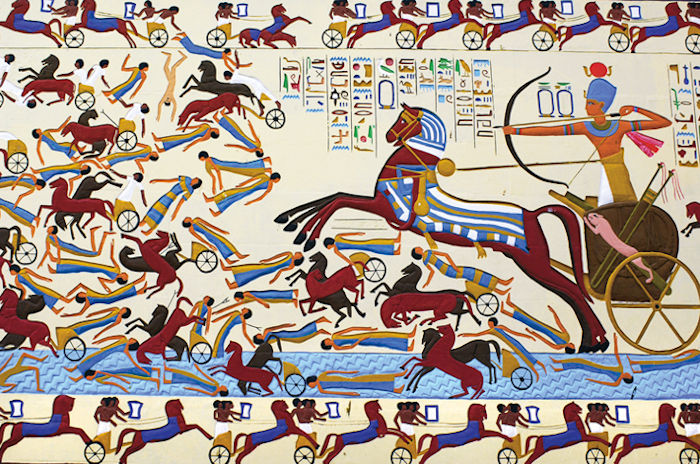
Ancient Egyptian battle. Credit: Public Domain
However, the Hyksos invasion changed the history of ancient Egypt in many ways. The experience of the long foreign occupation resulted in Pharaoh Ahmose I establishing buffer zones between Egypt and its Asian foes.
The period when the 500-meter-long ‘giant fence’ was built near the ancient city of Avaris in Egypt coincided with the invasion of Egypt by the Hyksos.
The emerging Egyptian empire stretched from Sudan to the south, across Syria in the north, and Iraq to the east. Ancient Egyptians were now able to bring home war trophies and slaves from neighboring countries that were also forced to pay taxes to the New Kingdom.
Ancient Egypt experienced a new wave of technological, cultural, and religious developments, highly influenced by the Mitanni Kingdom, the Hittite Empire, and Mesopotamia. Foreign diplomats, merchants, and craftsmen moved to ancient Egypt.
The war with the Hyksos led to the Egyptians establishing their first standing army.
Soldiers were given lands big enough to support their families, and those who distinguished themselves in battle were rewarded with large estates. The money they earned on their lands gave them the possibility to move to the larger cities. A new social class of richer people had been born.

Hyksos people - An earlier group of Asiatic peoples depicted entering Egypt c. 1900 BC, from the tomb of a Twelfth Dynasty official Khnumhotep II, under pharaoh Senusret II at Beni Hasan. Image credit: Wikipedia
The prosperity of the New Kingdom also changed Egypt’s religious life. The pharaohs still had larger temples than the gods, but the country’s military success made the rulers more eager to share the glory with the ancient gods.
Amun-Re was soon worshipped all across Egypt. With the expulsion of the Hyksos rulers of Egypt, Amun's growth was accelerated due to the vindication of Egyptian power and Amun-Re as a protector of the Egyptian state and the Monarchy, and the deity’s importance grew spiritually and politically.

Ram-Sphinx of Amun-Ra. Credit: Aidan McRae Thomson - Flickr - CC BY-SA 2.0
The New Kingdom that Egypt became something of a Theocracy. At the apex of his worship, Egyptian religion approached monotheism. The other gods became mere symbols of his power or manifestations of Amun-Re. In essence, he became the one and only supreme deity.
This was a very unusual religious development in ancient Egypt, where it was common for each city to have its own god.
Updated on August 18, 2023
Written by Ellen Lloyd – AncientPages.com
Copyright © AncientPages.com All rights reserved. This material may not be published, broadcast, rewritten or redistributed in whole or part without the express written permission of AncientPages.com
Expand for referencesReferences:
Fagan, Lord and Pharaoh: Carnarvon and the Search for Tutankhamun
Jan van Tuyl, A New Chronology for Old Testament Times
More From Ancient Pages
-
 Herne The Hunter – The Horned God And Lord Of The Forest In British Mythology
-
 Clay-Jar Tombs With Child Corpses – Unearthed In Northwest Iran
-
 Sacred Artifact With Mystical Powers – The Legend – Part 1
-
 Early Humans In Europe Were Making Fires At Least 250,000 Years Ago – New Study
-
 Rare Minoan Sealstone Is A Miniature Masterpiece Unearthed In 3,500-Year-Old Tomb Of Powerful Mycenaean Warrior
-
 Mystery Of The Kappas That Moved Swiftly Over The Waters Or Across The Sky
-
 Megalithic Structures Are Not Mass Graves For Neolithic Plague Victims
-
 Ancient Campfires Reveal A 50,000-Year-Old Grocer And Pharmacy In Australia
-
 The Burnt City And Its Mysterious Prehistoric Inhabitants
-
 Burial Of Queen Of Emma Of Normandy Discovered In Winchester Castle
-
 Rock Stars: How A Group Of Scientists In South Africa Rescued A Rare 500 Kg Chunk Of Human History
-
 Mysterious Code Hidden In Antique Silk Dress Bought In Maine Finally Deciphered!
-
 The Majestic Lion: Ancient Symbol Of Power And Royalty Found World-Wide
-
 Kallikantzaroi: Naughty Nocturnal Goblins Emerge From Underground Only During Twelve Days Of Christmas
-
 Early Homo Sapiens From Southeast Asia Could Adapt To A Rainforest Environment
-
 Remains of Santorini Volcanic Eruption Discovered West Of Suez Canal
-
 Ancient DNA Reveals Some Northern Europeans Came From Siberia
-
 Was Biblical King David Unknowingly Part Of A Secret Master Plan?
-
 First Early Roman Fortlet Found On The Isle of Anglesey, North Wales
-
 Peculiar Ancient Stone Disk Could Be World’s Oldest Celestial Map

