
Lugal-Anne-Mundu: ‘King Of The Universe’ And Powerful Leader Who Restored Sumer To Its Former Glory
A. Sutherland - AncientPages.com - Lugal-anne-mundu (Lugalannemundu) (ca. 25th century BC) was a powerful king and a great leader, who restored Sumer to its former glory.
His influence spread over a great number of territories from the Persian Gulf to the Mediterranean, neighboring the Taurus mountains in the north, and the Zagros mountains in the east.
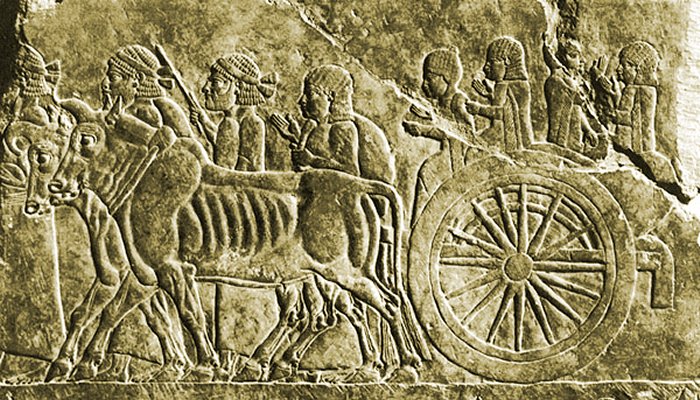
Excavations revealed the remains of buildings, walls, graves and a large number of inscribed clay, bronze and stone tablets, alabaster, onyx, porphyry and granite, vases in marble, some of which were inscribed, and others engraved and inlaid with ivory and precious stones.
According to the Sumerian King List, Lugal-anne-mundu ruled about 2400 BC and for the period of ninety years. He received the kingship following the fall of the Second Dynasty at Ur.
He was only one king ascribed to the Sumerian city-state Adab (modern Bismāyah) located south of Nippur, Iraq.
 Adab city was at the time, an important Sumerian center and at almost all other times in its history, ruled by kings who controlled all or most of Babylonia (southern Mesopotamia).
The principal deity of the city was the goddess Ninhursag, known not only as the goddess of animal birth but the Mother of All Children, a mother-goddess figure.
There are few authentic contemporary inscriptions for Lugal-Anne-Mundu's reign; he is known mainly from a much later text, probably copied from one of his inscriptions, and unearthed during excavations 1903-04.
In this document, Lugal-anne-mundu - described as "King of the universe" or 'King of the four quarters of the Universe' - was an accomplished military leader and strategist.
He managed to capture vast territories and was able to make all foreign lands pay tribute to him and finally brought peace. Lugal-Anne-Mundu’s empire, which is believed to be the first in recorded history, collapsed upon his death.
A series of excavations conducted by the American archaeologist Edgar James Banks in 1903–04, exposed ancient ruins of Adab city dating from as early as the prehistoric period and as late as the reign of Ur-Nammu (reigned 2112–2095 BC).
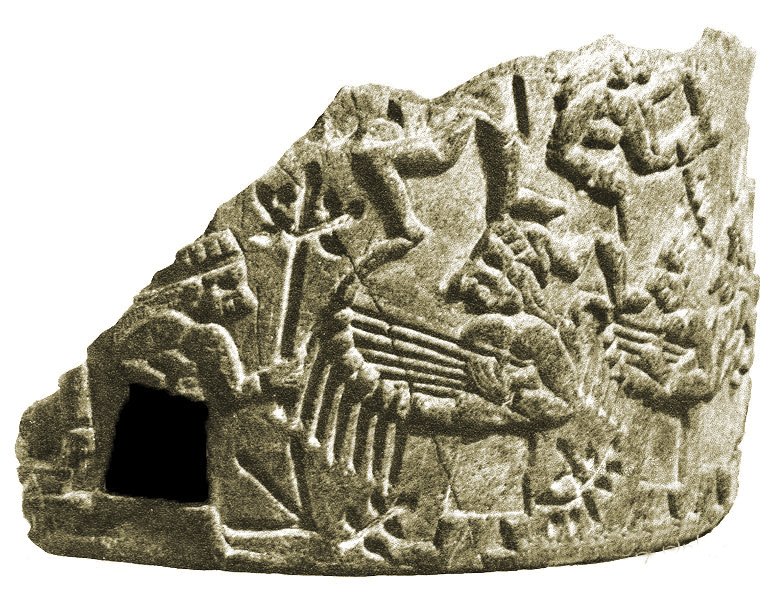
Bas relief from Adab depicts musicians playing various instruments.
The city of Adab was divided into two parts by a canal, on an island in which stood the temple, E-mach, with a ziggurat, or stepped tower. Archaeologists unearthed artifacts dated to Sargon of Akkad, ca. 2300 BC.
Further deep down, they found the remains of buildings, walls, graves and a large number of inscribed clay, bronze and stone tablets, alabaster, onyx, porphyry and granite, vases in marble, some of which were inscribed, and others engraved and inlaid with ivory and precious stones.
"...All were polished, some were engraved with a simple design; others were elaborately wrought with the figures of men and of animals... Others were inscribed with the name of the temple or of an unknown king...." wrote Edgar James Banks, who excavated the area of ancient Adab (now Bismaya or Bismya, Iraq).
Written by – A. Sutherland AncientPages.com Staff Writer
Copyright © AncientPages.com All rights reserved. This material may not be published, broadcast, rewritten or redistributed in whole or part without the express written permission of AncientPages.com
Expand for referencesOlmstead, A. T. "The Political Development of Early Babylonia." The American Journal of Semitic Languages and Literatures 33, no. 4 (1917): 283-321.
More From Ancient Pages
-
 Women’s March On Versailles: One Of The Most Significant Events Of The French Revolution
-
 Unique Ancient Artifacts Discovered In Melting Ice Patches In Norway
-
 Ancient Maps Reveal What Will Happen With Our Climate In The Future – Scientists Say
-
 Stone Age People Used Human Bones For Making Pendants
-
 Story Of Uncle Sam – Symbol Of The United States Government
-
 Author’s Encounter With A Mysterious Not Of This World Entity Inside Callixtus Catacombs
-
 Discovery Of Camouflaged Ancient Stone Chest In Egyptian Temple May Reveal Hidden Royal Tomb – Who Is Buried Near Hatshepsut’s Temple?
-
 Quest For Atlantis Of The Sands – Iram Of The Pillars – A Legendary Lost City
-
 Stunning Swiss Stonehenge Discovered Underwater
-
 Study Of Ancient Skulls Sheds Light On Human Interbreeding With Neandertals
-
 South American Musical Instruments Reflect Population Relationships – Archaeological Records Reveal
-
 Did Pharaoh Shishak Plunder King Solomon’s Temple?
-
 Queen Mavia And The Tanukhids Launched A Massive Revolt Against Romans – But Why?
-
 Finds At Timna Valley Date Back To King Solomon-Era And Point To Sophisticated Ancient Society
-
 Police Forces That Kept Order In Ancient Streets
-
 85 Beautiful And Rare Coptic Textiles – A Gift To Museum At Queens College
-
 Findings From The First Temple Period Discovered In The City of David Corroborate A Biblical Event
-
 Zapotecs’ Magnificent City Of Mitla Was Destroyed By A Seismic Landslide
-
 Gnomes – Fantastic Supernatural Creatures Knowing Secrets Of Earth Mountains Rivers And Rocks
-
 Ancient Clay Tablets Reveal Mesopotamians Experienced Emotions In Their Bodies Differently Than Modern Humans

