
Ancient Maya Ruins Of Tulum: Sea Port And Sacred Site For Worshiping Of Descending God
A. Sutherland - AncientPages.com - The ancient Maya site Tulum is the Yucatan Mayan word for ‘fence, trench or wall’ but it also has another name ‘Zama’, meaning ‘City of Dawn’, because it faces the sunrise.
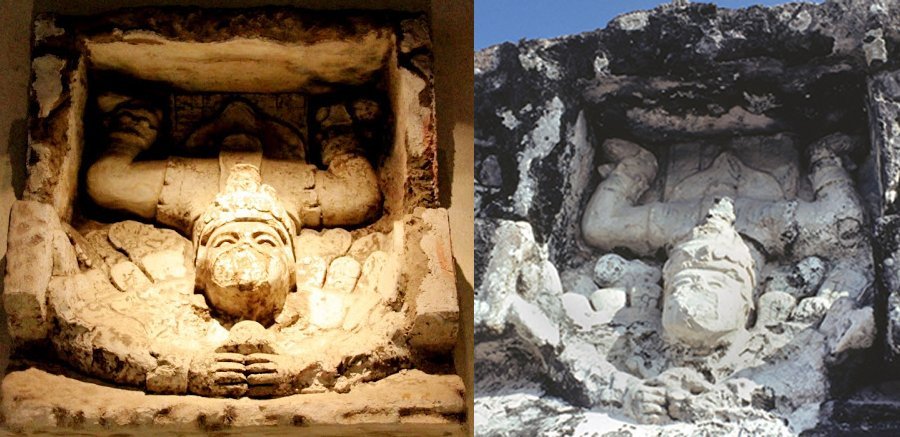
Diving or Descending God is depicted with the head in front, hanging arms and legs bent upwards in a lowered position as if down from heaven. National Museum of Anthropology in Mexico City.
Ancient ruins of Tulum demonstrate the strong influence of Chichen Itza, one of the largest Maya cities referred to in later Mesoamerican literature. The fall of this massive city-state in the 13th century, only 120 kilometers away, coincides with the rise of Tulum. In many respects, Chichen Itza’s aesthetic, inspired by Toltec example, is carried on at Tulum.

Early classic stela inscribed with the date - 564 AD – it is the earliest archeological evidence of human occupation in the area. In the 13th century AD, Tulum was a flourishing trading seaport with access to both land and sea trade routes; the city had a crucial strategic location.
 The murals at Tulum also show ocean-going canoes departing and arriving to Tulum, a prominent port city.
Obsidian trade was developed with central Mexico, jade came from Guatemala, copper from Honduras, and from Tabasco arrived cacao beans.
These goods were later transshipped in other canoes sailing south and north.
Tulum reached its height in the 13th to 15th century and was inhabited by about 1,000 to 1,600 people.
The walled seaport with beautifully painted temples of red white and blue, was spotted by a Spanish expedition on May 7, 1518
An enclosure wall and watchtowers in the northwest and southwest corners, allowed the Tulum fort to be defended against invasions.
Tulum - likely constructed, mainly for defensive purposes - was also a sacred site with unique architectural elements, such as small-sized temples with flat roofs.
Many depictions in the Maya murals and other Mayan artwork discovered around the site, confirm that Tulum was an important center for the worship of the Diving or Descending God, a deity depicted in the Temple of the Frescoes and in the Temple of the Diving God located in the central area of Tulum.
The same god - similar to Ah Mucen Cab, a bee god, is also depicted at Tulum's most impressive structure, the so-called (The Castle), which was originally painted red and covered with stucco. El Castillo has three niches and in the central niche above the doorway, there is a sculpture of the descending god.
This god was the main deity at Tulum, the diving god is likely associated with the planet Venus, and accordingly, Quetzalcoatl, the Feathered Serpent.

The Temple of the Frescoes was used as an observatory for tracking the movements of the sun. Niched figurines of the Maya “diving god” or Venus deity decorate the facade of the temple.
Above the entrance in the western wall, a stucco figure of the “diving god” is still preserved, giving the temple its name.
The ancient Maya were skilled astronomers who watched the movements of the stars and planets. The sun and the moon were not the only celestial bodies of importance to the ancient Maya. The movements of the planet Venus had special meaning for these ancient people. Tables that mark Venus’ position throughout the year are recorded in codices, ancient Maya books, and on monuments throughout the Maya kingdoms as well.
By the end of the 16th century, the site was abandoned completely.
Written by – A. Sutherland - AncientPages.com Senior Staff Writer
Copyright © AncientPages.com All rights reserved. This material may not be published, broadcast, rewritten or redistributed in whole or part without the express written permission of AncientPages.com
Expand for referencesReferences:
J. E. Thompson, Maya History and Religion
More From Ancient Pages
-
 Pilot Mountain Is Home To A Mysterious Underground Civilization – Cherokee Legend Tells
-
 Oldest Lunar Calendar Engraved On A Pebble Dated To 10,000 Years Ago
-
 What Rights Did Viking Women Have?
-
 Heliopolis ‘Sun City’ Was One Of The Most Ancient Cities Of Egypt
-
 The 426-Km-Long Roman Aqueduct Provided Water For Constantinople – New Study
-
 Medieval Mystic Nicholas Of Cusa’s Fascinating Ideas On Extraterrestrials Inspired New Ways Of Thinking About Our Place In The Cosmos
-
 Parthenon Marbles: MEPs Call On Boris Johnson To Return Treasures To Greece
-
 35 Secret Underground Passageways Discovered Beneath Chavín De Huántar Temple Complex In Peru
-
 Fionn Mac Cumhail: Legendary Irish Hero, Clairvoyant And Leader Of Fianna Warriors
-
 Cave Of The Stone Sepulcher – ‘Actun Tunichil Muknal’ And Its Dark History
-
 Mystery Of The Chinchorro Civilization And The World’s Oldest Mummies
-
 Race Against Time: Crucial Expedition To Delve Into Bouldnor Cliff, Europe’s Mesolithic Underwater Stone Age Site
-
 The Mystery Of The Serpent Seed
-
 7th Century Old Cistern Among Recent Finds In Medieval City Of Beçin, Turkey
-
 Three 1850-Year-Od Stone Ossuaries Prevented From Looting Near Kafr Kanna In Galilee
-
 Large Earthwork At Wichita Site In Kansas – Is It Long-Lost Native American City Of Etzanoa?
-
 Two-Million-Year-Old DNA Opens A ‘Game-Changing’ New Chapter In The History Of Evolution
-
 Gigantic Kailasa Temple: Engineering Marvel Of India’s Master Builders
-
 Thriving Faiyum Oasis Declined And Was Abandoned Due To Climate Change
-
 Tracking Prehistoric Relations With AI From The Middle Stone Age To Antiquity

