
Khara-Khoto ‘Black City’ – Besieged By Genghis Khan But Flourished Under Mongol Rule
A. Sutherland - AncientPages.com - Khara-Khoto ("black city" or "black water city") was inhabited by Tangut people and located about 200 miles north of the legendary Silk Highway and 625 miles west of the Inner Mongolian capital of Hohhot.

Eastern gate to Kharakhoto, facing northwest, October 2008. This file has been provided by the International Dunhuang Project from its digital collections, from original file BLP465_PHOTO1187_1_23. Image credit: Rachel Roberts - CC BY-SA 1.0
Today, some ancient ruins of the lost city are called the "forbidden" or "dead city." Historically, they lived in what is now the Gansu and Shaanxi provinces of northwestern China and in some parts of western Inner Mongolia near the Ejin, also called the "Black" River.
Once, Khara-Khoto was a renowned city and home to skilled artisans, brave warriors, merchants, and sages.
According to local rumors, the old city is buried under sand and inhabited only by demons and ghosts. However, it was only sometimes such a gloomy and lonely place.
In "The Travels of Marco Polo," the author wrote that the mysterious city Khara-Khoto was identified as "Etzina," which Polo writes is towards the north on the verge of the Sandy Desert; it belongs to the Province of Tangut. The people are Idolaters and possess plenty of camels and cattle, and the country produces many good falcons, both Sakers and Lanners.
The inhabitants live by their cultivation and cattle; they have no trade. At this city, you should lay in victuals for forty days because when you quit Etzina, you enter on a desert which extends forty days' journey to the north, and on which you meet with no habitation nor baiting-place."

Khara-Khoto in Inner Mongolia. Credit: Adobe Stock - 辉 李
Khara-Khoto was founded by the Tangut people in 1032 and became the capital of their Western Xia Dynasty (1038–1227) and a thriving trade hub.
Fortified City Fell To Genghis Khan's Army
The city was well-fortified, but finally, it was besieged by Genghis Khan's Army in 1227. Surprisingly, it did not collapse. It still flourished under Mongol rule. Even during the Mongol-led Yuan Dynasty (1271-1368), Khara-Khoto expanded its original size more than three times (!). In other words, despite obedience to the powerful Mongolians, the city could thrive and live in peace for more than 150 years under their rule.
"The ruins of Khara-Khoto, where Kozlov's expeditions discovered numerous Tangut documents in the early twentieth century, are located on the northwestern border of the original Xi Xia times; Khara-khoto was an essential military defense installation against attacks by Mongol nomads from the Mongol plateau to the north. Genghis Khan (Temujin) founded the Mongol Empire at the beginning of the thirteenth century and invaded Xi Xia many times before finally conquering it in 1227.
After the conquest of Xi Xia, the Mongol Empire controlled a territory of unprecedented size in Eurasia. According to a standard view, Genghis Khan's activities and the Mongol Empire's overwhelming military power were responsible for the defeat of Xi Xia." 1
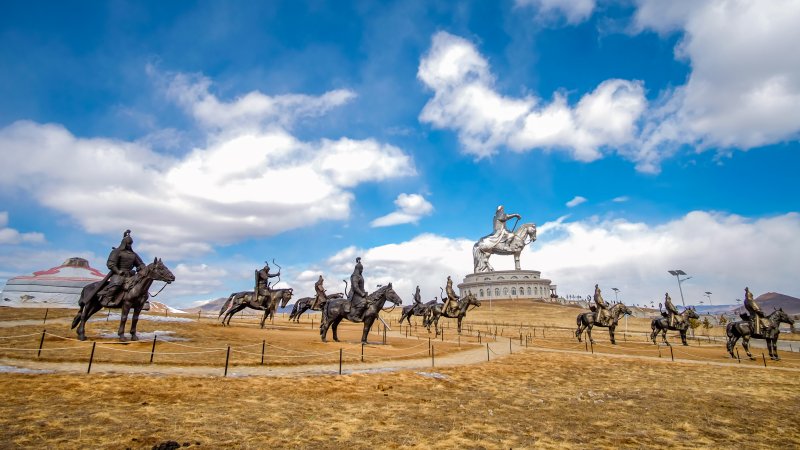
The Genghis Khan statue complex Ulaanbaatar, Mongolia. Credit: Adobe Stock - Nuttee
Khara-Khoto faced many problems much later. The Yuan Dynasty began to collapse and eventually was driven out of China by the armies of the Ming Dynasty (1368-1644) to Mongolia. Many Mongolian troops settled in Khara-Khoto, and no one attempted to pursue them. By 1372, they saw the possibility of conquering the country again and began to plan to reinvade China.
Soon, they discovered that it was a very unfortunate plane.
Ming Attack On Khara-Khoto Fortified City
Local legend says that China's Ming troops laid siege to the city that same year, but it took work. The town was so well-fortified that the Ming military forces could not take it. Instead, they had to use a cunning and cruel solution.
In 1372, a Mongol military general named Khara Bator (Mongolian: "Black hero") was surrounded by his troops by the armies of China's Ming dynasty. Ming troops found a way to divert the nearby Ejin River, the city's only water source that flowed outside the fortress. In this way, the enemy denied Khara-Khoto water for its wells and gardens.
As time passed, Khara Bator realized his fate. He killed his wife, children, and then himself. After his suicide, Khara Bator's soldiers waited within the fortress until the Ming finally attacked and killed the remaining inhabitants.
They knew they had to die of thirst or confront the Ming soldiers in combat. They chose the latter.
Another legend holds that Khara Bator breached the northwestern corner of the city wall and escaped through it. The Ming armies finally attacked and slaughtered the Mongols at Khara-Khoto. Afterward, the city was permanently abandoned and fell to ruin.
Researchers had to organize expeditions to the area to learn about the region's history and the city of Khara-Khoto. One of them was P. K. Kozlov, who arrived at the site and, with a dinner and gift of a gramophone to a local Torghut lord, Dashi Beile, the researcher obtained permission to excavate the Khara-Khoto ruins. Kozlov uncovered over 2,000 books, scrolls, and manuscripts in the Tangut language. Kozlov initially sent ten chests of manuscripts and Buddhist objects to St. Petersburg, returning in May 1909 for other things.
In June, the books and woodcuts were found while excavating a stupa outside city walls some 400 m (1,300 ft) westward.
Another researcher was Sir Aurel Stein, a Hungarian-born British archaeologist. Stein excavated Khara-Khoto during his third Central Asian expedition from July 1913 to February 1916, surveying Khara-Khoto for eight days at the end of May 1914. His findings have been described in his first volume of "Innermost Asia" (source below).
Written by – A. Sutherland - AncientPages.com Senior Staff Writer
Updated on Sep 28, 2023
Copyright © AncientPages.com All rights reserved. This material may not be published, broadcast, rewritten or redistributed in whole or part without the express written permission of AncientPages.com
Expand for references- Sato Takayasu 佐藤貴保. "Defense Challenges for the Capital of the Xi Xia (Tangut) Kingdom: Evidence from Research on Khara-Khoto Documents from around 1210." Central Asiatic Journal57 (2014): 201-08
Stein, Marc Aurel. "Innermost Asia Detailed Report of Explorations in Central Asia, Kan-Su and Eastern Īrān." source
More From Ancient Pages
-
 Ambition, Greed And Death: The Roman Roots Of ‘Game Of Thrones’
-
 Terrifying Buggane: Demonic And Tyrannical Celtic Demon That Hated Churches And Set Them On Fire
-
 Early Humans In The Paleolithic Age Had A More Varied Diet Than Previously Assumed
-
 Unusual 2,500-Year-Old Face Urns Reveal Garments, Appearance And Jewelry Of Prehistoric People
-
 Ouroboros: Ancient Infinity Symbol Used By Different Ancient Civilizations
-
 Towering Sacred Mt. Fuji: Abode Of The Immortals In Ancient Japanese Beliefs
-
 First Peoples Of Japan: Ainu Civilization And Its Unknown Origin
-
 Nicholas Owen ‘Little John’ Who Paid Highest Price For His Ingenious, Camouflaged Places To Hide
-
 Beautiful Ancient City Of Polonnaruwa With Hundred Of Tombs, Temples And Statues
-
 Tool Patterns Reveal What Caused The Neanderthals’ Extinction In The Iberian Peninsula
-
 Mysterious Ancient Shapeshifters Who Guided Humans And The Battle Of The Gods Described In Sacred Texts And Myths
-
 5,000-Year-Old Tavern With Food Remains Discovered In The Ancient Mesopotamian City Lagash
-
 Magnificent Etruscan Underground Burial With Beautiful Artifacts Discovered In Aleria-Lamajone, France
-
 Findings From The First Temple Period Discovered In The City of David Corroborate A Biblical Event
-
 Darabgerd: One Of The Oldest Cities Dated To Achaemenid Era
-
 8 Billion People: How Different The World Would Look If Neanderthals Had Prevailed
-
 What Can The 3D Reconstruction Of The Principia At Novae Reveal About Roman Propaganda?
-
 Lost Biblical City, Ancient Treasure And Atlantis – Biblical And Archaeological Perspective
-
 Mysterious Ancient Falicon Pyramid And Its Complex Obscure History
-
 Extraordinary Ancient Mosaics, Crucifixes, And Long-Lost Church Discovered In The Holy Land

