
Shu: Egyptian God Of Air, Symbol Of Life-Giving Breath And The One Who Separates Heaven From Earth
A. Sutherland - AncientPages.com - In Egyptian mythology, the god Shu was the god of air and of sunlight and represented a life-giving breath. In this function, he is seen by mythology as separating heaven from Earth.
Shu, whose name probably means: ‘emptiness’, ‘void’ or ‘dryness’ was a member of a group of nine gods that also included Atum, Tefnut, Geb, Nut, Osiris, Isis, Seth, and Nephthys.

They formed the Ennead that was worshipped at Heliopolis, one of the oldest cities of ancient Egypt occupied since the Predynastic Period, and home to the cult of the sun god Atum, who was first identified with Ra and later with Horus.
Shu was husband and brother of Tefnut, the goddess usually believed to symbolize moisture; the pair produced Geb, the god of the earth, and Nut, goddess of the sky.
An Egyptian myth tells that these two were constantly quarreling so Shu had to separate them. Nut kept swallowing the constellations (her own children) and Geb was very angry because every morning the stars disappeared. Shu had to lift Nut from Geb, separating Earth from heaven, and thus symbolically, he stands between Nut and Geb.
The widely known depiction shows Shu as a man standing, with his arms outstretched, and holding the body of the goddess Nut (or heaven) arched above him. It was not an easy task, so Shu created the Ogdoad (or Eight Infinite Ones), one pair to hold each of Nut’s limbs.
In the ‘Coffin Texts, a collection of ancient Egyptian funerary spells written on coffins, Shu confirms that he is self-sufficient by saying:
“I was not built up in the womb, I was not knit together in the egg.”
Shu was a very powerful god of the air, the protector of the Sun, and a god-pharaoh. He was the ancestor of the Pharaohs who, therefore, considered themselves his heirs.

Detail from the Greenfield Papyrus (the Book of the Dead of Nesitanebtashru). It depicts the air god Shu, assisted by the ram-headed Heh deities, supporting the sky goddess Nut as the earth god Geb reclines beneath. Credit: Public Domain
It is said, he ruled Egypt as its second mythological king, after the sun god, Ra. He was the creator of light and was sometimes called the father or begetter of the gods. Associated with life (ankh), change, and “eternal recurrence’, Shu is a symbol of the never-ending but continuously changing cyclical aspects of the world.
His divine existence was vital because he provided the air, indispensable for creatures to breathe and therefore to live. It was believed the wind was the god Shu’s ‘ba’. Like his sister/wife Tefnut, Shu also appeared sometimes as a lion but usually as a man wearing a false beard, an ostrich feather on his head and with the hieroglyph of his name, and carries an ankh, the symbol of life.
Shu is mentioned in the Pyramid Texts, the oldest ancient Egyptian funerary texts, dating to the late Old Kingdom, where the deceased king is purified in the ‘lakes of Shu’(probably a metaphorical expression, may represent mists) and then, the deceased is said to climb up to heaven upon the ‘bones of Shu’, and again, the bones are probably interpreted as clouds.
The god Shu was also associated with light, however, it is not exactly known why Shu was also associated with Thoth and Khonsu. Was it because they were lunar deities, or perhaps because his sister-wife Tefnut was also related to the moon?
In one myth found on a granite shrine dated to the Ptolemaic Period (332–30 BC), Shu ruled as king of Egypt for many years until he became very weak and tired. Then, he ascended to the heavens to accompany the sun god Ra.
The depiction of Shu, kneeling between two lions symbolizing Shu and Tefnut, and the horizons of yesterday and tomorrow, was discovered in the famous headrest in the tomb of Tutankhamun, as we see below.
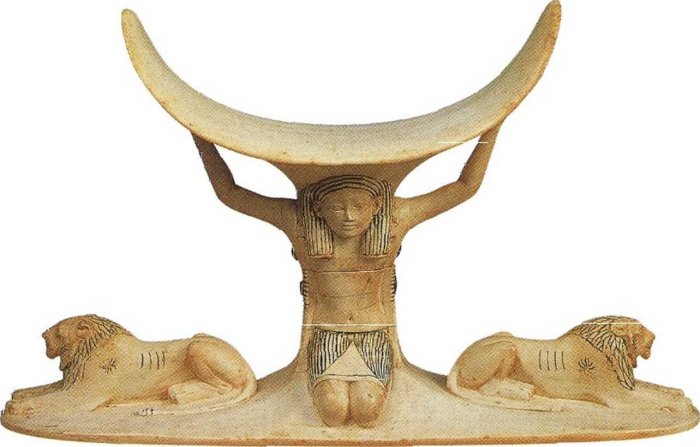
Ivory head-rest from the tomb of Tutankhamun showing the god Shu who supported the head of the king-symbolically the sun - as it ‘set’ and ‘rose’ between the lions of yesterday and the coming tomorrow. (Dated to 18th dynasty). Image credit: Egyptian Museum, Cairo.
Shu And The Judgement Of The Dead
The god Shu was one of the 42 judges and he helped to determine the fates of souls after death. Shu's main symbol is the ostrich feather, representing air. Interestingly, the goddess Maat (Ma'at) is also represented by the ostrich feather for a very different reason.
First, the judges would speak about the person's life, and then, the heart of the deceased was weighed on a scale against an ostrich feather representing the goddess Maat (Ma'at) who could see into the deepest secrets of the deceased.
If the heart was lighter, it would climb the ladder to heaven, held by Shu, but if it weighed more than the feather, the soul was eaten by the demon Ammit - 'devourer', or 'soul-eater'.
Shu Credited With Powers Associated With Renewing
Shu was worshiped in Heliopolis and Leontopolis (or ‘lion city’), now Tell-el-Muqdam). However, apart from early texts like the Pyramid Texts and Coffin Texts, the cult of this god is not attested until he reappears in several different texts dated to the New Kingdom.
See also: More Myths And Legends
With time, the god Shu was credited with powers associated with renewing the cosmos because the ancient Egyptians believed he was the one who filled the universe with the air, which was considered the breath of life.
Eventually, Shu was present in everyday prayer, and certain spells and magical texts to defeat negative and especially demonic threats. He was also represented in a number of other gods, including Osiris and Horus.
Written by – A. Sutherland - AncientPages.com Senior Staff Writer
Copyright © AncientPages.com All rights reserved. This material may not be published, broadcast, rewritten or redistributed in whole or part without the express written permission of AncientPages.com
Expand for referencesReferences:
Wilkinson, R. H. The complete gods and goddesses of ancient Egypt
More From Ancient Pages
-
 Ancient Codex Cospi: Intriguing Pre-Columbian Ritual Manuscript From Central Mexico
-
 Ivar The Boneless: Famous Viking And Son Of Ragnar Lodbrok
-
 Ceiba Tree: Sacred Tree Of Life Of Maya People And Universal Concept In Ancient Beliefs
-
 Fossil Teeth Reveal: Humans Were Present In Asia ‘20,000 Years Earlier’ Than Previously Thought
-
 Unexplained Encounters: Beings With Inhuman Eyes – A Darker Side Of Humanity Or Groundless Worries?
-
 Roman-era mass grave with 60 bodies found in farmer’s field
-
 Mysterious Shemsu Hor – Followers Of Horus Were Semi-Divine Kings And Keepers Of Sacred Knowledge In Predynastic Egypt
-
 Ancient Egyptian Temple, 30 Mummy Cards, 85 Tombs And Surveillance Points From The Era Of Ptolemy IIIs Discovered In Sohag
-
 Why Were Egyptian Pyramids Built Along Long-Lost Ahramat Branch Of The Nile?
-
 Erik The Red: Famous Viking Outlaw Who Colonized Greenland And Was Father Of Leif Erikson
-
 The Writing Ball: A Great Invention In 1870
-
 New Details On Discovery Of San Jose 300-Year-Old Shipwreck That Sank With Treasure Of Gold, Silver, And Emeralds
-
 Why Did Vikings Hide A Precious Silver Treasure Under The Thralls’ House?
-
 Sacrificial Remains From The Iron Age Unearthed Near Aarhus, Denmark
-
 Ruins Of Xunantunich – Mayan City That Once Flourished
-
 Uplistsikhe Devastated By Genghis-Khan Hordes But Once City-Fortress Of Queen Tamar
-
 Archaeologists Found A 16th-Century Shipwreck Of Merchant Ship Close To Saint-Tropez, France
-
 Sarcophagus Of Pharaoh Ramesses II Found In Abydos, Egypt
-
 Unexplained Ancient Encounters With Shining Beings Who Appeared Out Of Nowhere – Who Were They?
-
 Roman Roads Laid The Foundation For Modern-Day Prosperity – New Study Claims

