
Ruins Of Xunantunich – Mayan City That Once Flourished
A. Sutherland - AncientPages.com - Xunantunich, a major ceremonial center of the Maya Civilization, is an ancient Maya archaeological site atop a ridge above the Mopan River, about 80 miles (130 km) west of Belize City, Cayo District, in western Belize.
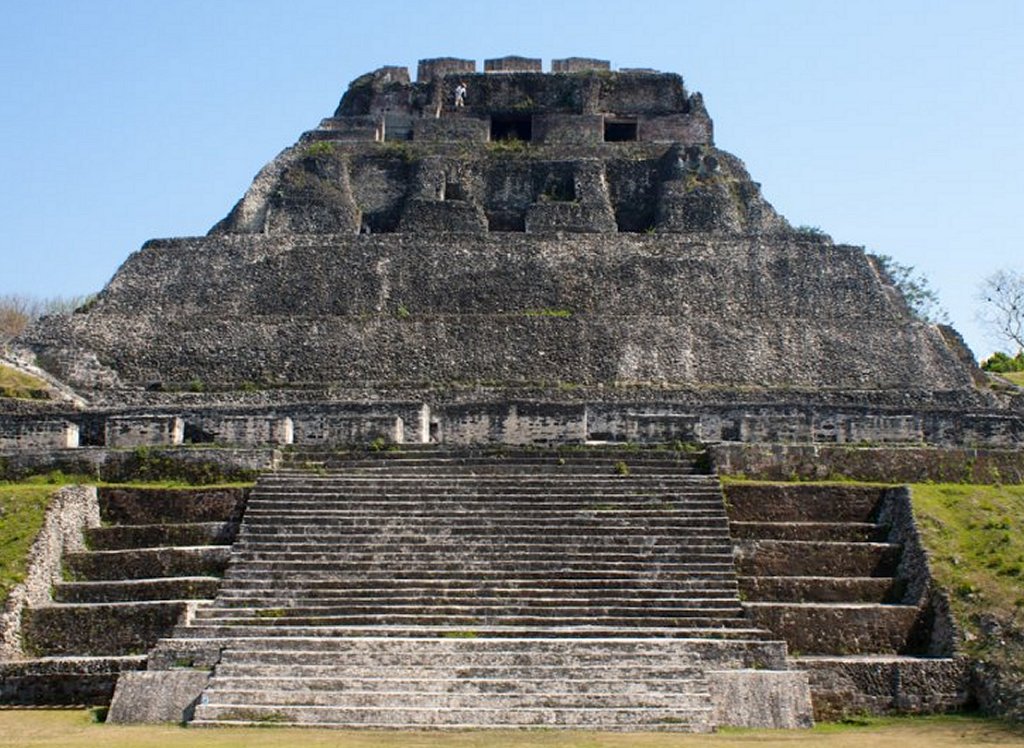
"El Castillo" at Xunantunich. Photo credits: - CC BY-SA 4.0
It comprises six major plazas, surrounded by over twenty-five temples and palaces.
The name 'Xunantunich' derives from the Yucatec Maya language and means 'Stone Woman' (or "Lady of the Rock"). It is a modern name; its ancient name is currently unknown.
Local legend holds that around the end of the 1800s, a man from the village of San Jose Succotz went hunting near the site and suddenly saw a beautiful statuesque Maya maiden standing motionless in the rays of the rising sun near the mouth of a cave, which extended beneath the giant structure.
Stricken by her appearance, the man threw his gun aside and ran downhill to the village. After recounting his tale, several villagers led by the native priest returned to the site.
Arriving at the large mound, they found the mouth of the tunnel, but the stone maiden had disappeared. After that, locals claim that the woman has appeared to several others, but none have been able to follow her into the cavern.
Xunantunich was first explored in the 1800s by Dr. Thomas Gann, a British medical officer who later returned to the ancient place. As records state, he unearthed many Maya treasures, the history of which have been lost and the whereabouts unknown.
The place was occupied perhaps as early as 300 B.C., but most of the Maya architecture there was developed in the late classic period. Later, the inhabitants of Xunantunich continually built new temples and residences over older buildings, enlarging the ceremonial center by raising the platforms and structures in the process.
Xunantunich has a very representative structure known as The Castle (El Castillo), which is the second tallest pre-Columbian building in Belize after the Temple of El Caracol, reaching a height of 40 meters from; it offers from the top an impressive view of the jungle canopy, the other ruins, and even beyond the border.
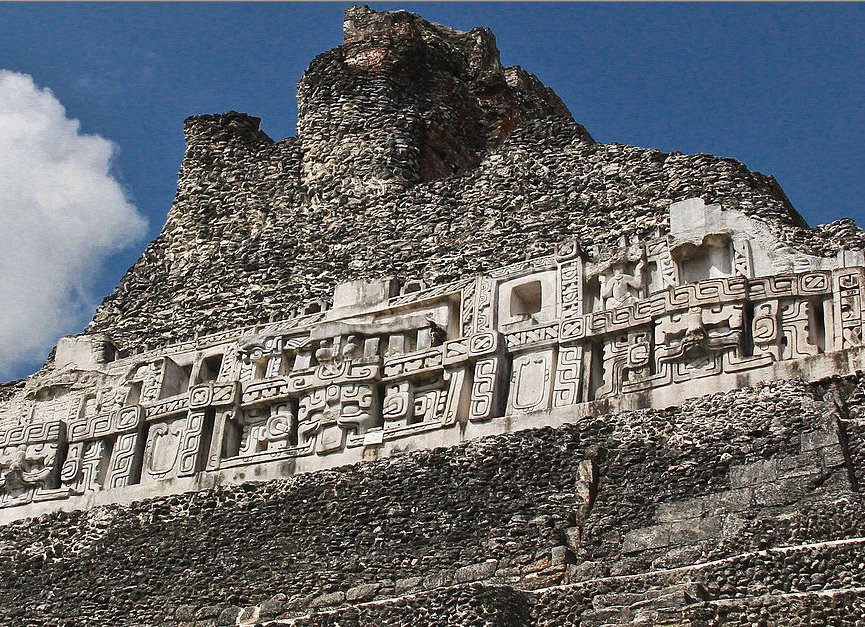 Carvings on the peak of the El Castillo pyramid (Structure A6) at Xunantunich, Belize. Image credit: - CC BY 2.0
The site's name comes from the Yucatec Maya for Stone Woman and is a modern name, like those given to many other archaeological sites in Mesoamerica. Old names still need to be discovered. According to Belizeans, the stone woman refers to a ghost that lives in the archaeological zone. The ghost is all black, and his eyes are lit like fire.
The figure usually appears before the Castle and then ascends the stone steps to disappear into the stone wall. After Xunantunich ceased being a famous ceremonial and civic center, some people continued to occupy its area or perhaps reoccupied it. The excavations of Xunantunich have confirmed that the Maya people lived in the Belize region for centuries.
Later, extensive archaeological work was done in Xunantunich, now an impressive, well-excavated, and easily accessible Mayan site.
Xunantunich was a thriving Mayan city during the Classic Period. The hills were first occupied between 400 BC and 200 BC, and it was in 600 AD that Xunantunich was first used as a ceremonial site, making the entire site some 1400 years old. The site has an ancient ball court where intense pok ta pok ball games were organized, and the loser of the game faced sudden death.
However, the Maya warriors often lost their heads regardless of whether they won. Not far from Xunantunich, there is a mysterious cave that was important for Mayan rituals and human sacrifice.
Interestingly, during a time when most of the Mayan civilizations were crumbling, Xunantunich was managing to expand its city and its power over other areas within the valley. Around 1000 AD, however, Xunantunich was abandoned.
Written by – A. Sutherland - AncientPages.com Senior Staff Writer
Updated on January 14, 2024
Copyright © AncientPages.com All rights reserved. This material may not be published, broadcast, rewritten or redistributed in whole or part without the express written permission of AncientPages.com
Expand for referencesMore From Ancient Pages
-
 Intrepid Southern Voyage In The Wake Of Early Waka
-
 Last Of The Giant Camels And Archaic Humans Lived Together In Mongolia Until 27,000 Years Ago
-
 Medieval Mythbusting – New Research Rewrites History Of Glastonbury Abbey
-
 Strange Tales Of Loughareema – The Vanishing Lake Where People Are Lost
-
 Dramatic Story Of Charlotte Corday And The Assassination Of Marat – Was She A Coldblooded Murderess Or Courageous Female Hero?
-
 Unsolved Archaeological Mystery Of Ta Prohm Temple, Cambodia
-
 Enigmatic Powers Of Albertus Magnus – Legends Of Unexplained Phenomena
-
 On This Day In History: Edict Of Longjumeau Was Signed And Ended Second War of Religion – On Mar 23, 1568
-
 Explorer Discovered A Lost Underground World Beneath Big Sur In North America – But Why Cannot Anyone Else Find It Now?
-
 Vast Network Of Previously Unknown European Bronze Age Megastructures Discovered
-
 4,500-Year-Old Ramp Might Explain How Huge Stones Were Transported To Great Pyramids’ Building Site
-
 Circular-Shaped 4000-Year-Old Wooden Henge Discovered In Yorkshire, Historic County of Northern England
-
 Major Discovery Of A Complete Ancient Roman City In Luxor, Egypt
-
 Strange Ancient Measurements Of The Earth Revealed – Ancient Texts And Physical Evidence Examined
-
 Paleolithic Workshop Unearthed In The İnkaya Cave In The Turkish Western Province Of Çanakkale
-
 Largest Ancient Embalming Cachette Ever Found Unearthed At Abusir, Egypt
-
 Lady SAS – Ancient Skeleton Of Foreign Woman Found In Palenque – Who Was She?
-
 Return Of Pahana – The Lost White Brother Of The Hopi And The Sacred Tablet
-
 Mysterious Inca Citadel With Platforms, Passages And Walls Discovered In Peru’s Rainforest
-
 Remote North Atlantic Islands Were Settled By An Unknown Group Of Humans Centuries Earlier Than Thought

