
Giants Of Monte Prama – Mysterious Ancient Statues With Unearthly Eyes
Ellen Lloyd - AncientPages.com - In 1974, remarkable ancient stone sculptures were accidentally discovered in farmland near Monte Prama, Sardinia. These huge statues are unique in size and material, and very little is known about them.

Credit: Monte Prama Italy
These mysterious ancient statues that do not resemble ordinary humans were deliberately hidden in the basement of a museum. It is commonly believed that they belong to the Nuragic civilization, which flourished on Sardinia for two millennia until the second century AD. Excavations revealed 30 gigantic stone statues, about two meters high.
The statues do not resemble ordinary humans. Instead, these mysterious ancient figures are distinguished by their unearthly eyes, consisting of two perfectly concentric circles and a very small, almost invisible mouth.
The giants of Monte Prama were given the name the "Kolossoi" by the archaeologist Giovanni Lilliu. They were discovered at a necropolis, so one theory is that the stone warriors guarded the tombs.
However, it has also been suggested that they belonged to an as-yet-undiscovered nearby temple. It's the only group of sculpted life-sized warriors ever found in Europe.
In some aspects, the figures remind of the famous Chinese terracotta warriors. However, their appearance and material differ. Compared to the terracotta warriors, the Sardinian Giants of Monte Prama are 500 years older, and they are made of stone rather than pottery.
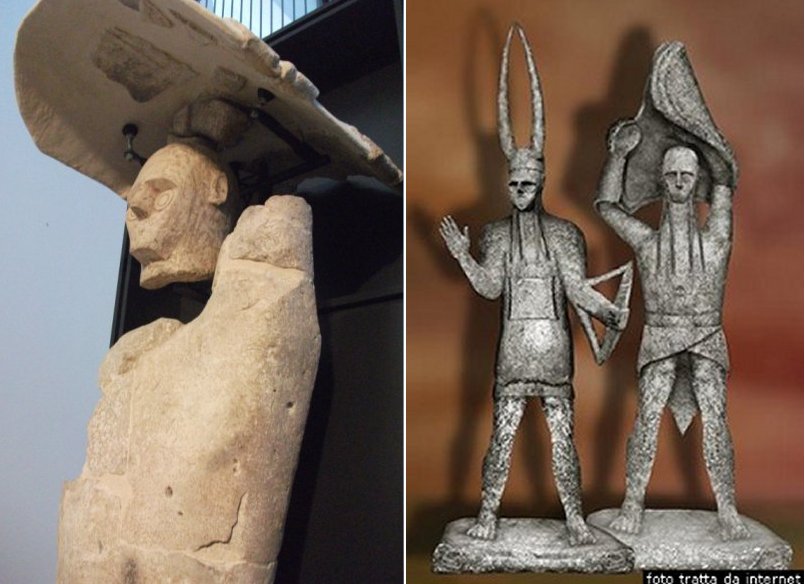
Giants of Monte Prama - Did the stone warriors guard tombs?
The giants of Monte Prama are undoubtedly one of the most incredible and astonishing discoveries ever made on the Italian island of Sardinia. Yet, no research was done, and there appeared to be no interest in these enigmatic 2,700-years-old ancient figures that some refer to as prehistoric cyber warriors.
Unfortunately, shortly after the discovery, the giants of Monte Prama were "abandoned" for 32 years in the museum of Cagliari. They were placed in a damp and dark placement.
It was not until recently that funds were set aside for the daunting task of reconstructing the statues, which also include representations of nuraghe, the tower-fortresses after which the Nuragic civilization is named.
The figures were not found intact. Archaeologists discovered more than 5,000 pieces, including fifteen heads and twenty-two torso, at the site, and it is unknown if everything has been found. It has been a great demanding challenge to put together the pieces. Fragmented into numerous pieces, it is believed that the fragments came from a total of forty-four statues.

More than 5,000 pieces had to be put together to create the statues.
"We don't know how many there were altogether. Nor do we know if they were originally set out in lines or perhaps in squares," said Alessandro Usai, the curator of the permanent exhibition, which opens on March 22, 2014 at the national archaeological museum, in Cagliari.
The reconstruction, which was completed in 2011, took four years. Researchers carefully cleaned the pieces and re-assembled the warriors using supports rather than glue the bits and modern plaster and stone to make them look like they did when new.
Twenty-five of the warriors are now intact once again and will go on display starting this summer at the Cagliari Museum in southern Sardinia.

More than 5,000 pieces had to be put together to create the statues.
There are three different types of fighters represented: 16 "boxers," bearing shields over their heads, six archers, and six other warriors, accessorized with bows, shields, swords, chest armor, and horned helmets.
Also re-assembled from the fragments are 13 models of nuraghe, massive conical stone castles built by the Nuragic culture.

Giants of Monte Prama - Did the stone warriors guard tombs?
Usai said 28 of the works would go on show in Cagliari, while another 10 would be displayed in Cabras, where it is hoped the Giants will help promote tourism.
Usai pointed out that the three-dimensional digital representations of the missing statues would be created at each site, "so that the two exhibitions will be complementary".
Written by - Ellen Lloyd - AncientPages.com
Copyright © AncientPages.com & Ellen Lloyd All rights reserved. This material may not be published, broadcast, rewritten or redistributed in whole or part without the express written permission of AncientPages.com and Ellen Lloyd
More From Ancient Pages
-
 Why Human Languages Can Be Likened To Branches On A Tree And Help Finding A Single Common Ancestor
-
 Aztecs’ Five Suns Creation Myth And Prophecy
-
 Who Were The Goths And Where Did They Come From?
-
 Mayapan: How The Last Big Mayan City Met Its End
-
 Surprising Discovery – Replica In The Field Museum Is A 3,000-Year-Old Sword
-
 Pax Romana: 200-Year-Long Period Of Stability Within The Roman Empire
-
 Two Rare Full-Sized Viking Burial Ships Uncovered In Sweden
-
 Unique 2,700-Year-Old Seal That Belonged To ‘Governor Of The City’ Of Jerusalem Discovered
-
 Sculpture Of Lord Vishnu Dated To The Early 9th Century Found In Kashmir
-
 Amazing Tomb Of Yuya And Tjuyu Filled With Ancient Treasures In The Valley Of The Kings
-
 Ancient Flying Canoes And Magic In The Pacific – Arrival Of Strange People – Part 1
-
 Ancient Dragon Stone That Inspired Legends Discovered In Turkey
-
 On This Day In History: Treaty Of Worms Signed Between Great Britain, Austria And The Kingdom Of Sardinia – On Sep 13, 1743
-
 First Chinese Murals Unearthed In Shimao Ruins Are Over 4,000 Years Old
-
 Nastrond (Náströnd): Grisly Hall Of Corpses – Norse Vision Of Most Terrible Place In Niflheim, Kingdom Of The Dead
-
 Tree Rings On the Oregon Coast Show Evidence A Tsunami That Struck The Pacific Northwest In 1700
-
 Rings Of Moray – Sophisticated Irrigation System In Sacred Valley Of The Incas, Peru
-
 New Evidence Vikings Failed To Wipe Out Communities And Anglo-Saxon Monasteries
-
 Cornucopia – ‘Horn Of Plenty’ – Ancient Symbol And Its Almost Forgotten Meaning
-
 Richard The Lionheart: Famous Leader, Warrior And Military Mastermind But Not The Best English King

