
What Is Pax Sinica?
AncientPages.com - Pax Sinica (in Latin:"Chinese peace") was similar in its meaning to Pax Romana, and it applied to the period of peace in East Asia, maintained by social, cultural, ideological, or economic influence of China.
The Pax Sinica is considered the Chinese version of the Romans' Pax Romana, a period of relative peace and stability across the Roman Empire which lasted for over 200 years.
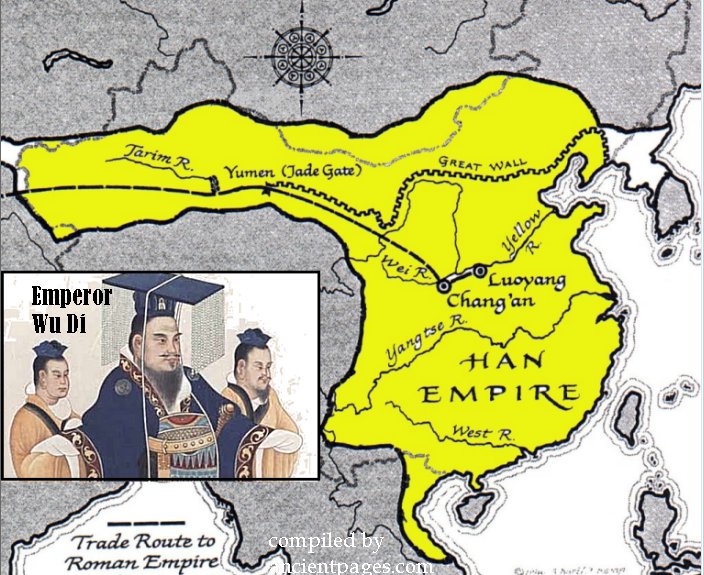
China Han Dynasty Empire - 206 B.C to 220 AD
When the high-ranking emperor of Han, Liu Pang (202 – 195 BC) founded the Han Dynasty in 202 BC, the Chinese began to experience a 400 year period of peace, known as the Pax Sinica.
It had various ways to manifest itself but it first of all concentrated on some basic innovations that were of great importance for the country.
The Han rulers established a strong central government formed of carefully chosen candidates instead of members of the royal family.
The government had to work in the people’s interest. It helped and protected the Chinese citizens, mainly by peace and prosperity.
See also:
Pax Romana: 200-Year-Long Period Of Stability Within The Roman Empire
Pax Mongolica: Time Of Peace And Stability That Helped To Spread Technologies And Inventions
Pax Assyriaca: Important Time For The Neo Assyrian Empire And Surrounding Regions
Among several introduced innovations was the storage of remaining food during times of plenty and selling it during difficult times. It stabilized both prices and feeding the public.
During this time, the Great Wall of China was built, the long-distance travel and trade, which was used to trade silk, spices, and tea with the Roman Empire, also prospered on the Silk Road.
During the Pax Sinica, several developments of the Han Dynasty took place such as the civil service, the first papermaking process was documented in China during the Eastern Han period (25–220 AD). In 140 BC, the land expanded due to conquests of Korea, Manchuria, and Vietnam by Han emperor, Han Wudi.
After the Han Dynasty ended in 220 AD, the Pax Sinica continued during a period of the next six dynasties (the Western Zhou, Tang, Western Han, Eastern Han, Ming, and Qing dynasties), which lasted for over 350 years.
As we said, the Pax Sinica introduced by Han dynasty of China coincided with the Pax Romana of the western world by Rome.
Copyright © AncientPages.com All rights reserved. This material may not be published, broadcast, rewritten or redistributed in whole or part without the express written permission of AncientPages.com
More From Ancient Pages
-
 On This Day In History: Battle Of Marton, Part Of Viking Invasions Of England Took Place – On Mar 22, 871
-
 Resourceful Pre-Hispanic Society In Bolivia Had Flourishing Agriculture Despite Harsh Environment Of The Andes
-
 Ancient DNA Reveals Bronze Age Women Altered Genetic Landscape Of Orkney
-
 Copper Artifacts Reveal New Cultural Connections In Southern Africa
-
 On This Day In History: Battle Of Pinkie Was Fought – On September 10, 1547
-
 Surprising Time Capsule In Antarctica – Evidence Of Toxic Heavy Metal Pollution 800 Years Ago
-
 British Museum Is World’s Largest Receiver Of Stolen Goods – Says QC
-
 Llanbadoc Discovery: Late Medieval Artifact And The Battle Of Usk
-
 Beautiful Temple Dedicated To Ninhursag, Goddess Of Childbirth And Divine Protector Of Wild Animals
-
 Facial Reconstruction Of Ancient Inhabitants Of Sagalassos Make Them Almost Real
-
 Mystery Of The Ancient Talayot Sword
-
 Early Christian Landmark – Re-Evaluation Of Its Architecture And Practices
-
 Huge Viking Burial Discovered Beneath Streets Of Dublin
-
 Rock-Cut Tomb Of Pennut, Viceroy Of Nubia Under Reign Of Ramses VI
-
 Centeotl: Lord Of Maize Who Was Revered Before The Olmecs By All Mesoamerica’s Inhabitants
-
 Magical Ring Of Gyges And Its Power To Be Invisible At Will
-
 Ancient Greek Costumes, Masks And Theater In Focus
-
 Amazing Victorian Time Capsule – 135-Year-Old Message In A Bottle Found In Edinburgh
-
 Freya And Her Lovely Husband Odr, God Of Summer Sun And Passion In Norse Mythology
-
 Oldest DNA From Domesticated American Horse Solves An Legendary Shipwreck Mystery

