AncientPages.com - Most people imagine philosophers as rational thinkers who spend their time developing abstract logical theories and strongly reject superstitious beliefs. But several 20th-century philosophers actively investigated spooky topics such as clairvoyance, telepathy – even ghosts.

Hamlet and the Ghost by Frederick James Shields (1901). Manchester Art Gallery
Many of these philosophers, including Henri Bergson and William James, were interested in what was called “psychical research”. This was the academic study of paranormal phenomena including telepathy, telekinesis and other-worldly spirits.
These thinkers attended seances and were attempting to develop theories about ghosts, life after death and the powers exhibited by mediums in trances. My recent archival research has been looking at how these topics shaped 20th-century philosophy.
CD Broad (1887-1971) was a professor of philosophy at the University of Cambridge. He is now recognised as one of the most important writers on the philosophy of time. He also published on ethics, logic and the history of philosophy. What is less known, though, is that he was an active member of the Society for Psychical Research, a learned society dedicated to the study of paranormal phenomena. The society twice elected him as their president, and he published widely on topics including clairvoyance and poltergeists.
In his 1925 book, The Mind and Its Place in Nature, Broad developed what has come to be known as the “compound theory” of ghosts. Broad argued that the human mind was a compound of two components. One of these was the “physical factor,” roughly corresponding to the body. The other one was the “psychic factor,” which carries our mental content like emotions or thoughts. The two of them conjointly form the human mind – just like salt is composed of sodium and chloride.
Broad believed that after death, the psychic factor can continue existing for a bit on its own and might enter, like a spirit, a medium during a seance.
Images in the ether
Another philosopher interested in ghosts and spirits of the dead was HH Price (1899-1984). He was a professor of logic at the University of Oxford and is mostly known for his publications on the philosophy of perception. However, just like Broad, he was heavily involved in the Society for Psychical Research and attended several international conferences dedicated to life after death and telepathy.
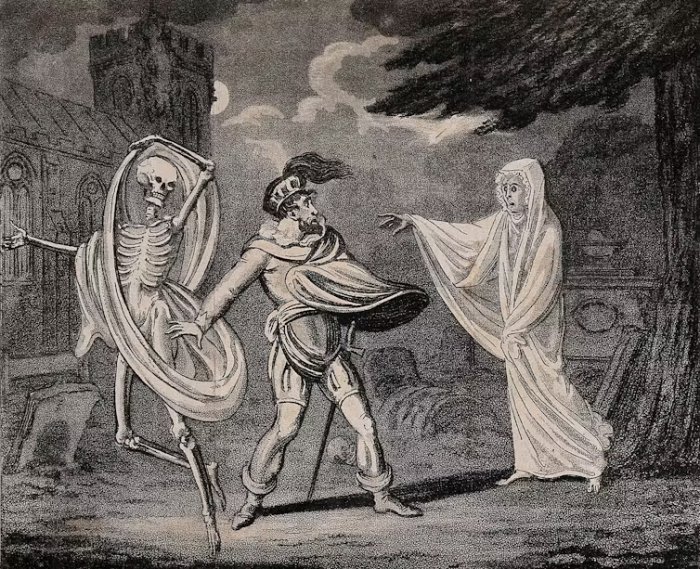
Price believed ghosts could appear to sensitive people. Wellcome Collection, CC BY
In his presidential address to the society in 1939, Price tried to offer an explanation of ghosts and hauntings.
At any given moment, he argued, your mind is full of “mental images” – the memory of your last holiday, the things you see outside your window, your hopes and expectations for the future. Price theorised that there is a substance, which he called the “psychic ether” that exists halfway between matter and the human mind. He believed that this ether could carry the images that currently exist in your mind even after you die. A bundle of these images and memories can appear as a ghost to some particularly sensitive people.
What does ‘ghost’ mean?
Casimir Lewy (1919-1991) was one of the most influential philosophical logicians of the 20th century. He spent most of his career at the University of Cambridge – in fact, the philosophy faculty library there is named after him.
Lewy is now mostly known for his work on logic, and few people know that he actually wrote his PhD thesis (which was examined by Broad) on life after death.
He was primarily interested in language and in the meanings of the terms people use when they talk about ghosts and life after death. What does it mean to say that I might survive the death of my body? What sort of experiences would I need to have as a ghost for the statement “I have survived my death” to be true? Would I have to be able to see myself in the mirror, or to speak to people in the seance room?
Lewy insisted that these questions need answering before looking at the empirical “evidence” for ghosts.
Following a series of scandalous and widely publicised discoveries of fraudulent mediums faking their supernatural powers and accusations of pseudo-scientific research methods, psychical research eventually moved to the fringes of academia. Lewy, for example, never returned to write on these topics after passing the defence of his PhD in 1943.
Nevertheless, despite its brief lifespan, academic psychical research had a significant influence on an entire generation of British philosophers. It shaped their views on time, causation and matter, and gave them an opportunity to think one of life’s most pressing questions: what happens after we die?
Provided by The Conversation
This article is republished from The Conversation under a Creative Commons license. Read the original article.