
Stonehenge May Have Aligned With The Moon As Well As The Sun
AncientPages.com - When it comes to its connection to the sky, Stonehenge is best known for its solar alignments. Every midsummer’s night tens of thousands of people gather at Stonehenge to celebrate and witness the rising Sun in alignment with the Heel stone standing outside of the circle. Six months later a smaller crowd congregates around the Heel stone to witness the midwinter Sun setting within the stone circle.
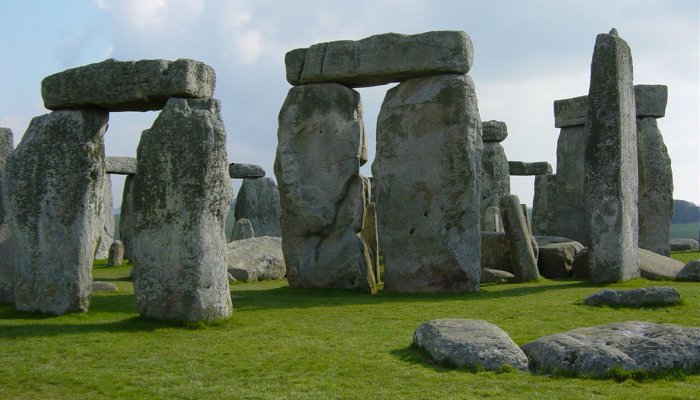
Image credit: Daveahern - Public Domain
But a hypothesis has been around for 60 years that part of Stonehenge also aligns with moonrise and moonset at what is called a major lunar standstill. Although a correlation between the layout of certain stones and the major lunar standstill has been known about for several decades, no one has systematically observed and recorded the phenomenon at Stonehenge.
This is what we are aiming to do in a project bringing together archaeologists, astronomers and photographers from English Heritage, Oxford, Leicester and Bournemouth universities as well as the Royal Astronomical Society.
There is now an abundance of archaeological evidence that indicates the solar alignment was part of the architectural design of Stonehenge. Around 2500 BC, the people who put up the large stones and dug an avenue into the chalk seemed to want to cement the solstice axis into the architecture of Stonehenge.
Archaeological evidence from nearby Durrington Walls, the place where scientists believe the ancient people who visited Stonehenge stayed, indicates that of the two solstices it was the midwinter one that drew the largest crowd.
But Stonehenge includes other elements, such as 56 pits arranged in a circle, an earthwork bank and ditch, and other smaller features such as the four station stones. These are four sarsen stones, a form of silicified sandstone common in Wiltshire, that were carefully placed to form an almost exact rectangle encompassing the stone circle.
Only two of these stones are still there, and they pale in comparison to their larger counterparts as they are only a few feet high. So what could their purpose be?
Lunar standstill
The rectangle that they form is not just any rectangle. The shorter sides are parallel to the main axis of the stone circle and this may be a clue as to their purpose. The longer sides of the rectangle skirt the outside of the stone circle.
It is these longer sides that are thought to align with the major lunar standstill. If you marked the position of moonrise (or set) over the course of a month you would see that it moves between two points on the horizon. These southern and northern limits of moonrise (or set) change on a cycle of 18.6 years between a minimum and a maximum range – the so-called minor and major lunar standstills, respectively.
The major lunar standstill is a period of about one and a half to two years when the northernmost and southernmost moonrises (or sets) are furthest apart. When this happens the Moon rises (and sets) outside the range of sunrises and sets, which may have imbued this celestial phenomenon with meaning and significance.
The strongest evidence we have for people marking the major lunar standstill comes from the US southwest. The Great House of Chimney Rock, a multi-level complex built by the ancestral Pueblo people in the San Juan National Forest, Colorado, more than 1,000 years ago.
It lies on a ridge that ends at a natural formation of twin rock pillars – an area that has cultural significance to more than 26 native American tribal nations. From the vantage point of the Great House, the Sun will never rise in the gap between the pillars.
However, during a major standstill the Moon does rise between them in awe-inspiring fashion. Excavations unearthed preserved wood that meant researchers could date to the year episodes of construction of the Great House.
Of six cutting dates, four correspond to major lunar standstill years between the years AD1018 and AD1093, indicating that the site was renewed, maintained or expanded on consecutive major standstills.
Returning to southern England, archaeologists think there is a connection between the major lunar standstill and the earliest construction phase of Stonehenge (3000-2500 BC), before the sarsen stones were brought in.
Several sets of cremated human remains from this phase of construction were found in the southeastern part of the monument in the general direction of the southernmost major standstill moonrise, where three timber posts were also set into the bank. It is possible that there was an early connection between the site of Stonehenge and the Moon, which was later emphasised when the station stone rectangle was built.
The major lunar standstill hypothesis, however, raises more questions than it answers. We don’t know if the lunar alignments of the station stones were symbolic or whether people were meant to observe the Moon through them. Neither do we know which phases of the Moon would be more dramatic to witness.
A search for answers
In our upcoming work, we will be trying to answer the questions the major lunar standstill hypothesis raises. It’s unclear whether the Moon would have been strong enough to cast shadows and how they would have interacted with the other stones. We will also need to check whether the alignments can still be seen today or if they are blocked by woods, traffic and other features.
The Moon will align with the station stone rectangle twice a month from about February 2024 to November 2025, giving us plenty of opportunities to observe this phenomenon in different seasons and phases of the Moon.
To bring our research to life, English will livestream the southernmost Moonrise in June 2024, and host a series of events throughout the year, including talks, a pop-up planetarium, stargazing and storytelling sessions.
Across the Atlantic, our partners at the US Forest Service are developing educational materials about the major lunar standstill at Chimney Rock National Monument. This collaboration will result in events showcasing and debating the lunar alignments at both Stonehenge and at Chimney Rock.
Provided by The Conversation
This article is republished from The Conversation under a Creative Commons license. Read the original article.
More From Ancient Pages
-
 Unique Page From Rare Illuminated Manuscript And Thousands Of Treasures Found Under The Floor Of Oxburgh Hall
-
 Dunino Den: Mysterious And Sacred Ancient Site In Scotland With Enigmatic Rock Faces And Symbols
-
 Amazing Prehistoric Forest Submerged Under Water Thousands Of Years Ago Re-Emerges On Welsh Beach
-
 Extremely Rare Ancient Gold Glass With Goddess Roma Found During Subway Works In Rome
-
 Oseberg Ship: Amazingly Well-Preserved Viking Burial Ship
-
 Mystery Of The Horrible ‘Thing’ Found In A Dominican Monastery
-
 Halloween: Facts And History About All Hallows’ Eve And Its Connection With Samhain – An Ancient Celtic Festival
-
 Paracelsus: Physician, Alchemist, Philosopher Well Ahead Of His Time
-
 Battle Of Abrittus: Roman Emperor Decius And His Troops Ambushed And Defeated By Invading Goths
-
 Huge Viking Hall From Harald Bluetooth’s Time Discovered In North Jutland
-
 Mysterious Old Ship With No Crew Reaches The Canadian Coast
-
 Cosquer Cave And Its Magnificent Underwater Stone Age Paintings Created 27,000 Years Ago
-
 Mama Cocha – Inca Goddess Of The Sea With Strong Connection To Lake Titicaca, Peru
-
 Mysterious Cave With Giant Skulls Decorated By The Neanderthals Discovered In Spain
-
 Island Archaeology Could Be A Model For Space Exploration
-
 Ancient People Dressed Baby Boys In Blue To Ward Off Evil Spirits
-
 What Can Fossil Footprint Discoveries Tell Us About The Past?
-
 Stunning 2000-Year-Old Roman Silver Dagger Used By Legendary Germanic Warriors Discovered By Teenager
-
 Abydos: One Of The Most Important Cities Of Ancient Egypt
-
 Ancient DNA Reveals: Iberian Males Were Almost Completely Replaced Between 4,500 And 4,000 Years Ago

