
What Is The History Of Pancakes?
Conny Waters—AncientPages.com—The term "pancake" may have emerged in the 15th century and became standard in 19th-century America, but the history of pancakes stretches much further back.
Astonishingly, evidence from Ötzi, a Stone Age man whose mummified remains were discovered in the Alps in 1991, suggests that he consumed a form of rudimentary pancake over 5,300 years ago. This shows that our love for pancakes is deeply rooted in human history.
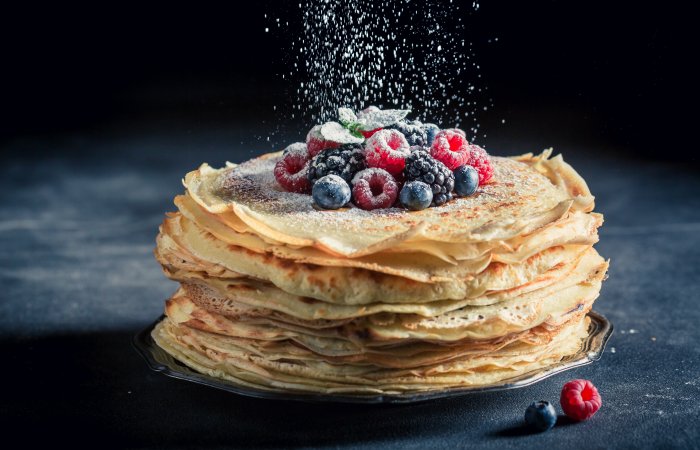
Credit: Adobe Stock - shaiith
In fact, scientists suggest that pancakes were enjoyed as far back as 30,000 years ago, during the Stone Age.
The examination of starch grains on grinding tools indicates that Stone Age culinary practitioners were producing flour from cattails and ferns. Researchers hypothesize that this flour was potentially combined with water and baked on a heated rock, possibly lubricated for the process.
Needless to say, Stone Age people did not say they were eating "pancakes". However, the outcome might have closely resembled hardtack rather than the contemporary crepe, hotcake, or flapjack. However, the underlying concept remained consistent: a flat cake concocted from batter and subsequently fried.
According to historians, "any primitive grain or tuber, dried, pounded and moistened, could have given rise to the very first pancake. With the domestication of wheat in the Fertile Crescent, corn in the Americas and rise in Asia, not to mention the countless other starchy staples cultivated around the globe, the pancake would find expression in countless forms." 1
The widespread popularity of pancakes can be attributed to their numerous benefits. Their versatility allowed them to serve as a perfect accompaniment for thick sauces, and their portability made them a convenient food choice.
Early versions of rolled crêpes were commonly sold in bustling street corners of ancient villages and towns. The batter's adaptability meant it could incorporate various ingredients, from classic blueberries to onions, dried shrimp, or pork - essentially anything that could be enveloped in batter.
Due to their affordability and nutritional value, pancakes became a staple for laborers involved in strenuous construction work and other demanding tasks. They were enjoyed across all social classes - from modest cottages to opulent palaces, making pancakes a universal delight.
The origins of the first pancake remain a mystery, with no clear record of when and where it first made its appearance. However, historical texts do mention the existence of flat cakes like 'libum', which were used in Roman sacrificial rituals.
"Even the ancient Hebrews served the Lord a form of pancake. In Chronicles 23:29 the Levites are given the responsibility for the bread offerings, fried pastries, and "that which is baked in the pan".
Among their cakes, the Greeks had a flat cake known as plakous, which actually means flat and which came to be known in Latib strangely enough as 'placenta' (from Greek plakounta in the accusative). The modern anatomical use of the term derives from its resemblance to the original pancake from. Some of these cakes were almost certainly cooked in ways that to our sensibilities must be types of pancake, but in general they are more closely related to what we think of as a cheesecake, containing honey, cheese, and flour," Ken Albala writes in his book Pancake: A Global History.
Galen, a second-century Greek physician and philosopher, mentions pancakes in his work Alimentorum facultatibus. He writes the cakes "appear to be just flour and water batter (or perhaps a dough) fried in oil and turned a few times. Some mix in honey or oil, he adds." 1

People of all ages and nations love pancakes. Credit: Adobe Stock - Lightfield Studios
Galen does not offer a specific recipe, but historians firmly believe that what he referred to as "pour-cakes" are indeed some of the earliest versions of pancakes.
Albala explains that “the very first pancake-like recipe is found in the Middle Ages, and is none other than the French crêpe. But this word did not mean what it later came to signify – a large, thin and floppy pancake. Remarkably, the word itself descends from the word for crisp, and is related to older forms of crisp fritter which in Latin were known as crispis (meaning curly, which these first crisps probably were). In Italian these became known as crispelli or crespelle, the later of which still survive, though like crêpes they began deep-fried fritters and only later became think pancakes." 1
So, there is no doubt that pancakes are popular all over the world, and they are much older than most realize.
Written by Conny Waters – AncientPages.com Staff Writer
Copyright © AncientPages.com All rights reserved. This material may not be published, broadcast, rewritten or redistributed in whole or part without the express written permission of AncientPages.com
Expand for referencesMore From Ancient Pages
-
 Ancient Maya Destroyed Their Environment 2,000 Years Ago – Effects Are Still Visible Today
-
 Dramatic Life Story Of Queen Marie Antoinette Executed By Guillotine During The French Revolution
-
 Christian Church And Large House Unearthed In Ancient Laodicea, A Major Hub Of Christianity
-
 Secret Knowledge Revealed: Mastermind Imhotep’s Connection To The Mysterious Shemsu Hor – The Followers of Horus
-
 Stone Age Europe Had Nine Distinct Cultures – Ancient Jewelry Reveals
-
 Qijia Culture – Its Disappearance Remains An Ancient Mystery
-
 Mysterious Ancient Tomb Reveals ‘Impossible’ Cosmic Connection – Wrong Identity – Part 1
-
 Oldest Surviving Drinking Straws Identified – ‘Sceptres’ From The Maikop Kurgan
-
 Statue Of Goddess Cybele Looted In The 1960s Returned To Turkey
-
 Evidence Of Advanced Military Robots In The Ancient World – Unknown High-Tech Examined
-
 Undeciphered Singapore Stone’s Carvings – New Attempt To Crack The Puzzle
-
 Connection Between Viruses And Ancestors Of All Complex Life Has Been Found
-
 Jiangshi – Terrifying Vicious Ancient Chinese Vampire In Disguise
-
 Attempt To Smuggle Three Artefacts From Alexandria Port – Failed
-
 Murder Of Archbishop Thomas Becket: One Of Most Famous Crimes Of Middle Ages
-
 Our Ancestors Made Drawings In The Sand At The Beach 140,000 Years Ago – Scientists Say
-
 Ancient Native Americans’ Encounter With The Star People – An Otherworldly Rescue?
-
 Fate Of Eminent Pharaoh Hatshepsut’s Statues After She Passed Away – New Study
-
 On This Day In History: Treaty Of Worms Signed Between Great Britain, Austria And The Kingdom Of Sardinia – On Sep 13, 1743
-
 10 Norse Gods Who Vikings Gained Strength From

