AncientPages.com - If you pay a visit to the Singapore Stone, displayed at the National Museum of Singapore, you might be disappointed. That’s because the inscription – carrying an unknown writing system transcribing an unknown language – is fading. But if you love puzzles, this won’t put you off.

The Singapore Stone, a fragment of a large sandstone slab which originally stood at the Singapore River mouth, now displayed at the National Museum of Singapore. The Stone bears an inscription that has not been deciphered. Credit: National Museum of Singapore - CC BY-SA 3.0
The stone is a fragment of a bigger slab, once welcoming visitors at the mouth of the Singapore River. The British blew it up in 1843, to build a fort. Discovered in 1819, the stone was almost entirely lost. Scottish military officer Lieutenant-Colonel James Low, amid general indifference, was able to save three fragments. He sent them to the Royal Asiatic Society’s Museum in Calcutta to be studied.
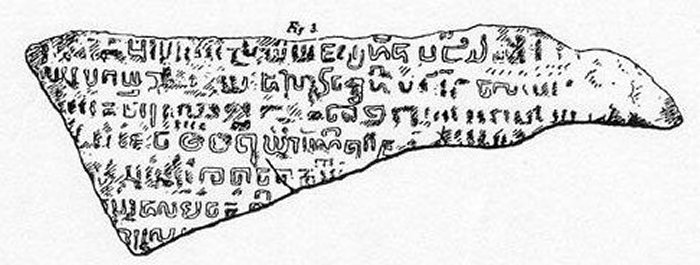
Detail from a drawing of three fragments from a sandstone block that once stood at the Singapore River mouth, showing the fragment called the Singapore Stone which is now in the National Museum of Singapore. Credit: National Museum of Singapore - CC BY-SA 3.0
They arrived in 1848. Meanwhile, other parts of the stone disappeared in the island. In 1918, the Raffles Museum of Singapore asked Calcutta to return the fragments. Only one was sent back. Nothing is known about the others, which are possibly lost forever. Despite its name, this sandstone slab is not a simple “stone”. It was once part of a monument, an ancient epigraph measuring three-by-three metres and carrying about 50 lines of text.
Many epigraphs didn’t survive the insults of time. Archaeological relics are often lost, over centuries. It’s sad, yet unavoidable. But the Singapore Stone was not just another epigraph. The writing system on its surface is unique, never found anywhere else and never used in any other text. And it remains undeciphered.
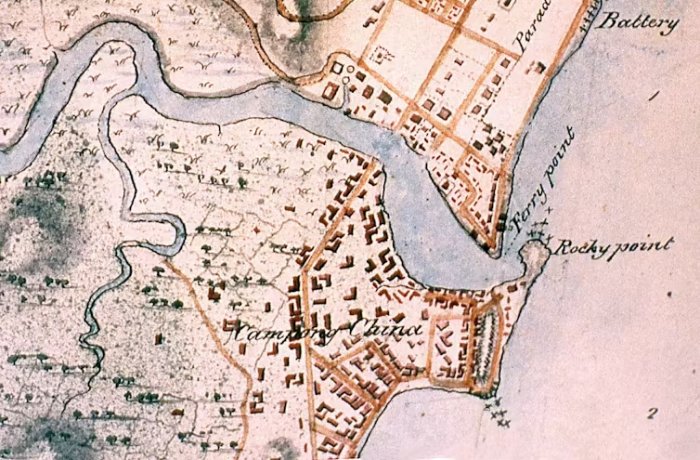
A map of Singapore from 1825. The Singapore Stone stood at the Rocky Point. Credit: British Library
Without understanding the epigraph's text, we cannot postulate a specific time frame for its origin. Hypotheses range from the 10th to the 13th century, but there is no consensus. Was the epigraph connected with the Majapahit empire? Or was it a gift by a rajah from south-eastern India celebrating the deeds of the local legendary hero Badang? No one will know until we can read it.
The script is one of the major puzzles in language deciphering of our times. It’s a conundrum in crypto and historical linguistics with apparently no solution. The challenge can be compared to the mysteries of better-known undeciphered writing systems, like Linear A and the Rongorongo script.
Despite the almost complete loss of the rest of the slab, the existing fragment and reproductions of missing parts of the full monument provide us with elements to investigate. Before being blown up, the monument was hand drawn in 1837 by the politician William Bland and philologist James Prinsep. Even Sir Stamford Raffles, the British East Indian administrator and founder of Singapore, worked on it, trying to understand its text. After its destruction, the three recovered fragments were graphically reproduced, before being sent to India.
A general, unwritten rule of crypto linguistics states that the more text we have – for comparisons, frequency analyses and pattern recognition – the higher our chances of deciphering it. The opposite situation leads to failure. The Singapore Stone is no exception. Its unknown writing system transcribing an unknown language represents every glyph breaker’s nightmare – a seal of indecipherability.
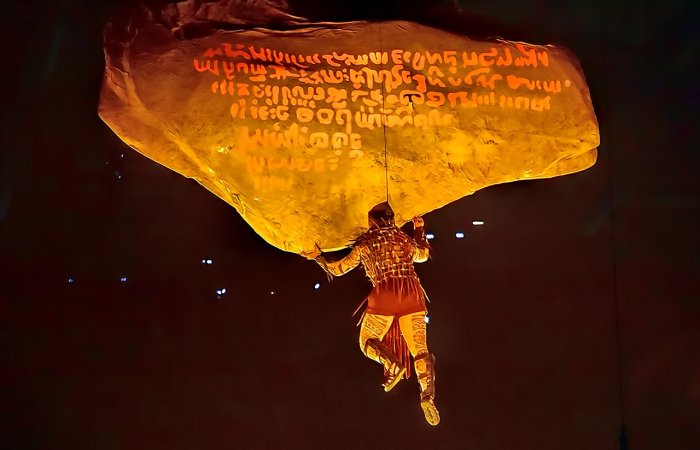
A depiction of the legendary strongman Badang lifting the Singapore Stone at National Day Parade 2016. Credit: Choo Yut Shing - CC0
However, human ingenuity has overcome such odds before. In 1952, architect Michael Ventris deciphered Linear B working in an analogous scenario – an unknown writing system (Linear B) and an unknown language (Mycenaean Greek, an archaic version of ancient Greek). Ventris had lots of texts available, but the task was almost impossible. And yet he succeeded.
For now, the stone is silent and lonely. But with my research team at Xi’an Jiaotong-Liverpool University, I am trying to find its voice.
My colleagues and I are developing Read-y Grammarian, an artificial intelligence program that can “learn” the surviving characters of the epigraph and guess and elaborate on the missing parts of its text. Unlike humans, the program doesn’t have interpretive biases (cognitive bias informed by a researcher’s beliefs). Mitigating these biases is a fundamental requirement for research in language deciphering.
If we can recover a reliable text for the slab, more material will be available for comparison, frequency analysis and pattern recognition – the first steps towards decipherment and hearing the voice of the stone for the first time.
Provided by The Conversation
This article is republished from The Conversation under a Creative Commons license. Read the original article.
















_-_cropped.jpg)