AncientPages.com - All human beings age. It is part of our biology and limits our lifespan to slightly over 120 years.
Not all animals experience ageing during their lives. Some animals’ bodies do not gradually degenerate as they get older the way our bodies do.

Credit: Adobe Stock - emilio100
But for humans once they reach about age 30 their chance of dying doubles roughly every eight years. So even if you are fortunate enough to become a centenarian, your chance of dying each year will be high.
This high mortality reflects numerous other health problems, such as loss of muscle mass and general frailty, cognitive decline, loss of vision and hearing and many other degenerative changes that characterise the human ageing process.
And the reason humans age so markedly may be due to the fact our ancestors evolved during the time of the dinosaurs.
Compared to other mammals, humans have a long life. We have the longest lifespan of all land-based mammals, and of all mammals only whales probably outlive us. I say “probably” because you need to keep animals in captivity to do a detailed study on lifespan, which for whales is virtually impossible due to their size and longevity.
We know that species of whales and dolphins exhibit menopause, and all mammals show some form of reproductive decline with age. In fact, all studied mammals show physiological ageing and increased mortality with age, even if some species – like mice and voles – age much faster than others – such as humans, whales, and elephants.
But many species of reptiles, amphibians and fish do not show signs of ageing. Examples include turtles and tortoises, salamanders and rockfishes.
One study of 77 species of reptiles and amphibians published in Science in 2022 showed that age-related increases in mortality are not seen in many species of reptiles and amphibians. It is as if these animals do not age at all. Some of these animals, such as turtles, probably live longer than humans.
Perhaps if we study these apparently non-ageing species for long enough they will show signs of ageing. But good luck studying animals such as the Greenland shark, which has been estimated to live nearly 400 years.
These animals die mainly from being eaten by predators and diseases. Indeed, most animals in the wild do not die of old age and, until the 20th century, of course, most people died of infectious diseases.
Some reptiles, amphibians and fish are also known for their ability to regenerate tissue.
Pressure on mammals
Amphibians evolved from fish about 370 million years ago, and about 50 million years later reptiles evolved from amphibians. Mammals then evolved from reptiles about 250-300 million years ago.
We are all products of evolution, which we see in relics such as our tailbone. Our evolutionary history can have a profound influence in modern times. For example, humans maintain evolutionary traits from when our ancestors roamed the savannah that are no longer fit for the modern world, from craving sugar to behaviour that leads to prejudices.
About 200 million years ago, massive volcanic eruptions wiped out 76% of marine and land species. Afterwards, the dinosaurs became the dominant predators in the land. To survive and avoid being hunted to extinction by dinosaurs, mammals became small, nocturnal and short-lived.
Our ancestors of this time were not like us at all. They were more like voles and mice, small animals going out in the dark to catch insects. Under the pressure from the dinosaurs, ancestral mammals had to reproduce rapidly, just like mice and rats do now. And just like mice, rats and voles, our ancestors had short lifespans.
For 100 million years, during the time of the dinosaurs, mammals were at or near the bottom of the food chain. Mammals were more often prey than predators. During this time there was no reason for mammals to keep processes and genes related to long life, such as DNA repair and tissue regeneration systems.
My longevity bottleneck hypothesis proposes that repair and regeneration systems were lost, mutated or inactivated by the evolution of early mammals. This imposed biological constraints that shape how mammals age to this day.
After the dinosaurs disappeared when an asteroid hit the Earth 66 million years ago, mammals conquered the world. An astonishing diversity of species evolved with a variety of lifespans. Some species, like humans, evolved a long lifespan, but they may have done it under constraints, remnants from the time of the dinosaurs.
Why dinosaurs made a difference
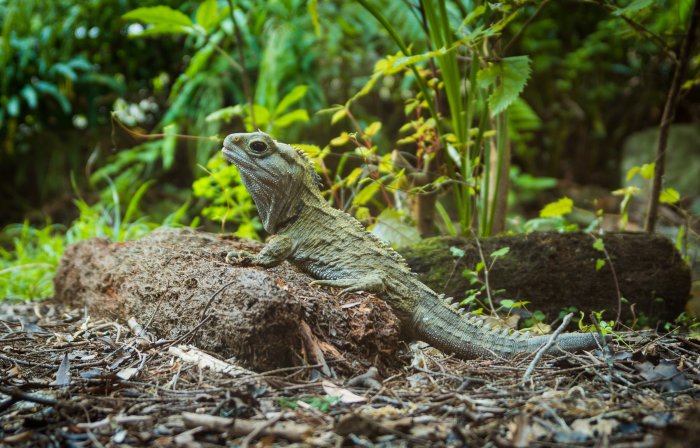
Tautara. Credit: Adobe Stock - rghenry
We can take a guess by looking at species that did not undergo the same evolutionary pressures as early mammals. For example, the tuatara, a reptile endemic to New Zealand, may look like a lizard but it diverged from snakes and lizards about 250 million years ago. It is sometimes referred to as a “living fossil”, due to its slow evolution.
Tuataras are thought to live for more than 100 years and age much slower than human beings, as a 2022 DNA analysis study showed. Perhaps they have kept their anti-ageing genes, unlike even the longest lived mammals.
Our lifespan may be limited because of our evolutionary history.
Written by Joao Pedro de Magalhaes, Chair of Molecular Biogerontology, University of Birmingham
Provided by The Conversation
This article is republished from The Conversation under a Creative Commons license. Read the original article.