
Legendary Basilisk With Deadly Petrifying Stare – King Of The Serpents
A. Sutherland - AncientPages.com - Who or what was this mysterious creature that could kill just by looking at you?
It is described by ancient writers and philosophers who often wondered about the creature's appearance and function.
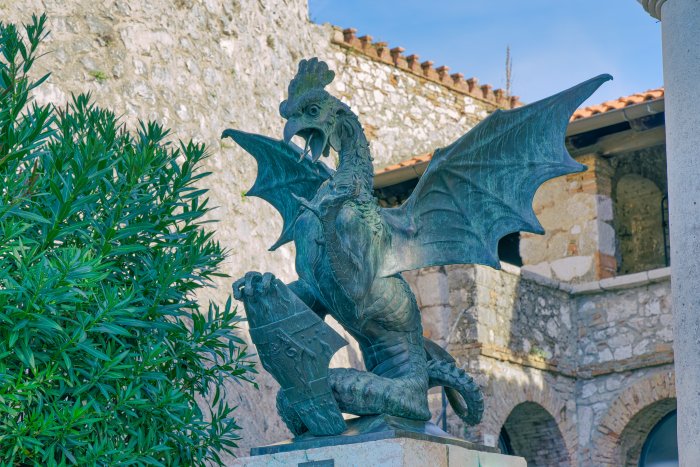 Rijeka Basilisk statue at the Trsat castle court. Credit: Adobe Stock -Dario Bajurin
Pliny described the Basilisk as a snake with white spots or stripes, fiery breath, and a death-dealing cry, and the creature could drive people mad with its poison. It was believed that the Basilisk had one thing in common with Medusa: the ability to strike onlookers dead by its glance alone.
"It destroys all shrubs, not only by its contact but those even that it has breathed upon; it burns up all the grass and breaks the stones."
"To this dreadful monster, the effluvium of the weasel is fatal, a thing that has been tried with success, for kings have often desired to see its body when killed; so true is it that it has pleased Nature that there should be nothing without its antidote."
" The animal is thrown into the hole of the Basilisk, which is easily known from the soil around it being infected. The weasel destroys the Basilisk by its odor but dies in this struggle of nature against its own self."
In later legends, however, the Basilisk appears to have grown in size. In medieval times, the creature had a mysterious power to kill itself by gazing at itself in a mirror or hearing the rooster's crowing. Some contemporary travelers had a tradition of carrying roosters around with them.
Writers such as Jonathan Swift, Leonardo Da Vinci, and Albertus Magnus often linked the Basilisk to alchemy.
When the terrible Basilisk is nothing more than only ashes, these ashes retain magical properties that were sought after by alchemists of the thirteenth century. As one ancient legend says, an alchemist uses the creature's ashes to turn silver into gold. Perhaps this terrible creature's impressive power may remain with him even after death.

The basilisk and the weasel, by Marcus Gheeraerts the Elder. The cockatrice (pictured) became seen as synonymous with the basilisk when the "basiliscus" in Bartholomeus Anglicus' De proprietatibus rerum (ca 1260) was translated by John Trevisa as "cockatrice" (1397).
Among the Basilisk's magical properties, especially one of them was widely known among the ancient people. The creature had the power to protect whatever you wanted to keep safe from danger like theft or attack.
In the late classical era, many Gnostic seals depicted the Basilisk to ward off evil. The beast is also mentioned in Geoffrey Chaucer's "Canterbury Tales," but the author calls it a Basilicok. Later, Basilisk's name appeared in works by William Shakespeare, Voltaire, and Abraham Stoker (or Bram Stoker), an Irish author famous today for his 1897 Gothic horror novel "Dracula."
Fascinating Myths And Legends From Across The World
According to Marianne Moore's Poetry, the Basilisk is a "machine-like creature, sensitive to its environment and able to register noise through vibrations. The basilisk's parts are "smooth-working" and efficient.
Its maneuverability is impressive and resembles the mechanisms deployed to recycle them as copies, images, and reproductions.
Sometimes known as the Jesus Christ lizard because of its ability to walk on water, the mysterious Basilisk is also a symbol of Christian divinity; it represents the faith in things beyond human perception and understanding.
Otherwise, in early Christian beliefs, the Basilisk was a symbol of the devil in his form as the one responsible for tempting Adam and Eve. It was also stunning in color and shape; however, it was deadly to the human race.
Written by – A. Sutherland - AncientPages.com Senior Staff Writer
Updated on July 19, 2022
Copyright © AncientPages.com All rights reserved. This material may not be published, broadcast, rewritten or redistributed in whole or part without the express written permission of AncientPages.com
Expand for referencesReferences:
V. Bazin, Marianne Moore and the Cultures of Modernity
Goldstein, J. 101 Amazing Mythical Beasts and Legendary Creatures
Matthews, J., Matthews, C. The Element Encyclopedia of Magical Creatures
More From Ancient Pages
-
 Evidence For A Divergence Between Eastern And Western Mediterranean Indo-European Languages Finally Provided By Ancient Genomics Study
-
 The Egyptian Dream Book Reveals Ancient Predictions Of The Future
-
 Was Pocahontas A Real Historical Person?
-
 2,000-Year-Old Lavatory In Turkey’s Denizli Province Will Be Restored
-
 3,000-Year-Old Recycling Center In What Is Now Dubai – Discovered
-
 Anthropologists’ Quest To Save An Alamo Cannon
-
 Why Did God Zeus Give King Sisyphus An Eternal Punishment?
-
 Only Apocalyptic Destruction Can Eliminate The Gap Between Rich And Poor – Historian Says
-
 Carved Symbols Related To The Galician Castro Culture Discovered At Castro de San Vicenzo, Orense, Spain
-
 Perplexing Accounts Of Ancient People Who Demonstrated Incredible Powers Of The Human Mind
-
 On This Day In History: First Battle Of Gaza Was Fought – On March 26, 1917
-
 ‘Incredibly Mysterious’ Bronze Age Gold Penannular Ring Found In Norfolk
-
 Inghirami Tomb – Spectacular Etruscan Burial With 53 Alabaster Urns In Ancient City Of Volterra, Italy
-
 Limestone Sarcophagus, Ushabti Figures Unearthed In Minya’s Al-Gharafa Area, Egypt
-
 Controversial Prehistoric Bronze Gears Of Peru
-
 New DNA Evidence Rewrites Ancient History Of Pompeii
-
 Food In Ancient Roman Funerary Meals Was Similar To That Consumed During Life
-
 Warrior King Eadberht Of Northumbria And A Four-Legged Beast Featured On Ancient Coin Discovered The Holy Island
-
 10 Magnificent Ancient Libraries
-
 Burial Chamber Of Ankhesenamun, Tutankhamun’s Wife May Soon Be Found

