
Namoratunga – Kenya’s Fascinating Megalithic Site Oriented Toward Specific Stars And Constellations
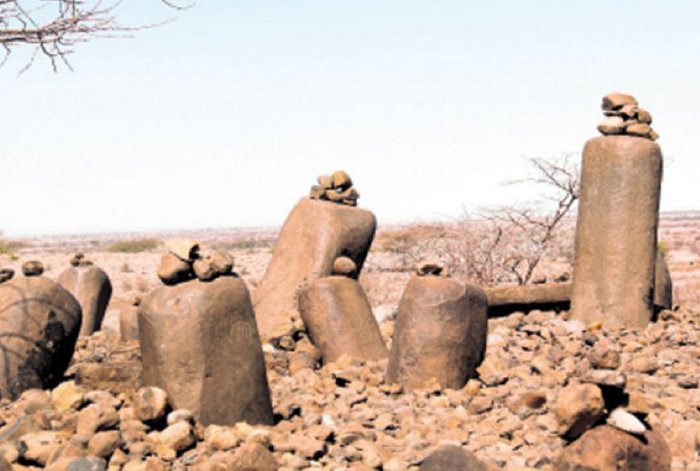
A.Sutherland - AncientPages.com - There is a fascinating and entirely different megalithic site known as Namoratunga. The site is located on the west side of Lake Turkana in northwestern Kenya and is known as Namoratunga II (or the Kalokol Pillar Site), which means "People of Stone."
 Namoratunga in Turkana, Kenya. Image credit: Darouet - CC BY-SA 4.0
It has alignments of 19 basalt pillars that are nonrandomly oriented toward certain stars and constellations. Interestingly, modern eastern Cushitic peoples use the same stars and constellations to calculate an accurate calendar.
The old Kenyan site dates to about 300 BC and suggests a prehistoric calendar based on detailed astronomical knowledge was in use in eastern Africa.
Legends Surround Namoratunga
According to legend, the pillars (found by the archaeological team in 1978) were once men but became petrified by the devil after failing their test. One story tells about a woman who came one day to the place and was dressed strangely, according to the locals. She wanted to dance and told the gathering people not to laugh at her as she danced. But they did, and she turned them into stones. Another legend claims that the devil would play a song, and anyone who showed emotions hearing it would be turned stone.
Local tradition says that the largest pillar is a chief, who had tried to outwit the devil and, in his victory, forgot about the 'no emotion' rule and smiled only for the devil to turn him into stone. The name "Dancing Stones" (Namoratunga, in Turkana language) came from the legend that sheepherders living in the area used to go to the site to dance and sing cradlesongs.
These are probably only ancient legends regarding the ancient site of Namoratunga, but the locals have feared the place and never went there over the years. Also, children were warned against going to the area because it was filled with evil spirits.
Magnetic Basalt Pillars Aligned With Seven Star Systems
Radiocarbon analysis dates Namoratunga II, and a related burial and rock art discovered approximately 130 miles south at Namoratunga I to 300 BC. (Namoratunga I contains a similar grave but no pillars.)
 Namoratunga II. Image credit: Research drawing - image credit: Lynch, B. M., and L. H. Robbins. “Namoratunga: The First Archeoastronomical Evidence in Sub-Saharan Africa”
The site contains 19 magnetic basalt pillars, almost cylindrical, some tilted over, others fallen completely, and all arranged in rows forming a specific pattern. Each of the pillars has four facets and an inclined top. The pillars are aligned with 7 star systems: Triangulum, Pleiades, Bellatrix, Aldebaran, Central Orion, Saiph, and Sirius, and lean in different directions; their bases are littered with about 20,000 stones.
Namoratunga II. Image credit: Research drawing - image credit: Lynch, B. M., and L. H. Robbins. "Namoratunga: The First Archeoastronomical Evidence in Sub-Saharan Africa"
"The burial customs of the sub-Saharan people who used the cemetery resemble what is done today by the Konso, who live in the same general vicinity in southern Ethiopia. The calendar scheme of peoples related to the Konso may, in turn, help us confirm the intent of the builders of Namoratunga II. At the northern site, one setting of upright stones encircles a grave, like those at Namoratunga I, but the 19 other megaliths at Namoratunga II are arranged in an unusual pattern unconnected with any other burials." 1
The 12-Month 354-Day Lunar Calendar Of Cushitic Speakers Of Southern Ethiopia
At Namoratunga II, one setting of upright stones encircles an ancient grave, like those at Namoratunga I, according to research conducted by anthropologists at Michigan University, B. M. Lynch and L.H. Robbins.
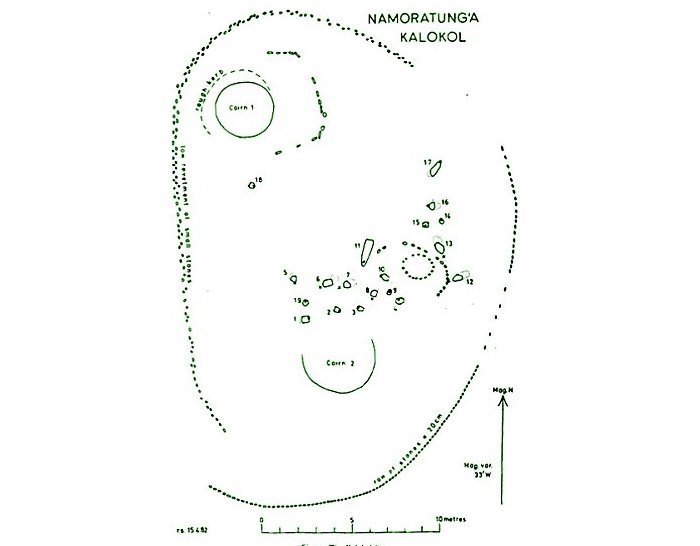
Namoratunga II. Image credit: Research drawing - image credit: Lynch, B. M., and L. H. Robbins. “Namoratunga: The First Archeoastronomical Evidence in Sub-Saharan Africa”
The stones are placed relatively close to each other, separated at the most by 35 feet, usually less. Further, research states that Namoratunga represented an accurate and complex calendar system.
The late Mark Lynch (he died tragically as the victim of a hit-and-run accident in California in 1982) believed that the basalt pillars - surrounded by a circular formation of stones - link the constellations or stars to the 12-month 354-day lunar calendar of Cushitic speakers of southern Ethiopia.
Stone alignments relative to the seven stars at Namoratunga II. Image credit: Lynch, B. M., and L. H. Robbins. "Namoratunga: The First Archeoastronomical Evidence in Sub-Saharan Africa"
Alignments of the stones indicate the rising positions of bright stars – adapted to calendar keeping by ancient civilizations.
According to researchers, "the positions of key phases of the moon were intricately combined with zones of the sky that correspond to each star or asterism, in order of their use (Triangulum, the Pleiades, Aldebaran, Bellatrix, Orion's Belt, Saiph, and Sirius). Other months in a complex lunar cycle were coordinated with the position of the Triangulum with respect to staggered phases of the waning moon.
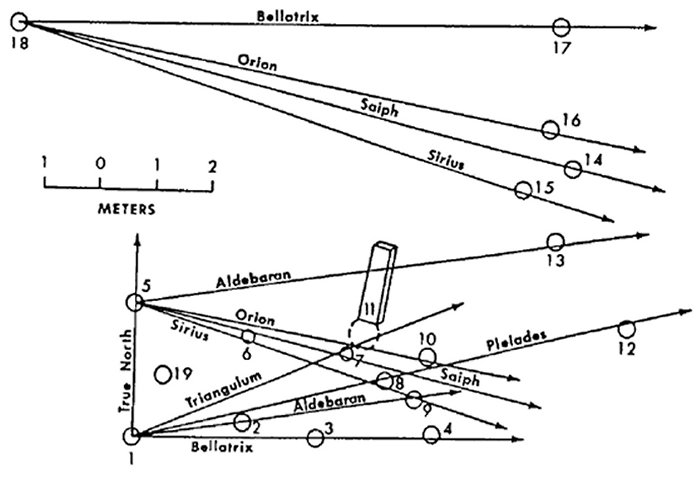
Stone alignments relative to the seven stars at Namoratunga II. Image credit: Lynch, B. M., and L. H. Robbins. “Namoratunga: The First Archeoastronomical Evidence in Sub-Saharan Africa”
The Konso speak a Cushitic language, and it is reasonable to believe the Namoratunga sites were erected by the ancestors of the present-day Eastern Cushities, who still employ a calendar now likely to be at least 7,000 years old. Namoratunga II is a modest site, relatively simple, with little there besides the alignments.
While it could have been used ritually, its layout and the diversity of its alignments seem more appropriate for systematic observation. Some of the same astronomical objects observed by the Namoratunga calendar keepers were used more than two millennia earlier by the Egyptian calendar priests. Richard A. Parker, a renowned authority on Egyptian astronomy and calendrics, established that the earliest Egyptian calendar was based on the moon and calibrated by the stars." 1
It is believed that the Namoratunga sites were erected by the ancestors of the present-day Eastern Cushites, who still live in this region of Africa.
Written by – A. Sutherland - AncientPages.com Senior Staff Writer
Updated on March 1, 2023
Copyright © AncientPages.com All rights reserved. This material may not be published, broadcast, rewritten or redistributed in whole or part without the express written permission of AncientPages.com
Expand for references- Krupp, E. C.. Echoes of the Ancient Skies
Lynch, B. M., and L. H. Robbins. “Namoratunga: The First Archeoastronomical
Evidence in Sub-Saharan Africa,” Science 200 (May 19, 1978): 766–768.
A monumental cemetery built by eastern Africa’s first herders near Lake Turkana, Kenya
More From Ancient Pages
-
 Blue Pigment Originating In Egypt 5000 Years Ago – Recreated By Researchers
-
 Sumerians Built A Huge ‘Anti-Drought Machine’ To Save Ancient City Of Girsu From Destruction
-
 Hunter-Gatherers, Neolithic Farmers Followed “Danube Route” To Central Europe Expanded, Coexisted And Gradually Mixed
-
 Mag Mell: Irish Tradition Of Otherworldly Paradise That Could Be Reached Through Death And Glory
-
 Huge Defensive Wall Excavated At Tel Erani, Israel Is More Than 5,300 Years Old
-
 Avraga In Eastern Mongolia Was Winter Base Camp Of Genghis Khan – Study
-
 Giant Pre-Hispanic Jar Used To Make Mexican Traditional Corn Beer
-
 Was Mysterious 2,000-Year-Old Miniature Clay Token Used By Pilgrims Arriving To The Temple In Jerusalem?
-
 Ancient People In Tasmania Witnessed Stunning Auroras When The Earth’s Magnetic Field Flipped
-
 Mystery Of The 80 Million-Year-Old Sharks’ Teeth In The City Of David
-
 Ancient Mesopotamian Artifacts Unearthed In Kurd Qaburstan Fill A Historical Gap
-
 Mysterious Golden Curmsun Disc And Its Connection To King Harald Bluetooth And The Legendary Jomsvikings
-
 Genetic Evidence Retrieved From 800,000-Year-Old Human Tooth
-
 On This Day In History: Feast Day Of The Venerable Bede – Remarkable Priest, Monk And Scholar – On May 25, 735
-
 Ponte di Cecco – Legend Of A Bridge Built By An Astrologer With The Help Of The Devil
-
 Remarkable Funerary Relief Of Life-Size Couple Discovered At The Necropolis Of Porta Sarno In Pompeii
-
 Ancient Society In The Sahara Desert Rose And Fell With Groundwater – Study
-
 On This Day In History: American General Benedict Arnold Commits Treason – On Sep 21, 1780
-
 Rare Lost Pictish Stone With Strange Mythical Beasts Goes On Display For The First Time
-
 Ask And Embla: First Human Pair Created By Powerful God Odin And His Two Brothers

