
Abu Simbel – Spectacular Ancient Egyptian Temples Unique In Design And Size
Angela Sutherland - AncientPages.com - Many spectacular structures of antiquity, such as the pyramids, temples of Luxor and Karnak, Ramesseum, Abu Simbel, and others, attest to ancient Egypt's superior civilization.

Abu Simbel - Image credit: Angel Aroca Escámez - CC BY-SA 3.0
One of them is Abu Simbel, now an archaeological site located in Muhafaz Aswan, on the West Bank of the Nile, in southern Egypt, close to the border with Sudan.
Built between 1264 and 1244 BC (or 1244 and 1224 BC) during the reign of Pharaoh Ramesses II, Abu Simbel represents a vast complex of two prominent temples reaching 56 m deep into the rock.
It took twenty years to carve out the temples of a solid mountainside on the West Bank of the Nile in Lower Nubia, close to the border with Sudan. One of the temples celebrates Ramses II's victory over the Hittite Empire at the Battle of Kadesh in 1274 BC. The other commemorates the pharaoh's love for his favorite queen, Nefertari.
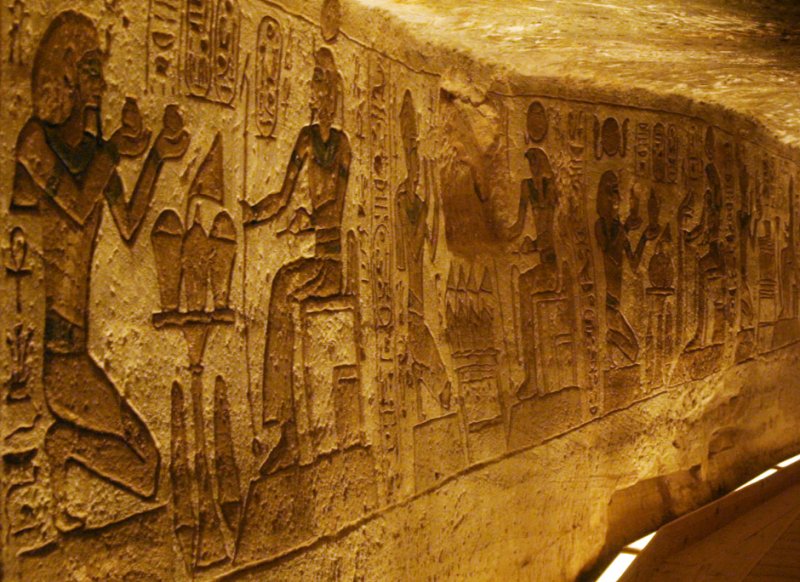
Interior of Ramses II's temple at Abu Simbel. Image credit: qwelk - Public Domain
The entrance of the Great Temple is guarded by four (20 m high) giant statues representing Ramesses II seated on a throne and wearing the double crown of Upper and Lower Egypt. Inside, there are eight more of his sculptures. The statues of the king and his queen are about 10 m (33 ft) high.
Next to Ramesses's legs are smaller statues depicting his chief wife, Nefertari, his queen mother, Mut-Tuy (Tuya), his first two sons, and six daughters. The temple is dedicated to the pharaoh and the sun gods Amon-Ra and Ptah, the god of arts and crafts, and Ra-Horakty, the god of the "morning sun."
Without a doubt, the temples are unique in both design and size.
"The front of the main temple is 31 meters (102 ft) high. Cutting through two columned halls, the inner passage reaches 54.8 (180 ft) back into solid rock." 1
The decorations inside the first chamber are reliefs commemorating the battles of Ramesses II at the Battle of Kadesh.

Inside the great temple of Ramses II at Abu Simbel. Credit: Adobe stock - Nick Brundle
"The walls of the halls are covered with superbly preserved reliefs showing Ramesses conquering his enemies in the mighty battle of Kadesh that he fought in his fifth year as king. Almost 1500 figures of soldiers are carved and painted here. Side chambers off the hall were perhaps store chambers for the temple's wealth." 1
There are also images of the deities to whom the temple was dedicated and of Ramesses II himself. In addition, the rooms are decorated with precious paintings and reliefs.
The Small Temple honors Hathor, the goddess of love and beauty, and Queen Nefertari, Ramesses' favorite wife. The statues of Nefertari - equal in height to her husband's figures - attest to the great respect that Ramses II gave her.
Six giant statues (10 m (33 ft) high) decorate the facade of this temple. Two depict the queen placed between four others, representing Ramesses II.
Built by Pharaoh Ramses II, these two structures unquestionably testify to the outstanding building achievements of this ruler and his power as the king. Ramses wanted to show the power of ancient Egypt to the newcomers from Nubia.
Phenomenon Associated With The Great Temple In Abu Simbel
A beautiful phenomenon associated with the Great Temple occurs twice a year, initially on February 19 and October 21. The rising sun illuminates the image of Amun-Ra and Ramesses II, and after some time, also Re-horachty. Interestingly, only the sun's rays never illuminate the depiction of Ptah. After the transfer of the temple, the phenomenon was still preserved, although postponed by one day.
With time, the marvelous work of Pharaoh Ramses II has been forgotten and covered by sand. In March 1813, the Swiss traveler Johann Ludwig Burckhardt (1784 – 1817) stumbled upon the sand-covered ruins of the Great Temple of Ramesses II at Abu Simbel. He attempted to excavate the temple entrance, but he failed. He later told his friend Giovanni Battista Belzoni about the ruins and returned in 1817 to excavate the temple.
Danger Of Flooding And Time To Move The Temples To Safe Place
In 1964, the salvage of the Abu Simbel temples began. The rising waters of the Nile threatened these historical landmarks (along with some others) due to the construction of the Aswan High Dam.
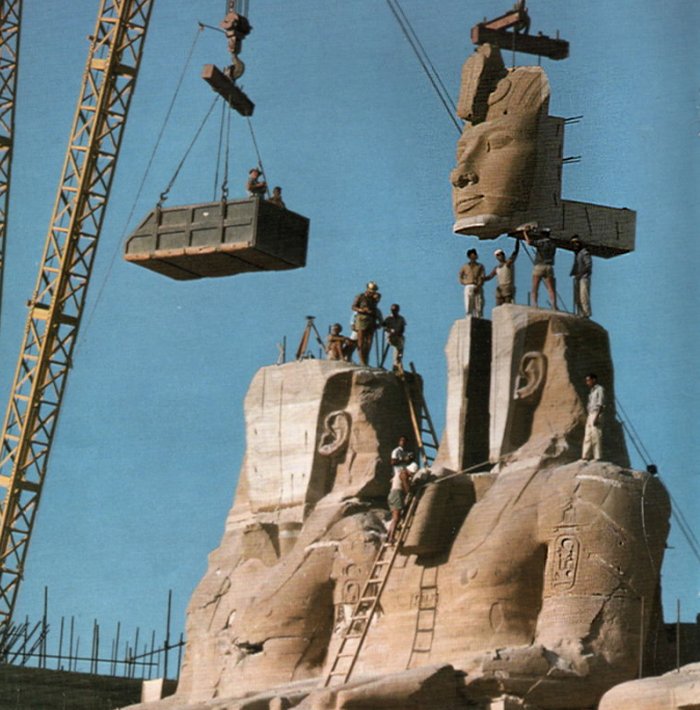
The statue of Ramses the Great at the Great Temple of Abu Simbel is reassembled after having been moved in 1967 to save it from being flooded. Source
It was decided that the structures needed to be moved. The most ambitious project was to lift the temples of Abu Simbel.
All involved in the project had to transport the temples and reassemble them in a safe place about 65 m higher than their previous location. Then, the hard work began at the site. Engineers, archaeologists, and ordinary workers equipped with heavy lifting and cutting equipment reached Nubia. Soon, 807 blocks from the main temple, 235 meters from the smaller ones, and almost 7000 blocks of rock framing both Abu Simbel temples were transported to the prepared warehouse.
The works were completed in 1966.
In the meantime, the temples' original place had already been flooded.
The project was both extensive and challenging to carry out, but the valuable landmarks of the country were saved. The cost of the operation was approximately $ 36 million. The temples were included in the UNESCO World Heritage list in 1979.
Written by – A. Sutherland - AncientPages.com Senior Staff Writer
Updated on December 17, 2023
Copyright © AncientPages.com All rights reserved. This material may not be published, broadcast, rewritten or redistributed in whole or part without the express written permission of AncientPages.com
More From Ancient Pages
-
 Gigantic Bird Ziz Is One Of Participants At Messianic Banquet At The End Of Days In Jewish Folklore
-
 Mystery Of Pre-Adamic Didanum Race: Giants Who Were Ancestors Of The Nephilim and Rephaim
-
 Puzzling Connection Between Fairies, Ghosts And Ancient Civilizations Revealed
-
 On This Day In History: Rosa Parks’ Act Of Defiance And The Montgomery Bus Boycott – On Dec 1, 1955
-
 Neolithic Cow Tooth And Evidence Linking Cattle Remains From Stonehenge To Wales
-
 Cacao Was Cultivated By Cultures Along The Pacific Coast Around 5,000 Years Ago – New Study
-
 Long-Lost Ancient Maya Kingdom Unearthed In Mexico
-
 Beautiful 2,300-Year-Old Gold Ring Found In The City Of David
-
 8th Century Sculpture Of Lord Vishnu Belonging To Pandya Dynasty – Unearthed
-
 Evidence Of A Lost Advanced Ancient Civilization In Cincinnati – Remarkable Artifacts And Ancient Bodies That Shouldn’t Exist
-
 Stunning Gold Jewelry And Artifacts From The Time Of Nefertiti Found In Bronze Age Tombs In Cyprus
-
 Mysterious Books With Dangerous Secret Knowledge Deliberately Hidden From Public View
-
 Why Did Modern Humans Replace The Neanderthals? The Key Might Lie In Our Social Structures
-
 How Ancient Scientists Calculated The Circumference Of The Earth
-
 A 1,600-Year-Old Mosaic Accidentally Unearthed In Ancient City Of Yavne, Israel
-
 Oldest Surviving Drinking Straws Identified – ‘Sceptres’ From The Maikop Kurgan
-
 Prehistoric Evidence Of Sophisticated Prosthetics In Ancient Egypt – Artificial Toes Helped Egyptians Walk
-
 Capoeira: Ancient Martial Art Disguised As A Dance Became A Symbol Of Resistance To Oppression
-
 2,300-Year-Old Tablet Found In Mugla, Turkey – Region Of Great Historical Importance In Ancient Times
-
 1,700-Year-Old Roman Villa, Beautiful Mosaics, Coins Unearthed In Ancient Roman Port Of Ptolemais

