
Chacmool (‘Chac-Mool’) – Intriguing Pre-Columbian Statue Found At Many Ancient Sites In Mesoamerica
A. Sutherland - AncientPages.com - "Chac Mool" (chacmool, or chaacmol) is one of Mexico's most famous Pre-Columbian statues. Chac-Mool altars are generally found at the entrance to Toltec temples and other pre-Columbian cultural sites where Toltec influence was powerful, for example, Chichen Itza.
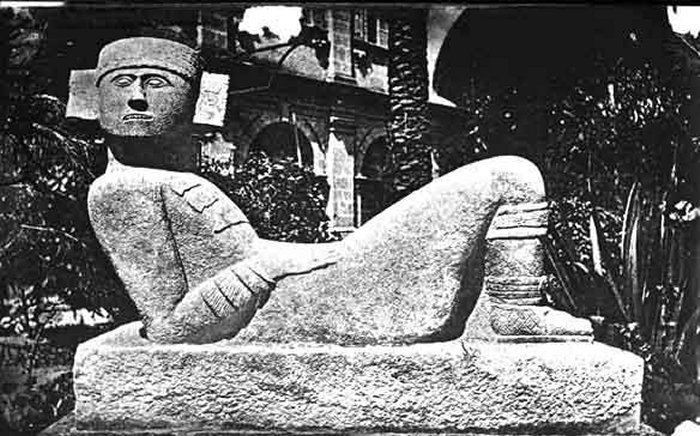
Chacmool excavated by Augustus Le Plongeon (d. 1908) from the Platform of the Eagles and Jaguars at Chichen Itza, Yucatan. 1875. Image uploader: Infrogmation - Public Domain
The great city of Chichén Itzá was the most important Mayan political, religious, and military Center in the north of Yucatán during its flourishing years, towards the end of the classic and the beginning of the Postclassic (800-1100 AD).
One such statue, for example, has been discovered in the Temple of Kukulkan (the Plumed Serpent), one of the most famous Maya pyramids - built at Chichén Itzá and later renamed El Castillo by the Spanish.
Archaeology confirms that twelve chacmools have been discovered at the Toltec city of Tula, known for its famous Atlantean Statues, the massive stone sculptures of warriors, the "Atlantes" that still hold a mystery: how the figures were carved and transported to the pyramid's top.
Usually, the sculpture is approximately human-sized and decorated with a headdress, bracelets, ear flares, and anklets. It depicts a resting man with his head directed to the left or the right but always facing 90 degrees from the front. The statue's posture is unique.
Curiously, this individual is always looking out away from the associated temple, supporting itself on its elbows and, at the same time, keeping a bowl (or disk) placed upon its torso. The bowl probably served as a holder for sacrificial blood and burnt offerings. It may also have had a symbolic meaning associated with the circular cenotes, which are deep sinkholes or holes particularly characteristic of Central America and Mexico and used during religious ceremonies (sacrifices) during the Mayan Empire.
What Is The Original Name Of The Statue?
As far as we know, Augustus Le Plongeon named "chac mool" after a mysterious statue he discovered during an archaeological expedition to Chichen Itza in 1873. However, the first published account of this kind of statue first appeared in 1832.
 Maya Chacmool from Chichen Itza displayed at the National Museum of Anthropology. Image credit: Ziko van Dijk - CC BY-SA 3.0
Le Plongeon, a British-American archeologist and photographer, studied the pre-Columbian ruins of America and focused his research on the Maya civilization living on the northern Yucatán Peninsula. He discovered several important sites of Mayan culture and wrote several books later criticized by the scientific community as based on the author's flawed ideas.
According to Le Plongeon, the statue was supposed to represent an ancient Mayan king named "Chac-Mool" ("red Jaguar"), but the researcher was wrong, and historians have rejected his theory. According to the Maya, "chac-mool" means "the paw swift like thunder" (or "Thunderous Paw"), but the simple name "chac mool" has been widely adopted by researchers.
It's important that the statue's name, "Chac Mool," should not be confused with Chac, one of the foremost gods of Mayan mythology, who was initially related to rain, storms, and thunder. Aztec chacmools were associated with Tlaloc, the Mesoamerican rain god and the important deity in the Aztec pantheon.
Unknown Real Name, Identity And Function Of This Pre-Columbian Statue
The ancient name for these types of sculptures is unknown. It is also still being determined what or who the statue represents or its purpose.
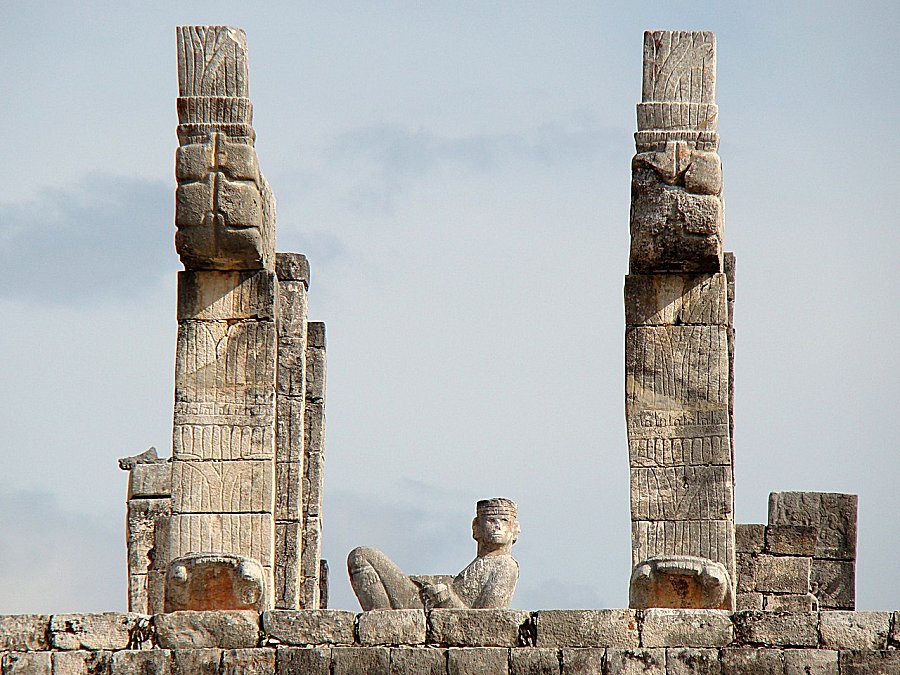
Chuck-Mool. Statue at the top of the Temple of Warriors of the Chichen Itza complex. Credit: One for the Road. CC BY-SA 3.0
What was the statue's original function? The Chaacmol does not appear to be of Maya origin. What mysterious ancient culture does he represent? Who were the male figures representing chacmools?
For over two centuries, "chacmool" has remained the subject of scientific speculations, and some possible explanations for this curious pre-Columbian figure are widely accepted.
As chackmools have never been discovered inside the temple's sanctuary or shrine, they have not been a subject of worship. Instead, they have been used by priests during their religious ceremonies. The statue could be a cuauhxicalli ("eagle gourd bowl") to receive blood and human hearts during sacrificial rituals prevalent among the Aztecs. The Aztecs used this bowl instead of the usual disc-altar. A chacmool from Tlaxcala. Mexico, for example, has a bloodied heart sculpted on the underside, supporting this interpretation.
It was also proposed that the bowl (or similar vessel) was used for collecting donations and gifts such as tobacco, turkeys, feathers, incense, tortillas, and pulque.
Or was Chac Mool perhaps a sacrificial stone over which victims were stretched so their hearts could be cut from their chests? In other words, "chacmools" were most probably related to the bloody ceremonies of the ancient Maya people.
Enigmatic monumental sculptures of "chacmool" were still in use when the Spanish contact in Central Mexico in the Aztec capital, Tenochtitlan, in the region of Chichen Itza) far as in El Salvador. In other Maya areas, researchers found fewer of these statues.
Updated on Nov 26, 2023
Written by – A. Sutherland - AncientPages.com Senior Staff Writer
Copyright © AncientPages.com All rights reserved. This material may not be published, broadcast, rewritten or redistributed in whole or part without the express written permission of AncientPages.com
Expand for referencesReferences:
Salisbury S. and Le Plongeon, A. The Mayas, the Sources of Their History Dr. Le Plongeon in Yucatan, His Account of Discoveries
More From Ancient Pages
-
 1,500-Year-Old Inscription ‘Christ, Born Of Mary’ Engraved On Magnificent Building Discovered In Israel
-
 Huge Ancient Underwater Structure And Stunning Artifacts Discovered Off The Coast Of Salamis
-
 How Gold Rushes Helped Make The Modern World
-
 Was The Mysterious Powerful Viking Warrior Buried In A Ship In Scottish Highlands A Woman?
-
 On This Day In History: Last Inca Emperor Atahualpa Captured By Francisco Pizarro – On Nov 16, 1532
-
 Ancient Artifacts Used In Magical Rituals To Ward Off The Evil Eye Found Next To The Pilgrimage Road
-
 Neanderthal Genes Influence Your Mood And Much More – Study Shows
-
 Rare Mammoth Ivory Tool Offers Evidence Of Ropemaking In Central Europe More Than 35,000 Years Ago
-
 Hidden Text Discovered Inside Ancient Scroll
-
 Unusual Grave Of The Trzciniec Culture Is An Archaeological Puzzle
-
 Historic Shipwreck Mentor Reveals Its Underwater Secrets
-
 Excavations Of 7th Century Shipwreck In Israel Reveal Christian And Muslim Symbols
-
 Genetic Changes In Bronze Age Southern Iberia
-
 7,000-Year-Old Tepe Ozbaki Mounds Yielded Valuable Relics – But Now The Site Is In Trouble
-
 On This Day In History: Howard Carter Discovered King Tut’s Tomb In The Valley Of The Kings – On Nov 4, 1922
-
 Mysterious Bronze Age Burial Chamber Discovered In Devon, UK
-
 Motilla del Azuer: Impressive And Unusual 3,200-Year-Old Fortress
-
 Earliest Fascinating Concepts Of Artificial Intelligence And Robots In Ancient Myths – Examined
-
 On This Day In History: Vasco De Gama Departed On First European Voyage To India – On July 8, 1497
-
 Tipón (Tipon): Who Taught The Inca How To Build Artificially Irrigated Garden?

